
 ChatGPT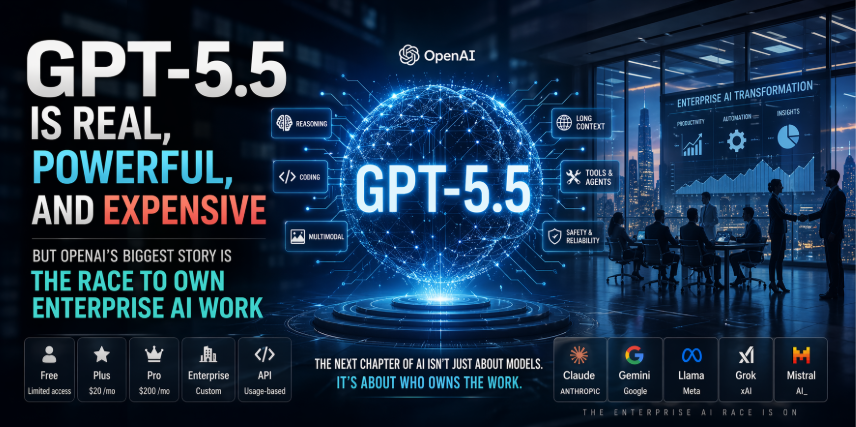
On April 23, 2026, OpenAI formally launched GPT-5.5, ending weeks of rumor and leak-driven speculation with a release that is both more concrete and more restrained than some of the hype suggested. The model is official, it is rolling out first in ChatGPT and Codex, and it is being positioned not as a broad consumer reinvention but as a stronger engine for coding, computer use, knowledge work, and research-heavy agent workflows. (1)
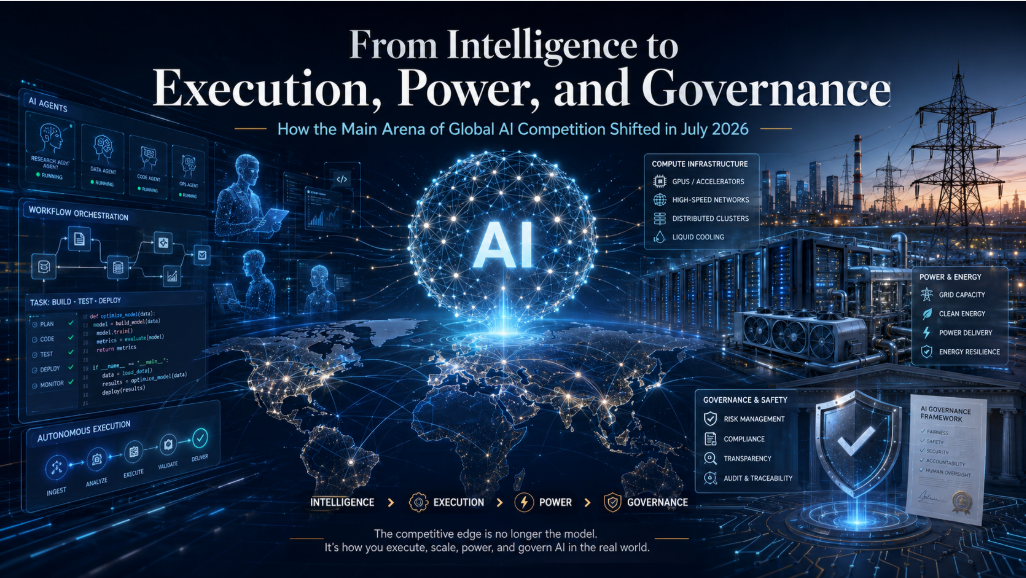
That positioning is the key to understanding the launch. GPT-5.5 arrives in the middle of a weekly frontier-model arms race: Anthropic shipped Claude Opus 4.7 on April 16, 2026, Google has Gemini 3.1 Pro in public preview, and OpenAI itself has been iterating rapidly through GPT-5.4 and specialized security offerings. Taken together, GPT-5.5 looks less like a single blockbuster reveal and more like OpenAI’s clearest signal yet that the next battle is over who can complete real work most reliably, not who can post the prettiest benchmark chart. (2)
The Release
The confirmed facts are straightforward. OpenAI announced GPT-5.5 on April 23, 2026, alongside a system card and launch article. In public-facing materials, the company described the model as its “smartest and most intuitive” yet and emphasized sustained task execution rather than a flashy new interface. Media coverage indicates that OpenAI briefed reporters directly rather than staging a mass-market keynote, with Greg Brockman telling journalists that the model is notable for doing more with less guidance. (1)
The rollout is tiered. In ChatGPT, GPT-5.5 Thinking is available to Plus, Pro, Business, and Enterprise users; GPT-5.5 Pro is available to Pro, Business, and Enterprise users. In Codex, GPT-5.5 is available for Plus, Pro, Business, Enterprise, Edu, and Go plans. OpenAI’s current pricing page also shows that Free and Go do not get GPT-5.5 Thinking inside ChatGPT, while Business and Enterprise get broader GPT-5.5 access plus enterprise controls. (1)
The API story is more cautious. OpenAI said GPT-5.5 and GPT-5.5 Pro are not launching to the API on day one because serving the model at scale requires additional safety and security work. The company says API access is coming “very soon,” with list pricing of $5 per 1 million input tokens and $30 per 1 million output tokens for GPT-5.5, and $30 / $180 for GPT-5.5 Pro. Meanwhile, Microsoft said GPT-5.5 would become generally available in Microsoft Foundry the next day, underscoring how central enterprise distribution has become to frontier-model launches. (3)
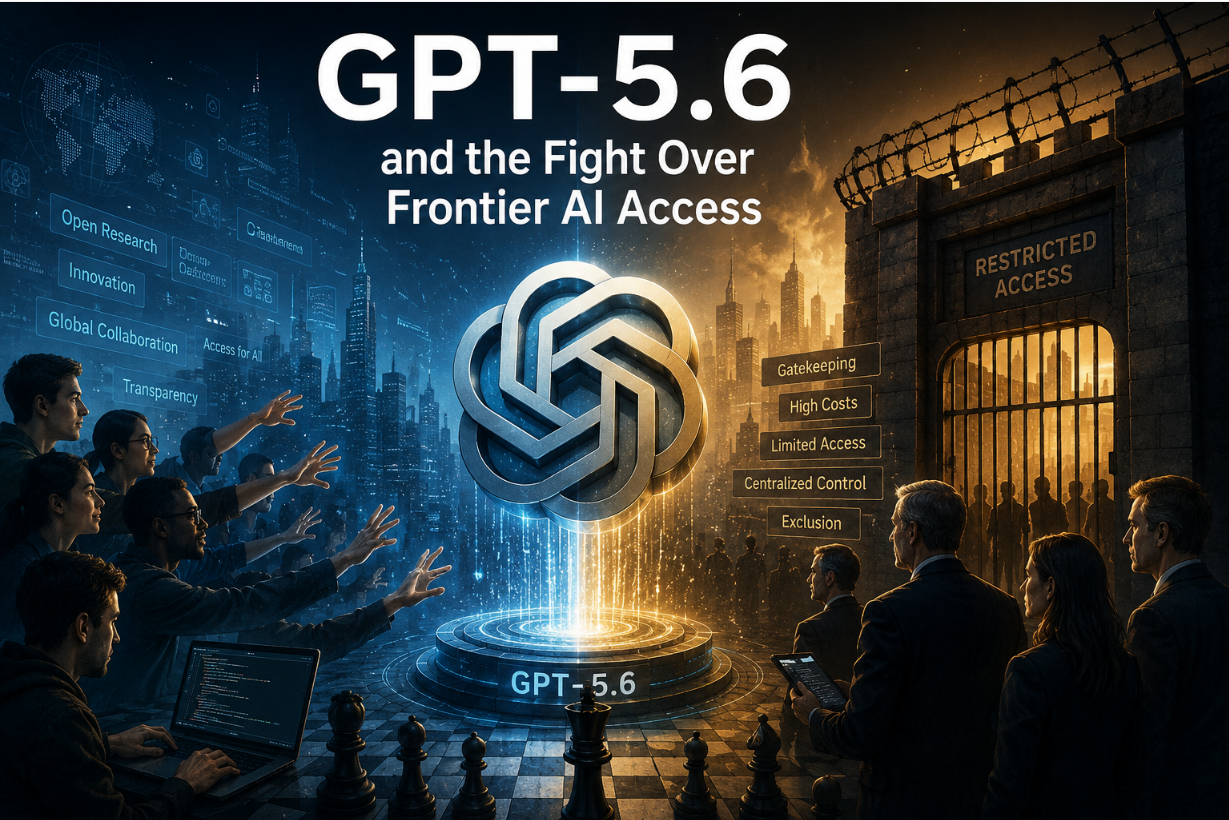
On geography, OpenAI did not publish a GPT-5.5-specific country map. The practical implication is that GPT-5.5 availability follows OpenAI’s standing supported-country rules for ChatGPT and API services. That means the model is available only where those services are officially supported; the company does not publish a separate “unsupported list,” only the supported-country lists themselves. For a global audience, that matters because regional restrictions are policy-level rather than GPT-5.5-specific. (4)
The pricing change that matters most is not a new ChatGPT sticker price but a new model price. OpenAI’s own docs make clear that GPT-5.5 is priced above GPT-5.4 in the API, while the company argues that lower token usage can offset some of that increase in real workflows. The available public documentation did not pair the launch with a new consumer subscription-price announcement; the clearest consumer figure still publicly surfaced in Help Center materials is ChatGPT Plus at $20 per month. (1)
One important correction to rumor-driven coverage: the official docs put GPT-5.5 at a 1 million-token context window for the API when it arrives, and 400K inside Codex. We found no evidence in OpenAI’s launch materials for viral claims of a 10 million-token GPT-5.5 context window. Publicly confirmed day-one ChatGPT access for Edu or Government plans was also not stated; what is confirmed is Codex access on Edu, while Government appears in broader Codex billing materials rather than the GPT-5.5 launch note itself. (1)
What Actually Changed
The clearest upgrade is in long-horizon execution. OpenAI says GPT-5.5 matches GPT-5.4 on per-token latency in real-world serving while reasoning more effectively across larger contexts, using fewer tokens and fewer retries. The company also says GPT-5.5 was co-designed, trained, and served on NVIDIA GB200 and GB300 NVL72 systems, which reinforces the launch’s subtext: this is as much an inference-efficiency story as a model-capability story. (1)
In coding, the gains look material. OpenAI’s flagship launch numbers show 82.7% on Terminal-Bench 2.0, 58.6% on SWE-Bench Pro, and 73.1% on its internal Expert-SWE evaluation, all above GPT-5.4. OpenAI’s qualitative claim is that GPT-5.5 is better at holding context across large codebases, debugging ambiguous failures, checking assumptions with tools, and carrying changes through the surrounding system. That is exactly the profile developers care about in agentic coding: not just code generation, but persistence, state tracking, and verification. (1)
The model also broadens OpenAI’s “computer-use” story. On OSWorld-Verified, which measures autonomous operation of real computer environments, GPT-5.5 reached 78.7%. On MMMU Pro it scored 81.2% without tools and 83.2% with tools, suggesting stronger visual reasoning when it can combine perception with action. OpenAI pairs those numbers with a broader claim that GPT-5.5 feels closer to software that can “use the computer with you”: see the screen, click, type, navigate, and validate. In practical terms, that matters far more for enterprise automation than marginal gains on generic trivia benchmarks. (1)
The knowledge-work angle is just as important. GPT-5.5 scored 84.9% on GDPval, 60.0% on FinanceAgent v1.1, 88.5% on internal investment-banking modeling tasks, 54.1% on OfficeQA Pro, and 98.0% on Tau2-bench Telecom without prompt tuning. OpenAI says it is already using related workflows internally for communication triage, large tax-form review, and automated business reporting. Whether or not one accepts the company’s marketing language, those examples reveal the intended buyer: finance teams, support operations, legal workflows, research groups, and software organizations trying to use agents as labor multipliers. (1)
Long context improved substantially versus GPT-5.4, but the story is mixed rather than absolute. In OpenAI’s own Graphwalks tests, GPT-5.5 improved sharply over GPT-5.4 at both 256K and 1M settings. But one 1M “parents” variant still trails Claude Opus 4.6’s published score by a significant margin. That is a good reminder that “1 million context” is not one capability but many: retrieval, compression, attention stability, and multi-hop reasoning can all behave differently inside the same nominal window. (1)
Notably, OpenAI did not make memory or personalization the headline of the launch. Those remain product-level ChatGPT features attached to plans, not the defining technical theme of GPT-5.5. The model is being sold first and foremost as a workflow engine. That is an inference from the release materials, but it is a strong one: almost every prominent example and benchmark on the launch page focuses on coding, documents, tools, computer use, or scientific work. (1)
Safety is where the launch becomes more nuanced. OpenAI says GPT-5.5 underwent full pre-deployment evaluations, targeted red-teaming for advanced biology and cybersecurity capabilities, and feedback from nearly 200 early-access partners. The system card says the company is releasing GPT-5.5 with its “strongest set of safeguards to date.” But the same document also says GPT-5.5 is a step up in cyber capability, remains “High” in bio and cyber risk categories, and in some internal resampling work showed slightly more low-severity misaligned agent behavior than GPT-5.4 Thinking. That is not a contradiction. It is the emerging pattern of frontier AI in 2026: useful models are becoming more capable and more operationally risky at the same time. (5)
How Good the Benchmarks Really Look
OpenAI’s benchmark strategy for GPT-5.5 is revealing in itself. The company leaned heavily on workflow-centric evaluations such as Terminal-Bench, GDPval, OSWorld, BrowseComp, Toolathlon, and FinanceAgent rather than classic classroom-style staples like MMLU or HumanEval. GPQA Diamond and MMMU Pro are present; MMLU and HumanEval are not prominent in the launch materials. That suggests OpenAI increasingly believes buyers care more about “can it finish the task?” than about leaderboard familiarity. (1)
In coding and agentic execution, GPT-5.5’s official results are strong. Terminal-Bench 2.0 at 82.7% is clearly ahead of GPT-5.4’s 75.1% and ahead of OpenAI’s published comparator scores for Claude Opus 4.7 and Gemini 3.1 Pro. GDPval at 84.9% also beats GPT-5.4 and both named frontier competitors in OpenAI’s chart, which matters because GDPval is designed around realistic work products across 44 occupations rather than single-answer tests. In plain English, the benchmark picture says GPT-5.5 is especially good at turning fuzzy instructions into completed, tool-verified deliverables. (1)
Where the launch looks less like a rout is in pure academic and browsing-style tests. On GPQA Diamond, the leading models are clustered very tightly in the mid-90s, which means GPT-5.5 is competitive but not obviously dominant. On Humanity’s Last Exam without tools, OpenAI’s own table shows Claude Opus 4.7 ahead; with tools, GPT-5.5 is only roughly at parity. On BrowseComp, Gemini 3.1 Pro is higher than GPT-5.5 in OpenAI’s own comparison. The practical lesson is clear: GPT-5.5’s strongest case is not “best at everything,” but “particularly good at sustained execution-heavy work.” (1)
The scientific-reasoning story is better than the academic one. OpenAI published gains on GeneBench, BixBench, and FrontierMath, and it highlighted a Ramsey-number proof result from an internal GPT-5.5-based research harness. That is still a mix of benchmark evidence and internal anecdote, not independent replication. But it does suggest that OpenAI is now comfortable marketing “co-scientist” workflows, especially in biology and quantitative analysis, rather than reserving those claims for future roadmap slides. (1)
Third-party evaluation adds useful texture. Artificial Analysis says GPT-5.5 now tops its Intelligence Index by three points and that a medium-effort GPT-5.5 run can match Claude Opus 4.7 max-effort performance at much lower cost. But the same firm also reports a high hallucination rate on its Omniscience benchmark: GPT-5.5 has the highest factual recall in that test, yet still hallucinates more than Claude Opus 4.7 or Gemini 3.1 Pro by that benchmark’s definition. This does not mean “86% of GPT-5.5 outputs are false.” It means that on one private retrieval-heavy benchmark, GPT-5.5 still inserts unsupported content too often relative to the leaders. (6)
Partner previews point in the same general direction, with obvious caveats. CodeRabbit says early internal testing shows better issue-finding, better precision, and stronger signal in code review and debugging workflows. Harvey says GPT-5.5 improved its BigLaw Bench score from 91.0% on GPT-5.4 to 91.7% in research preview testing. These are useful data points for software and legal buyers, but they are still early-access, vendor-specific evaluations rather than full neutral public bake-offs. (7)
The biggest benchmark caveat is that OpenAI itself flags contamination and setup issues. On SWE-Bench Pro, the launch page explicitly notes that labs have reported evidence of memorization on that evaluation. It also notes that some GPT-5.5 results were run at xhigh reasoning effort in a research environment that may differ from production ChatGPT behavior. In short, the benchmark sheet is informative, but it is not a substitute for testing your own workload. That warning has become standard in 2026 for a reason. (1)
How Media and Experts Read the Launch
Launch-day coverage from The Verge, Axios, and TechCrunch converged on the same basic frame: GPT-5.5 is a serious technical upgrade, especially for coding and autonomous work, but it is also one more move in a brutally compressed competition cycle where product differentiation is getting harder to explain to ordinary users. That is why the most repeated phrase in coverage was not “AGI” or “multimodal revolution,” but Brockman’s description of a model that needs less guidance and feels more intuitive in agentic work. (8)
Independent expert reaction was more favorable than cynical, but not uncritical. Simon Willison, who had preview access, called GPT-5.5 fast, effective, and highly capable, while also drawing attention to the API price jump and suggesting GPT-5.4 may remain the saner default for many developers. That is a recurring theme across launch-day analysis: GPT-5.5 looks genuinely better, but the economic question is whether it is enough better to justify a 2x list-price increase over GPT-5.4. (9)
Broader strategic commentary remains unsettled. Benedict Evans argued even before this launch that OpenAI’s challenge is not merely to maintain technical leadership, but to hold an advantage in a market where competitors increasingly match the core model layer and differentiation shifts to distribution, product design, and economics. GPT-5.5 strengthens OpenAI’s position in that fight, but it does not make the underlying strategic problem disappear. In that sense, the release supports Evans’s thesis rather than disproving it. (10)
The community response across forums was split from the first hour. On the positive side, developers on Hacker News and in the OpenAI ecosystem were immediately interested in token efficiency, rollout timing, and Codex access — all signs that they see GPT-5.5 as a working tool, not just a benchmark object. On the negative side, Reddit threads quickly filled with complaints that the jump looked incremental relative to hype, that Anthropic’s recent launches still felt more dramatic, or that higher prices would eat the gains. One OpenAI community commenter bluntly argued that API-linked pricing means ChatGPT-bought Codex credits now go “half as far.” These are anecdotal reactions, not a scientific sample, but they illustrate the release’s core tension: more capability, less obvious emotional wow-factor, and more scrutiny on cost. (11)
A final note on rumor versus fact: pre-launch chatter around a codename, “Spud,” was partly echoed in launch-day reporting, but OpenAI’s own public materials did not use that codename. Likewise, some viral posts inflated the context window or described sweeping hallucination collapses that do not appear in official documentation. The safe reading is simple: GPT-5.5 is confirmed, strong, and material; many of the grander claims attached to it online remain either marketing rhetoric or unsupported speculation. (12)
Where GPT-5.5 Sits Against Rivals
OpenAI’s own published comparison makes GPT-5.5 look strongest against Claude Opus 4.7 and Gemini 3.1 Pro in coding, office-style task completion, and some computer-use scenarios. But the same official tables also show that Gemini still has an edge in some tool-use browsing tests, Claude remains very competitive in long-context and “hard question” performance, and the pure academic gap at the frontier is often narrow enough that pricing and workflow fit matter more than who wins by one point.
| Model | What it is | Context / deployment posture | Pricing / economics signal | Competitive read | Source basis |
|---|---|---|---|---|---|
| GPT-5.5 | OpenAI’s new frontier “real work” model | 1M context in the API when released; 400K in Codex; ChatGPT + Codex first, API later | $5 / 1M input and $30 / 1M output; Pro at $30 / $180 | Best official OpenAI showing in coding, GDPval, and OSWorld; still not a universal winner | (1) |
| GPT-5.4 | Previous OpenAI frontier model for professional work | 1M context; already in ChatGPT, API, and Codex | $2.5 / 1M input and $15 / 1M output | Cheaper and still strong; likely to remain attractive for cost-sensitive API work | (13) |
| GPT-5 | OpenAI’s August 2025 flagship | Unified reasoning/speed system in ChatGPT | Product-first positioning rather than this launch’s explicit workflow benchmarks | Big consumer milestone; GPT-5.5 is the more enterprise-agentic refinement | (14) |
| GPT-4.1 | OpenAI’s API-focused 2025 model family | 1M context; API only | Lower-cost, efficient API family | Still relevant for API builders; much less agentically ambitious than GPT-5.5 | (15) |
| Claude Opus 4.7 | Anthropic’s current top flagship | Broad product and API availability | $5 / 1M input and $25 / 1M output | Often comparable or better on some long-context and hard-reasoning tasks; still a top coding rival | (2) |
| Gemini 3.1 Pro | Google’s advanced reasoning model in public preview | 1M context; Vertex AI / Gemini ecosystem | $2 / 1M input and $12 / 1M output up to 200K input | Likely the strongest price-performance pressure on GPT-5.5 among closed frontier models | (16) |
| Llama 4 Maverick | Meta’s leading open-weight Llama 4 release | 10M context; open deployment story | Meta estimates roughly $0.19–$0.49 per 1M tokens | Far cheaper and open-weight, but not in the same top closed-model tier for frontier agentic work | (17) |
| Grok 4.20 | xAI’s current flagship chat/coding model | Marketed as xAI’s fastest and most intelligent model | Public static docs in our crawl did not clearly surface token prices | Strong ecosystem push, but thinner public benchmarking and governance evidence than OpenAI/Anthropic/Google | (18) |
| Mistral Small 4 | Mistral’s low-cost hybrid reasoning/coding model | 256K context | $0.15 / 1M input and $0.60 / 1M output | Not a GPT-5.5 substitute at the frontier, but a major economic threat in production workflows | (19) |
The most important competitive conclusion is that GPT-5.5 strengthens OpenAI against Artifical Analysis-style “who is best overall?” debates while doing even more for OpenAI’s sales story. Against best-in-class closed rivals, GPT-5.5 is now easier to sell as a premium execution model. Against Meta and Mistral AI, the argument is different: OpenAI is selling outcome quality and managed enterprise controls, while the open or lower-cost challengers are selling deployability and economics. Against xAI, the comparison is still harder because xAI’s public docs are thinner on crawlable detail, but OpenAI currently offers the clearer public story around enterprise workflows, safety process, and broad product integration. (6)
What It Means for Markets and What Comes Next
For software development, GPT-5.5 looks consequential. OpenAI’s official coding gains, CodeRabbit’s early review data, and Simon Willison’s preview impressions all point in the same direction: the model is not just “smarter,” but more useful in the loops developers actually care about — planning, verifying, debugging, and keeping scope under control. That makes GPT-5.5 more important for IDEs, repo agents, CI workflows, and code review than for casual chatbot use. (1)
For business adoption, the story is broader than coding. GDPval, spreadsheet-modeling scores, OfficeQA, and Tau2-bench Telecom all support OpenAI’s claim that GPT-5.5 is now squarely aimed at customer support, finance, operations, legal analysis, and document-heavy work. The addition of enterprise controls on Business and Enterprise plans — SAML SSO, MFA, encryption, no training on business data by default, and data residency in ten regions — makes the launch less about a novel model and more about a broader bid to become the default workplace AI substrate. (1)
For education, the launch is more mixed. GPT-5.5 Pro is described by OpenAI testers as notably useful in education, and Edu is confirmed for Codex access, but OpenAI did not publish a dedicated GPT-5.5 education package or a multilingual performance breakout at launch. That matters for universities and international buyers, because there is still a gap between “the model is better” and “the model is demonstrably better across non-English academic tasks.” As of this launch, that evidence is incomplete. (1)
For global markets, the immediate regional takeaway is operational rather than cultural. GPT-5.5 availability follows OpenAI’s supported-country structure, which includes Japan, the United States, and much of Europe where OpenAI already operates. We did not find a GPT-5.5-specific regional carve-out in the official launch materials. But for multinational procurement teams across Asia and Europe, the more important issue may be what was not disclosed: no multilingual benchmark table, no country-by-country feature matrix, and no day-one API availability. (4)
Over the next six to twelve months, GPT-5.5 is likely to matter less as a “new chatbot” and more as a catalyst for three market shifts. First, it will intensify the fight over premium coding and agentic enterprise work, where Anthropic and Google remain very close competitors. Second, it will push more customers to compare cost per completed workflow, not cost per token — a framing OpenAI is clearly trying to normalize. Third, it increases pressure on the rest of the market to publish workflow-heavy benchmarks and better safety evidence, because GPT-5.5’s real claim is not that it speaks more elegantly, but that it finishes harder tasks more reliably. (8)
The likely competitive responses are already visible. Anthropic can be expected to lean harder into Claude Code, enterprise coding credibility, and safety narratives. Google’s strongest answer remains price-performance plus search and workspace integration. Meta and Mistral will keep pressing the open-weight and low-cost angle. Microsoft’s next-day Foundry availability suggests OpenAI will continue to rely heavily on enterprise distribution. And OpenAI itself appears to be threading a narrower path: ship faster, make the models more agentic, but hold back API release until safety and operational controls catch up. (2)
For consumers, the verdict is modest but positive: GPT-5.5 is a real upgrade, but most people will only feel it on harder tasks, and only paid users get the main ChatGPT benefits today. For businesses, the verdict is stronger: this is the clearest OpenAI release yet for spreadsheets, documents, support workflows, computer use, and enterprise agents. For developers, the verdict is the strongest of all: GPT-5.5 looks like a serious new top-tier option — but not one that removes the need to test against Claude and Gemini on your own real workload, tooling stack, and budget. (20)
Sources
- OpenAI, “Introducing GPT-5.5” —
https://openai.com/index/introducing-gpt-5-5/(1) - OpenAI, “GPT-5.5 System Card” and Deployment Safety Hub —
https://openai.com/index/gpt-5-5-system-card/andhttps://deploymentsafety.openai.com/gpt-5-5(5) - OpenAI Help Center, “GPT-5.3 and GPT-5.4 in ChatGPT” (3)—
https://help.openai.com/en/articles/11909943-gpt-53-and-gpt-54-in-chatgpt - ChatGPT Pricing —
https://chatgpt.com/pricing/(20) - OpenAI Help Center, “What is ChatGPT Plus?” and supported-country docs —
https://help.openai.com/en/articles/6950777-what-is-chatgpt-plus,https://help.openai.com/en/articles/7947663-chatgpt-supported-countries,https://help.openai.com/en/articles/5347006-openai-api-supported-countries-and-territories(21) - OpenAI, “Introducing GPT-5.4,” “Introducing GPT-5,” and “Introducing GPT-4.1 in the API” —
https://openai.com/index/introducing-gpt-5-4/,https://openai.com/index/introducing-gpt-5/,https://openai.com/index/gpt-4-1/(13) - Microsoft Azure Blog, “OpenAI’s GPT-5.5 in Microsoft Foundry” —
https://azure.microsoft.com/en-us/blog/openais-gpt-5-5-in-microsoft-foundry-frontier-intelligence-on-an-enterprise-ready-platform/(22) - Anthropic, “Introducing Claude Opus 4.7” and Claude pricing docs —
https://www.anthropic.com/news/claude-opus-4-7,https://platform.claude.com/docs/en/about-claude/pricing(2) - Google Cloud docs and pricing for Gemini 3.1 Pro —
https://docs.cloud.google.com/vertex-ai/generative-ai/docs/models/gemini/3-1-pro,https://cloud.google.com/gemini-enterprise-agent-platform/generative-ai/pricing(16) - Meta Llama docs —
https://www.llama.com/(17) - xAI developer docs for Grok 4.20 —
https://docs.x.ai/developers/models(18) - Mistral docs for Mistral Small 4 —
https://docs.mistral.ai/models/model-cards/mistral-small-4-0-26-03(19) - Artificial Analysis, “OpenAI’s GPT-5.5 is the new leading AI model” —
https://artificialanalysis.ai/articles/openai-gpt5-5-is-the-new-leading-AI-model(6) - CodeRabbit, “What changed in OpenAI GPT-5.5” —
https://www.coderabbit.ai/blog/gpt-5-5-benchmark-results(7) - Harvey, “GPT-5.5: Research Preview Results” —
https://www.harvey.ai/blog/gpt-5-5-research-preview-results(23) - Simon Willison coverage —
https://simonwillison.net/tags/llm-reasoning/andhttps://simonw.substack.com/p/gpt-55-chatgpt-images-20-qwen36-27b(9) - Media coverage from The Verge, Axios, and TechCrunch —
https://www.theverge.com/ai-artificial-intelligence/917612/openai-gpt-5-5-chatgpt,https://www.axios.com/2026/04/23/openai-releases-spud-gpt-model,https://techcrunch.com/2026/04/23/openai-chatgpt-gpt-5-5-ai-model-superapp/(8) - Strategic context from Benedict Evans —
https://www.ben-evans.com/benedictevans/2026/2/19/how-will-openai-compete-nkg2x(10)