
 ChatGPT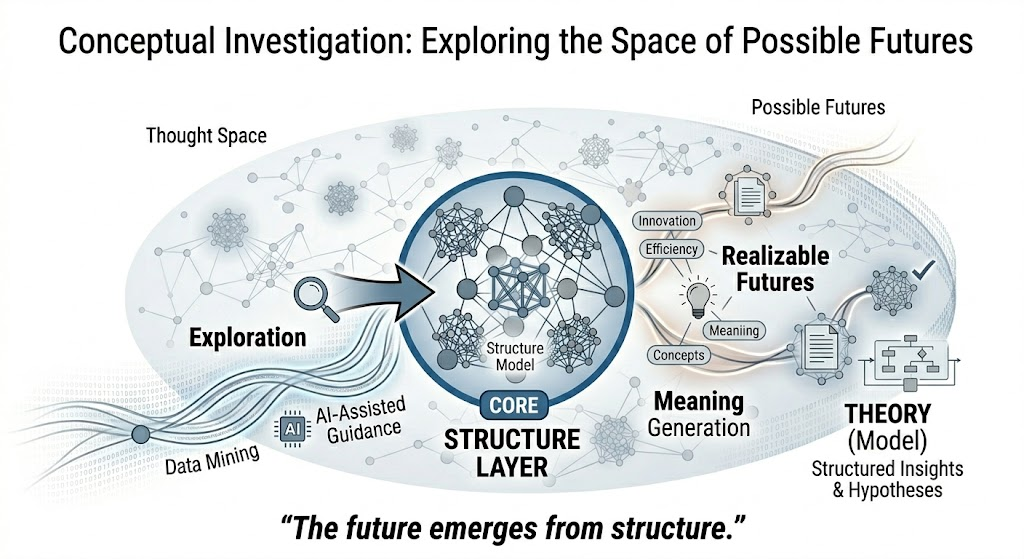
Kunihiro Tada / Mindware Research Institute
A Methodology for Thinking in the Age of Innovation
We are living in the midst of a profound wave of innovation.
Technological advances—especially in AI—are transforming not only industries, but the very structure of reality in which businesses and societies operate.
Innovation is not merely incremental improvement; it is a transformation of reality itself.
As a result, the “facts” observed before and after an innovation are fundamentally different.
This leads to a critical implication:
No matter how accurately we observe pre-innovation facts,
they do not allow us to know post-innovation reality.
In this sense, the future cannot be predicted.
At least, it cannot be derived deterministically from past data or existing facts.
However, this does not mean we are powerless.
We can imagine desirable futures and act toward realizing them.
Thinking is not merely an internal process;
it has the potential to shape reality.
What we think can become real.
Yet when multiple, competing visions of the future exist,
it is not obvious which one will materialize.
In general, the outcome depends on which vision is “more natural” or more aligned with underlying conditions.
However, determining this “naturalness” is far from trivial.
Human decision-making is inherently constrained.
We cannot evaluate all possible conditions with perfect rationality.
Instead, we operate under bounded rationality—
a limitation that is also fundamental to machine learning itself.
Under such constraints, how do innovation winners emerge?
Historically, successful innovators are those who happened to envision a “correct” future.
Yet it remains unclear whether their reasoning process was inherently superior,
or whether they possessed unique abilities unavailable to others.
In practice, we can only say that their vision was validated by outcomes.
This suggests a shift in perspective.
The future is not represented by a single line of reasoning.
Rather, there may be hundreds, thousands, or even tens of thousands of possible ways of thinking about it.
Not all of these possibilities will materialize,
but it is reasonable to assume that some of them are realizable.
Therefore, the problem can be reframed as follows:
The question is not which idea is correct,
but whether we can explore the space of possible ideas itself.
If we could systematically explore this space of thought,
we might be able to identify “better” ideas—
those with higher potential for realization.
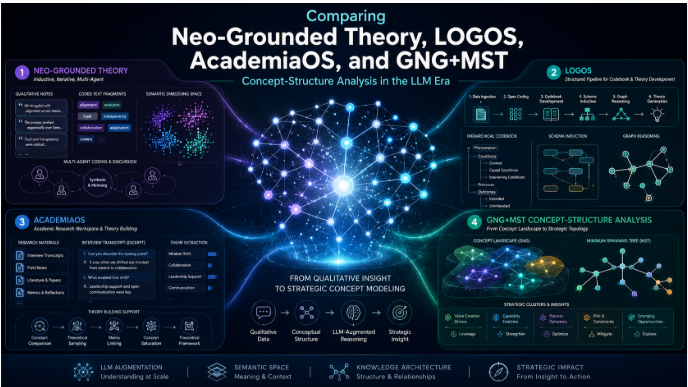
This is precisely what Conceptual Investigation aims to achieve.
Conceptual Investigation does not analyze isolated facts.
Instead, it explores the space formed by concepts and ideas,
and derives meaning and theory from its structure.
Exceptional individuals such as Steve Jobs may have performed such exploration intuitively.
However, for most of us, navigating a vast, high-dimensional space of thought within our own minds is extremely difficult.
Therefore, external tools are required.
Specifically:
A combination of large language models (LLMs) for processing text,
and data mining techniques for extracting structure.
Conceptual Investigation is built upon this technological foundation.
It extends human cognitive capabilities and enables the exploration of thought spaces that were previously inaccessible.
In doing so, it provides a new framework for decision-making in the age of innovation.

 tada@aicritique.org