
 ChatGPT
Executive Summary
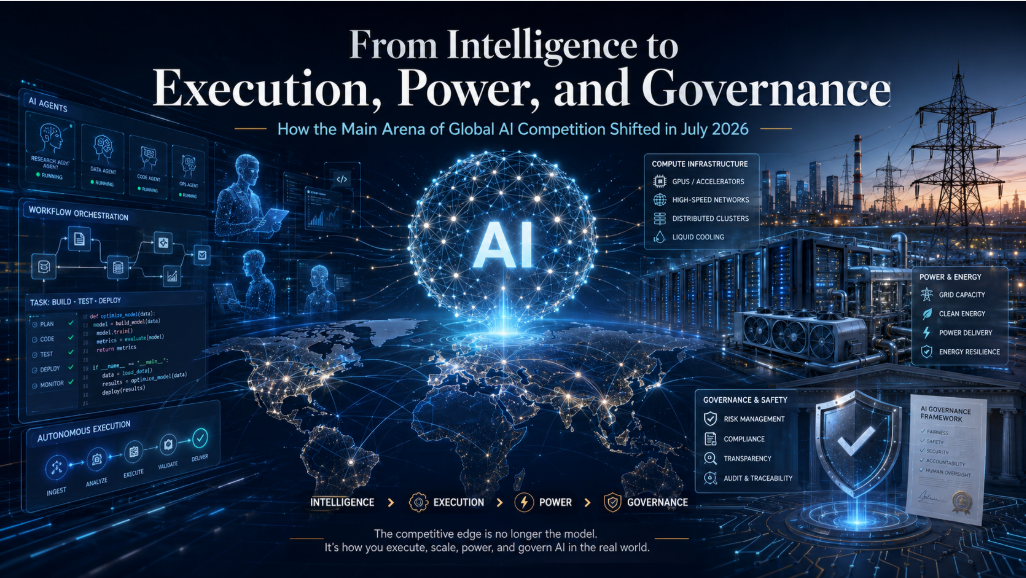
March 2026 marked a consolidation phase in which “AI capability” increasingly meant operational capacity: models that can reliably act across tools, apps, and workflows—not just converse. Several leading labs shipped upgrades explicitly optimized for professional and agentic work (spreadsheets, documents, tool use, and computer-use automation), signaling that frontier competition is shifting from raw benchmark scores toward end-to-end task execution and verification in real environments.
A second defining trend was the acceleration of real-time multimodality—especially voice. The most visible product posture in March was “AI that can listen, speak, interpret context, and respond at conversation speed,” with built-in guardrails like watermarking to manage authenticity risks. This trend matters because voice and live interaction compress latency requirements and increase the cost of mistakes (misinformation, impersonation, unsafe instructions), forcing advances not only in models but also in provenance and safety tooling.
On the infrastructure side, March delivered unusually clear messaging that the industry’s bottleneck is no longer “can we train bigger models?” but “can we deploy and serve them economically at scale?” Inference was repeatedly framed as the next revenue and engineering inflection point, with multiple announcements converging on a two-stage inference decomposition (prefill vs. decode), more heterogeneous silicon, and a renewed importance of CPUs as orchestration and data-movement workhorses for large fleets of AI agents.
Policy and governance developments also intensified, but with a split personality. In Europe, March brought both streamlining/delay proposals for major AI rules and a parallel push to harden transparency requirements around synthetic media (marking, labeling, watermarking), reflecting a pragmatic attempt to reduce compliance friction while still addressing deepfake harms. In the United States, the federal government signaled a desire for a national legislative framework, while states continued moving on procurement and safety standards—illustrating persistent regulatory fragmentation risk for companies operating at scale.
Finally, the research conversation in March leaned heavily toward evaluation under realistic constraints: new benchmarks for agentic intelligence, chained multimodal reasoning, and economic/behavioral impacts. The subtext is that as models become more capable at acting, the field is racing to define tests that measure reliability, deception resistance, and “can this system actually do the job” rather than merely “can it answer a question.”
Key News by Category
Technological advancements
OpenAI released GPT‑5.4 as a “professional work” frontier model (with a Pro variant), emphasizing reduced hallucinations, improved tool use, and stronger performance on office-like tasks such as spreadsheets and documents. Notably, the launch framed spreadsheet competence as a first-class capability and tied it directly to product integration (including a newly released Excel add-in).
OpenAI followed with GPT‑5.4 mini and nano—smaller models positioned not merely as cheaper general-purpose options, but as fast components for high-volume workloads and “subagent” styles of system design. This matters because it normalizes multi-model architectures: a large model plans and arbitrates, while smaller models execute parallel subtasks (codebase search, targeted edits, file review).
Google shipped Gemini 3.1 Flash‑Lite (a low-cost, high-throughput model) and Gemini 3.1 Flash Live (a real-time audio model). Flash‑Lite’s positioning explicitly paired cost control with adjustable “thinking” levels—signaling that inference-time compute budgeting is becoming a core product feature. Flash Live pushed voice-first agents while highlighting watermarking of audio outputs, reinforcing provenance as part of model design rather than an afterthought.
Anthropic’s March updates centered on agentic control surfaces: computer-use previews in Cowork and Claude Code; “Dispatch” improvements; cross-application context sharing between Excel and PowerPoint add-ins; and interactive rendering in the mobile app. Collectively, these moves point to a product strategy where the model is embedded into workflows that require persistence, app-to-app continuity, and the ability to act while the user is away.
Corporate developments
Microsoft announced Copilot upgrades that operationalize “multi-model collaboration”: a “Critique” workflow in which one model drafts while another reviews, plus a “Council” feature for side-by-side comparison of outputs and expanded access to Copilot Cowork under its Frontier program. This is significant because it treats hallucination reduction as a system design pattern (cross-checking) rather than a single-model property.
Arm launched the Arm AGI CPU and, more importantly, crossed a strategic boundary—moving beyond licensing into selling its own data center silicon aimed at agentic AI infrastructure. Arm marketed the CPU as rack-scale orchestration infrastructure, with Meta as lead partner and a broader launch-partner list spanning cloud, networking, and enterprise. The move reflects growing belief that “agentic AI” increases demand for CPUs that coordinate accelerators, memory, networking, and scheduling.
Meta expanded its AI infrastructure buildout, increasing investment in a West Texas data center project to $10 billion as it targets 1-gigawatt capacity. This exemplifies the scale shift: hyperscalers are treating AI compute as grid-scale industrial infrastructure with multi-year timelines, not just “more servers.”
SoftBank secured a $40 billion bridge loan to deepen investments in OpenAI, underscoring the continued willingness of major capital allocators to use leverage to fund AI expansion. From an industry lens, this highlights how AI’s capital intensity is pulling financing strategies (debt markets, large syndicated loans) into what used to be predominantly cash-funded Big Tech capex.
In enterprise adoption, Canal+ signed multi-year agreements with Google Cloud and OpenAI to integrate generative AI into production workflows and streaming recommendations, including the use of Google’s Veo 3 for pre-visualization and content reconstruction and AI-driven natural-language content discovery planned for rollout starting June. This matters because it illustrates “verticalized” generative AI deployment: models + rights/IP protections + integration into high-value media pipelines.
Policy and regulation
The Council of the European Union agreed a position to streamline AI rules (as part of a broader EU simplification agenda), including timeline adjustments for high-risk systems and a new prohibition targeting non-consensual sexual/intimate content and child sexual abuse material generation. The Council text also introduced specific new application dates for high-risk rules (December 2027 and August 2028, depending on system type). This is a clear signal that Europe is balancing competitiveness concerns with targeted harm mitigation.
The European Commission advanced its transparency agenda by publishing a second draft Code of Practice on marking and labeling AI-generated content. The draft emphasized a two-layer marking approach involving metadata and watermarking, plus design requirements for labels/disclaimers for deepfakes and certain public-interest text, with feedback due by March 30 and finalization expected by early June. For deployers, this foreshadows operational expectations for provenance tooling across the content supply chain.
The European Parliament voted to delay key parts of the EU AI Act while backing proposals to ban “nudify” apps and to postpone deadlines for watermarking obligations and high-risk AI compliance. While the final outcome depends on negotiations, the vote shows that synthetic sexual content is becoming a policy forcing function—capable of reshaping broader AI regulatory timelines.
In the United States, the White House released a national AI legislative framework describing objectives including child protection, data center permitting/energy concerns, and broader “national policy” scope. Reuters reporting later in March described the administration’s push for the first comprehensive federal AI bill and the political goal of preempting a patchwork of state regulations.
California issued an executive order focused on strengthening AI protections through procurement standards and best practices (including watermarking recommendations) for companies seeking to do business with the state. The move underscores that, even amid federal efforts toward a unified framework, state-level governance is still evolving rapidly—especially through procurement leverage rather than direct model regulation.
China’s March policy signals combined industrial ambition with governance mechanisms. Reuters described China’s new five-year plan as pushing an “AI+ action plan,” AI agents with minimal human guidance, and expanded computing clusters, alongside a broader drive for technological self-reliance. Separately, the Cyberspace Administration of China published updated filing/registration information for generative AI services (January–February registrations) and reiterated transparency requirements (displaying model names and registration numbers), reinforcing ongoing administrative control over commercialization.
Japan continued refining public-sector governance for generative AI. The Digital Agency opened a public comment period on revising procurement and utilization guidelines for generative AI in government, reflecting institutionalization of GenAI risk management and acquisition standards in the public sector.
Research and academic work
The ARC Prize Foundation introduced ARC‑AGI‑3, an interactive benchmark designed to test “frontier agentic intelligence” in abstract, turn-based environments where agents must explore, infer goals, and plan without explicit instructions. The paper’s framing—comparing system performance to human baselines and emphasizing adaptive efficiency—reflects a broader research push to measure agent competency beyond static QA.
MM‑CondChain proposed a programmatically verified benchmark for deep compositional reasoning in multimodal models, emphasizing chained conditional workflows (e.g., GUI navigation with branching logic). Importantly, the benchmark construction pipeline used verifiable intermediate representations to ensure mechanical checkability—an approach aligned with the industry’s increasing demand for evaluation with “ground truth” execution traces.
$OneMillion‑Bench offered a large-scale, budgeted evaluation for agentic LLM applications, explicitly incorporating financial cost as part of the benchmark design. Its popularity reflects a reality of March 2026: organizations are no longer simply asking which model is “best,” but which system is “best within a cost envelope” under production constraints.
A cluster of March arXiv papers focused on deception, oversight, and trust in multi-agent contexts. DeceptGuard, for example, argued that deception monitoring regimes vary substantially depending on whether monitors can access chain-of-thought or internal activations and described trade-offs between transparency and detectability. Even without consensus on methods, the volume of deception-focused work signals that “agentic autonomy” is now being treated as a safety-relevant capability, not a product bonus.
Anthropic’s Economic Index work continued quantifying real-world usage and labor/task patterns, reporting shifts between consumer and API use, migration of coding toward more automated API-driven workflows, and persistent inequality in per-capita usage across countries. The broader significance is methodological: labs are increasingly publishing aggregate behavioral telemetry as a complement to benchmark-centric claims about model usefulness.
Market and business trends
Nvidia used GTC to frame inference as a trillion-dollar revenue opportunity through 2027 and announced a strategy that decomposes inference into prefill and decode stages, alongside a new CPU and an AI system built on Groq technology to push inference performance. This is not merely marketing: treating inference as the next “platform shift” changes silicon priorities (latency, power, memory bandwidth), system architecture, and competitive dynamics (CPUs and custom silicon become more central).
The prefill/decode split also appeared in Amazon’s partnership with Cerebras, which will place Cerebras chips inside AWS data centers and pair them with Trainium3, with each chip family assigned to different inference stages. The key market implication is that clouds are actively productizing heterogeneous inference stacks, offering paths that reduce dependence on a single GPU vendor and that can be optimized per workload.
Across the hyperscaler ecosystem, Reuters Breakingviews highlighted the sheer scale of projected 2026 AI infrastructure spend and argued that bottlenecks are increasingly physical: permitting timelines, grid interconnects, transformers, cooling systems, and supply chains for electrical gear. From a business standpoint, this introduces “stranded capital” risk: expensive silicon depreciates quickly if facilities and power can’t come online as planned.
Europe’s infrastructure race continued with Mistral raising $830 million in debt financing to buy 13,800 Nvidia chips for a large data center near Paris, targeting operations in Q2 2026. The financing structure itself—debt for GPU procurement—signals maturation of AI infrastructure into an asset class with project-finance characteristics, especially within strategic “sovereign compute” narratives.
Venture and strategic capital remained aggressive. Reuters reported that Thinking Machines Lab (founded by former OpenAI CTO Mira Murati) struck a multi-year partnership with Nvidia involving investment and procurement commitments equating to at least one gigawatt of next-generation processors—an unusually explicit “compute scale” reference point in a startup deal. Meanwhile, defense and space-adjacent AI bets saw large rounds and valuation jumps, such as Shield AI’s Series G and Starcloud’s funding for orbital compute concepts—evidence that AI’s capital cycle is spilling into adjacent sectors where autonomy and compute density are strategic.
Deep Dives on Key Topics
Agentic AI becomes the new product battleground
Background context. “Agentic AI” in March 2026 is best understood as a convergence of three requirements: (1) the model can plan, (2) it can act through tools and interfaces, and (3) the system is designed to verify or constrain action with checkpoints. Major product releases explicitly described this shift from answering questions to executing multi-step tasks with user control points.
What is new or innovative. The most concrete innovation was not a single model architecture, but a system architecture pattern: multi-model orchestration and critique loops. Microsoft’s “Critique” and “Council” features formalized this at the product layer by routing outputs through multiple models and exposing comparisons to users. OpenAI’s positioning of mini/nano models as “subagent” components likewise normalizes the idea that strong systems will be assemblies of specialized models working in parallel.
Impact on the industry. The strategic implication is that the winning products may be those with the best “agent reliability stack”—not only a strong frontier model, but robust tool-search, permissions, logging, sandboxing, UI interaction, and cross-app memory. Anthropic’s March upgrades (computer use previews, persistent threads, cross-app add-in context) show that competitors are racing to package the operational scaffolding around the model. Over the next product cycles, differentiation is likely to move toward observability (what did the agent do?), governance (who allowed it?), and recoverability (how do we roll back mistakes?) as much as raw reasoning.
Inference-first infrastructure and the CPU comeback
Background context. For several years, training large models drove infrastructure narratives and concentrated advantage around GPU availability. In March 2026, leading infrastructure announcements repeatedly emphasized that serving models to hundreds of millions of users—and supporting agentic workflows—changes the shape of demand: lower latency, geographically distributed capacity, and tighter integration between accelerators and general-purpose compute.


What is new or innovative. A striking technical motif was the explicit splitting of inference into prefill and decode stages, with different silicon choices for each stage. Nvidia described this decomposition alongside new CPU/system announcements, while Amazon and Cerebras announced an almost identical conceptual split in their joint cloud service. The novelty is that inference is becoming modular and composable: clouds can mix-and-match chips to optimize throughput, latency, and cost per token rather than assuming one general accelerator wins everywhere.
Impact on the industry. Two second-order effects stand out. First, CPUs regain strategic importance as orchestration and data-plane components for agentic infrastructure—reflected in Arm’s move to sell the AGI CPU explicitly for rack-scale agentic workloads and in commentary emphasizing inference-driven CPU demand. Second, physical infrastructure constraints increasingly dictate pace: power interconnects, transformers, cooling systems, and permitting timelines can bottleneck even well-capitalized buildouts, creating execution risk for the entire “AI capex cycle.” The business implication is that competitive advantage increasingly includes construction, grid strategy, and supply chain management—not just model quality.
Trust and provenance as first-order constraints
Background context. By 2026, synthetic media harms (deepfakes, non-consensual sexual imagery, misinformation) are no longer niche ethical debates—they are drivers of concrete compliance regimes and product decisions. March 2026 showed regulators and companies converging on provenance and labeling as pragmatic levers: even if you can’t stop generation, you can require disclosure and enable detection.
What is new or innovative. Europe’s second draft Code of Practice proposed a structured approach (secured metadata + watermarking, plus optional mechanisms) and set an expectation for a future EU icon and consistent disclosure practices. In parallel, Google highlighted watermarking for audio outputs from its real-time model, suggesting that provenance is expanding beyond images/video into voice—an especially sensitive modality for impersonation.
Impact on the industry. Two tensions define the near-term landscape. One is “speed vs. safety”: real-time voice and agentic automation reward low latency, but low latency leaves less time for safety checks and human review. The other is “global fragmentation”: the EU is building detailed transparency scaffolding, the U.S. federal government is signaling a national framework while states act via procurement, and China continues administrative control via filings and registration. Companies operating globally will likely respond by building layered compliance and provenance systems that can be selectively enabled by jurisdiction and use case, effectively baking “regulatory routing” into AI platforms. This is an inference-based outlook grounded in the direction of March policy moves and announcements.
Future Outlook
The next 3–6 months are likely to be shaped by the operational consequences of March’s agentic and infrastructure announcements rather than by a single “breakthrough model.” In technical terms, the near horizon points to more multi-model orchestration, more explicit compute budgeting (latency and “thinking” controls), and more productized computer-use tooling. Evidence for this trajectory is visible in March releases that framed smaller models as subagents and that expanded agent control surfaces across productivity suites.
A credible short-term milestone is the formalization of transparency regimes for synthetic content in Europe. The European Commission’s Code of Practice process set expectations for feedback through late March and a finalized version by early June, creating a near-term policy heartbeat that vendors and deployers will track closely. Companies selling generative media or voice capabilities in the EU should expect accelerating “compliance-by-design” requirements (marking, labeling UX, metadata retention), with knock-on effects on product defaults globally. The first sentence is factual; the second is reasoned extrapolation from the process and its incentives.
On infrastructure, the central risk is execution. March commentary and reporting highlighted that physical constraints (power, transformers, cooling, permitting, and supply chain latency) are becoming binding. Over the next 3–6 months, expect more public commitments to demand response, on-site generation strategies, and modular data center approaches, because these offer near-term relief while long-lead-time grid and turbine constraints persist. This is a forward-looking inference anchored in March reporting on grid stress and data center flexibility efforts.
Finally, model roadmaps will likely be punctuated by planned retirements and migrations that reflect a continuous-release cadence. OpenAI stated that GPT‑5.2 Thinking would remain available for three months before retirement on June 5, 2026, while Anthropic’s platform notes described upcoming beta retirements and model lifecycle changes (e.g., 1M-context beta retirement for older models). These lifecycle signals matter for enterprises: “model availability risk” is now operationally significant, pushing larger customers toward abstraction layers, model gateways, and evaluation suites that can manage frequent substitutions without breaking workflows. The retirement dates are factual; the enterprise implication is a reasoned conclusion.