
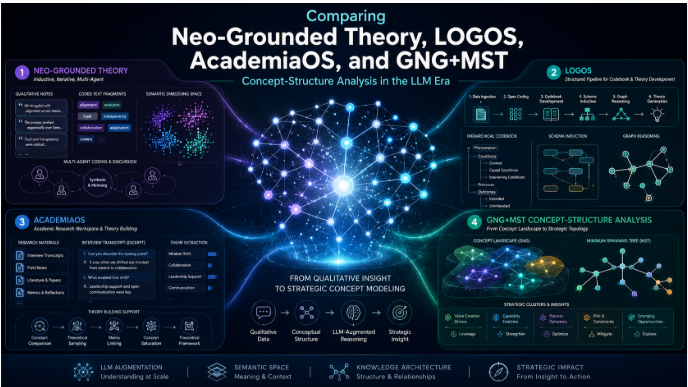
Comparing Neo-Grounded Theory, LOGOS, AcademiaOS, and GNG+MST Concept-Structure Analysis
Executive Summary This report argues that the four approaches under comparison do not belong to a single methodological family in the same sense. Neo-Grounded Theory, LOGOS, and AcademiaOS are best understood as LLM-era attempts to automate, augment, or scale grounded-theory-style qualitative analysis for scholarly inquiry. By contrast, GNG+MST concept-structure…
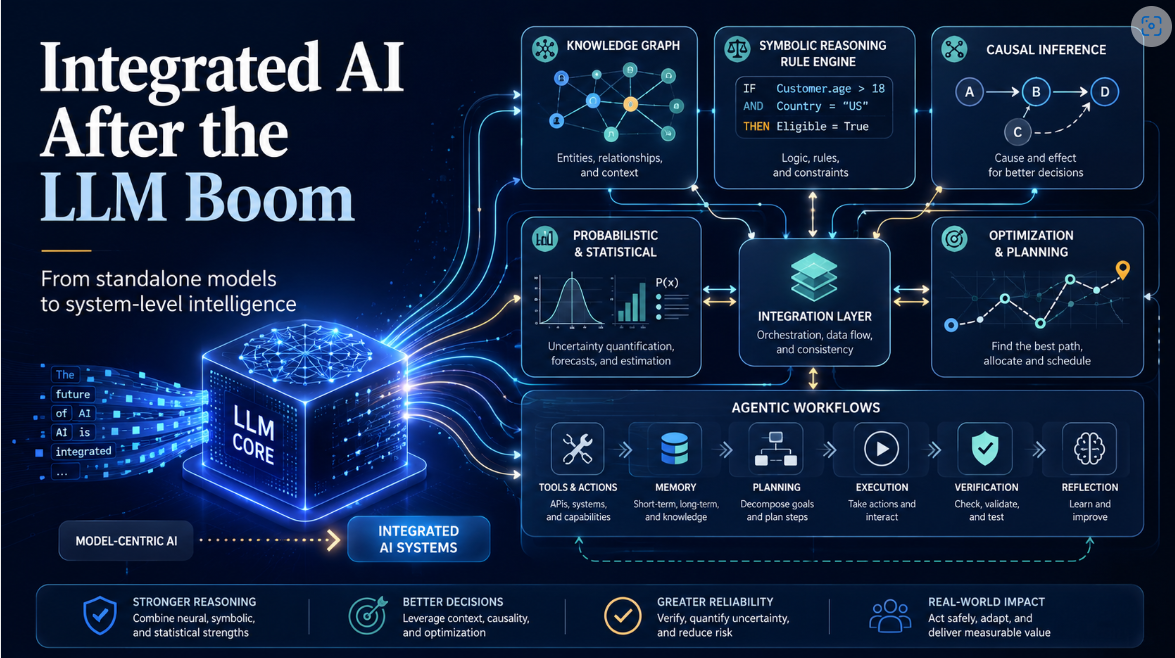
Integrated AI After the LLM Boom
Executive summary Detailed research report for article writing Background and context. Neural AI’s achievements remain extraordinary. Frontier models now write and summarize text, generate and debug code, handle multimodal inputs, and in many products invoke external tools, search the web, or…
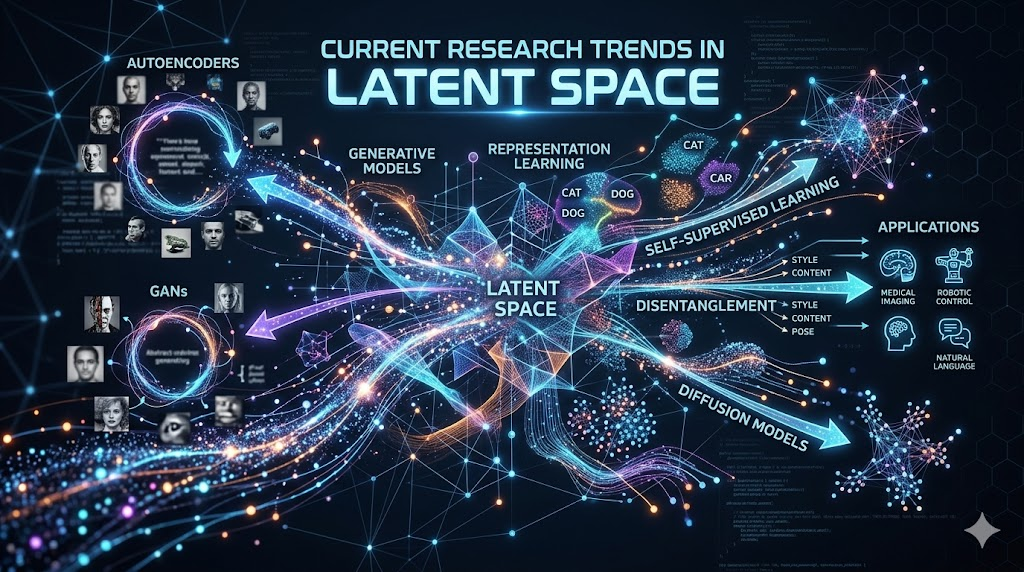
Current Research Trends in Latent Space
Executive Summary As of April 2026, “latent space” is no longer a single technical object. Recent surveys now treat it as a broad research landscape rather than a single definition, and the fact that ICLR 2026 hosts a dedicated workshop…
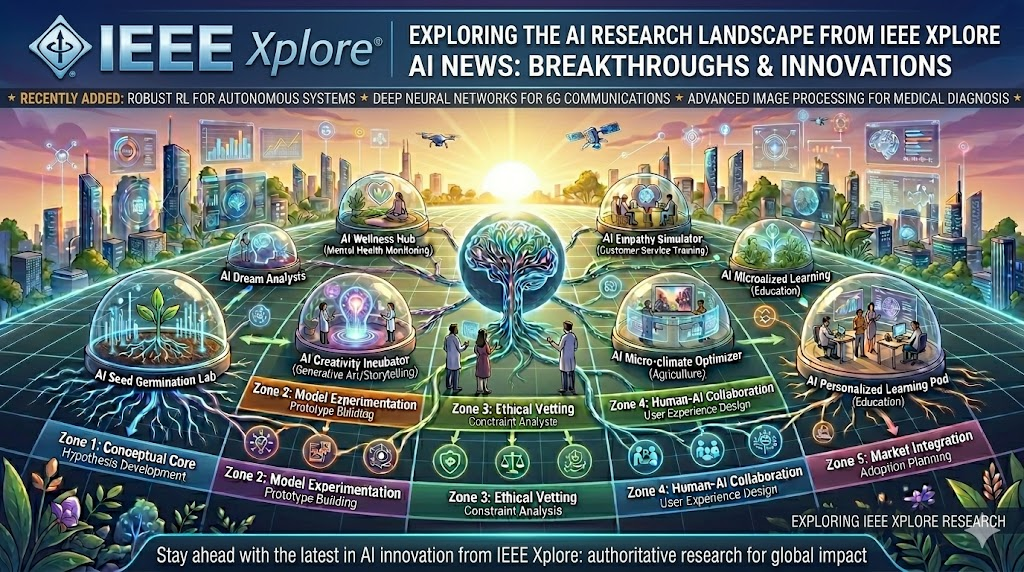
ThinkNavi
- Academic , Concept Research , Trende
- April 16, 2026
- 395 views
AI Articles from IEEE Xplore
ing ThinkNavi, 200 aritcles were retrieved from IEEE Xplore, and a conceptual structure network model was constructed. By reviewing similar articles clusters, trends in related topics can be identified. Cluster 0: AI in Healthcare The integration of artificial intelligence (AI)…
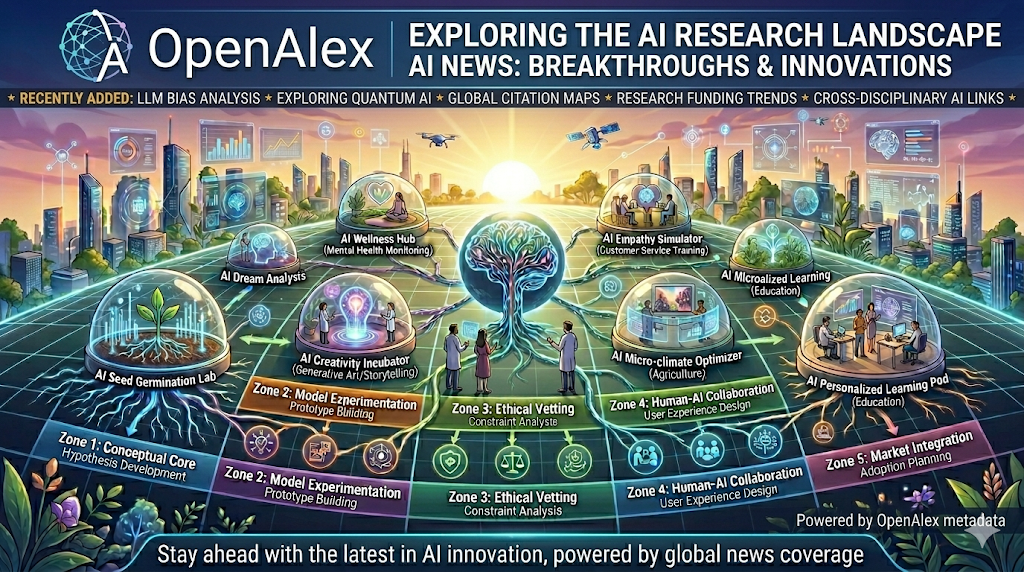
- Academic , Concept Research , Reports
- April 15, 2026
- 332 views
AI articles from OpenAlex
Using ThinkNavi, 178 articles were retrieved from OpenAlex, and a conceptual structure network model was constructed. By reviewing similar articles clusters, trends in related topics can be identified. Cluster 0: AI Governance and Sovereignty Overview AI governance and sovereignty encompass…

tada@aicritique.org
- Academic , Agent , Generative AI , LM
- February 1, 2026
- 1036 views
Will OpenAI Prism accelerate scientific research?
1) Official announcements (what OpenAI says Prism is) What it is Launch details & availability Stated goals Capabilities OpenAI highlights (feature-level)From OpenAI’s launch post and product page, Prism is presented as supporting: Integration with other OpenAI products 2) Media coverage…

Grokking in Large Language Models: Concepts, Models, and Applications
Basic Concepts and Historical Background Definition of Grokking: Grokking refers to a surprising phenomenon of delayed generalization in neural network training. A model will perfectly fit the training data (near-100% training accuracy) yet remain at chance-level on the test set…

Video To Blog
- Academic , LM
- July 8, 2025
- 2144 views
Why AI Gets “Lost” in Multi-Turn Conversations: Causes and Solutions Explained
Have you ever had an extended conversation with an AI, only to feel like it’s getting confused or stubbornly refusing to adjust its answers? Maybe you noticed it going in circles or giving inconsistent responses as the chat went on.…

Potemkin Understanding in AI: Illusions of Comprehension in Large Language Models
Executive Summary Figure: A newly painted façade of a building in Kolín, Czech Republic conceals the decayed structure behind it. The term “Potemkin” originates from such facades that create an illusion of substance – a fitting metaphor for AI systems…

ChatGPT
- Academic , Creativity
- June 15, 2025
- 1619 views
Physics of Intelligence: A Physics-Based Approach to Understanding AI and the Brain
Dr. Hidenori Tanaka’s “Physics of Intelligence” project (also called the Physics of Artificial Intelligence) is an ambitious research initiative aiming to apply concepts from physics – such as symmetry, conservation laws, and phase transitions – to the study of intelligence…