
AI-Driven Restructuring in R&D Sectors

Companies across various industries are undergoing significant restructuring of their research and development operations, driven by AI advancements. Notably, firms like SAP and Intel are investing heavily in AI while reducing traditional roles, highlighting a shift towards AI-centric business models.

In recent years, artificial intelligence (AI) has significantly transformed research and development (R&D) across various industries, leading to substantial organizational restructuring to harness AI’s potential.

Key Developments:

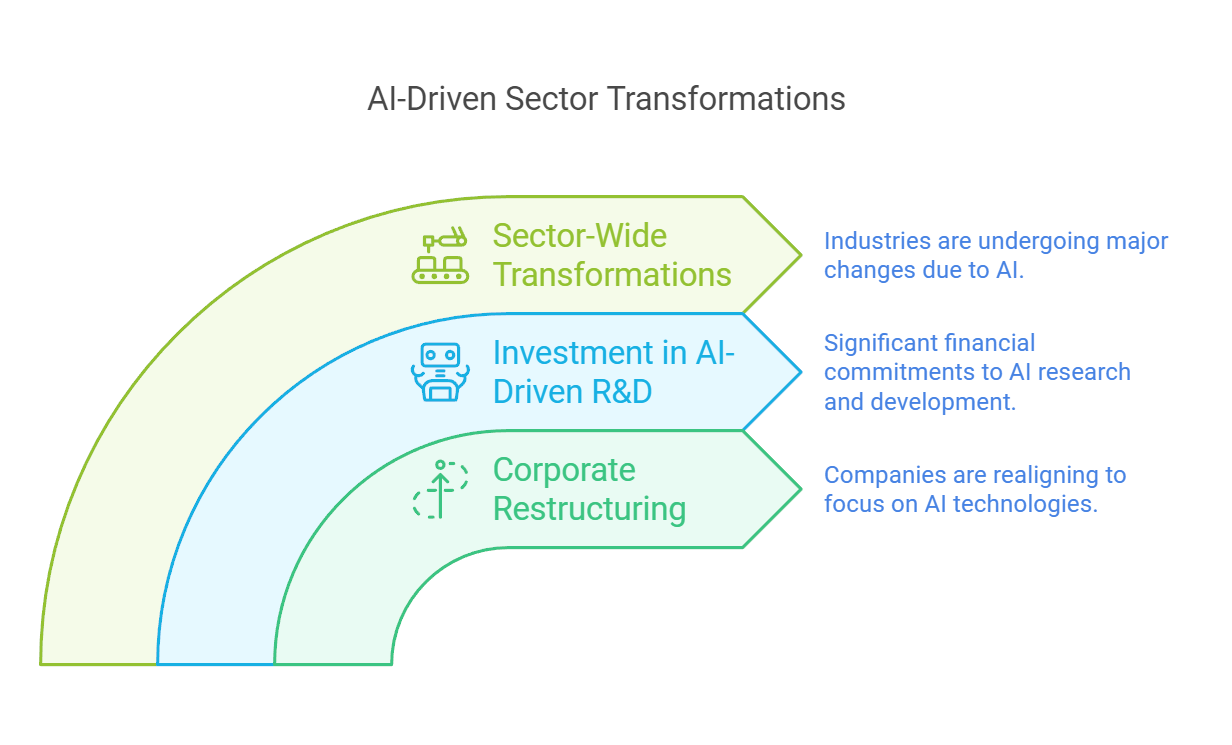
  1. Corporate Restructuring:
    • SenseTime’s Strategic Shift: SenseTime Group, a prominent Chinese AI company, announced a major organizational restructuring to focus on generative AI technologies, aiming to make it the company’s core business to enhance growth and profitability. Reuters
    • Pharmaceutical Industry Adaptations: Companies like Exscientia have implemented workforce reductions while emphasizing AI-driven drug discovery, aiming to streamline operations and automate discovery processes. RD World Online
  2. Investment in AI-Driven R&D:
    • SAP’s Commitment: The enterprise software giant SAP is investing €2 billion annually in AI, reflecting a significant commitment to integrating AI into its R&D processes. RD World Online
    • AMD’s Strategic Investments: Advanced Micro Devices (AMD) has increased its forecast for 2024 data center AI-enabling GPU chip revenue to over $5 billion, highlighting the growing demand for AI capabilities. RD World Online
  3. Sector-Wide Transformations:
    • Biopharma Innovations: The biopharmaceutical sector is leveraging AI to accelerate drug discovery and development, with companies like Xaira Therapeutics launching with over $1 billion in committed capital to focus on AI-driven drug development. RD World Online
    • Semiconductor Industry Shifts: Companies such as Intel and AMD are restructuring their workforces to focus more on AI chip development, aligning resources with key growth opportunities in AI technologies. RD World Online

Implications:

  • Accelerated Innovation: AI integration in R&D processes enables faster product development cycles, allowing companies to bring innovative products to market more swiftly.
  • Operational Efficiency: Automation of routine tasks through AI leads to streamlined operations, reducing costs and improving efficiency.
  • Competitive Advantage: Organizations that effectively implement AI in R&D can gain a significant edge over competitors by rapidly adapting to market changes and consumer preferences.

These developments underscore AI’s transformative impact on R&D, prompting companies across various sectors to restructure and invest in AI capabilities to drive innovation and maintain competitiveness.
  • Related Posts

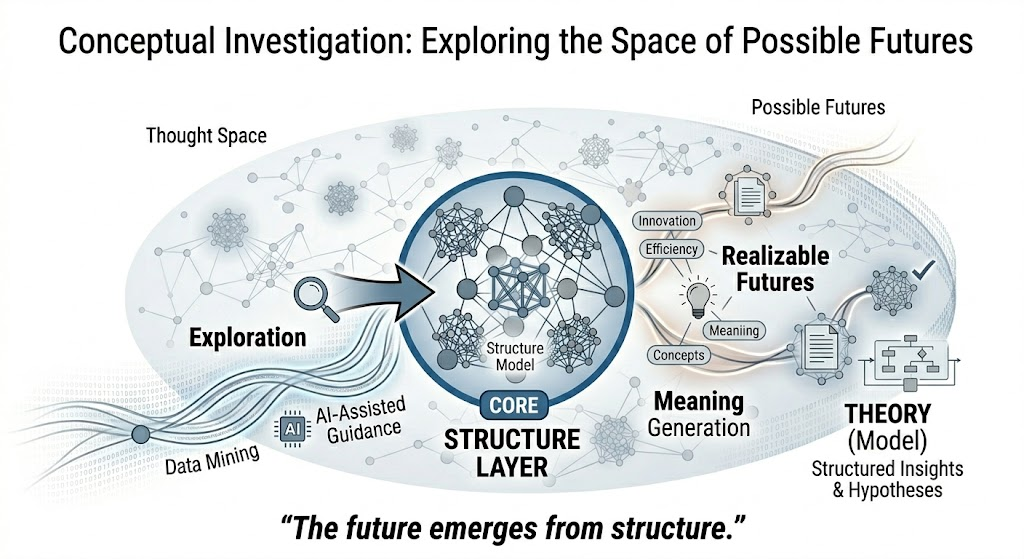
    Why Conceptual Investigation?

    Kunihiro Tada / Mindware Research Institute A Methodology for Thinking in the Age of Innovation We are living in the midst of a profound wave of innovation.Technological advances—especially in AI—are transforming not only industries, but the very structure of reality…

    KJ Method Resurfaces in AI Workslop Problem

    To solve the AI ​​Workslop problem, an information organization technique invented in Japan in the 1960s may be effective. Kunihiro Tada, founder of the Mindware Research Institute, says that by reconstructing data mining technology in line with the KJ method,…

    You Missed

    AI News Briefing for April 13–20, 2026

    AI News Briefing for April 13–20, 2026

    Current Research Trends in Latent Space

    Current Research Trends in Latent Space

    AI Patents from Google Patents Search

    AI Patents from Google Patents Search

    AI Articles from IEEE Xplore

    AI Articles from IEEE Xplore

    AI articles from OpenAlex

    AI articles from OpenAlex
    AI News from NewsAPI
    AI News from Google News

    Idea of New AI services

    Idea of New AI services

    Problem to use AI services

    Problem to use AI services

    AI Services Market Structure 2026

    AI Services Market Structure 2026

    Why Conceptual Investigation?

    Why Conceptual Investigation?

    AI Development in March 2026

    AI Development in March 2026

    GPT-5.4 and the March 2026 ChatGPT Upgrade Cycle: Official Release, Media Narratives, and Real-World Reactions

    GPT-5.4 and the March 2026 ChatGPT Upgrade Cycle: Official Release, Media Narratives, and Real-World Reactions

    AI Agent Startups Trends 2023–2026

    AI Agent Startups Trends 2023–2026

    The Rise of Generative UI Frameworks in 2025–26

    The Rise of Generative UI Frameworks in 2025–26

    Will OpenAI Prism accelerate scientific research?

    Will OpenAI Prism accelerate scientific research?

    Considering AI and Communism

    Considering AI and Communism

    Order in the Age of AI

    Order in the Age of AI

    Where Should AI Memory Live?

    Where Should AI Memory Live?

    2026 Will Be the First Year of Enterprise AI

    2026 Will Be the First Year of Enterprise AI

    Does the Age of Local LLMs Democratize AI?

    Does the Age of Local LLMs Democratize AI?

    Data Science and Buddhism: The Ugly Duckling Theorem and the Middle Way

    Data Science and Buddhism: The Ugly Duckling Theorem and the Middle Way

    Google’s Gemini 3: Launch and Early Reception

    Google’s Gemini 3: Launch and Early Reception

    AI Governance in Corporate AI Utilization: Frameworks and Best Practices

    AI Governance in Corporate AI Utilization: Frameworks and Best Practices

    AI Mentor and the Problem of Free Will

    AI Mentor and the Problem of Free Will