
 ChatGPT
Executive Summary
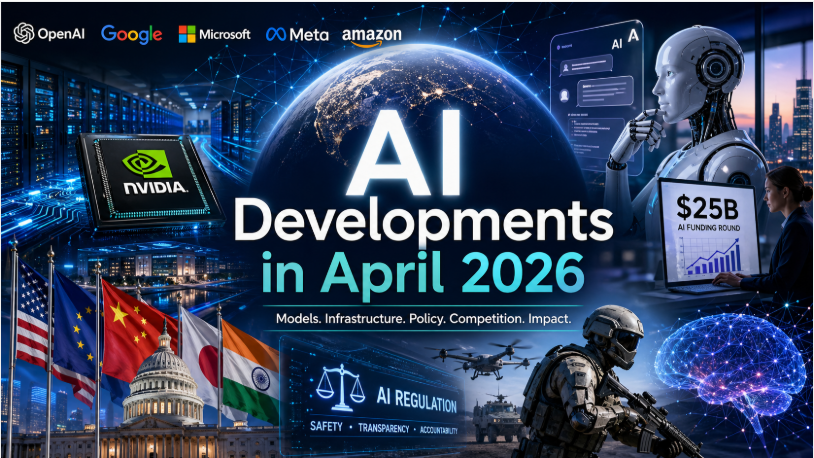
May 2026 saw rapid advances in AI across technology, business, and policy worldwide. Frontier LLMs and agentic AI dominated the headlines: Google unveiled Gemini Omni (video-and-multi-modal generation) and Gemini 3.5 agent models at its I/O conference(1)(2), while OpenAI updated ChatGPT’s engine to GPT-5.5 Instant (reducing “hallucinations” by 52.5%) and introduced real-time voice AI models (GPT-Realtime-2/Translate/Whisper). Anthropic raised a record $65 billion (valuing it at $965B) and launched Claude Opus 4.8, a stronger, faster model for coding and agents. In the open-source arena, Google’s Gemma 4 and Mistral’s new models (e.g. Small 4 with 119B parameters and 256K context) pushed performance, while Cohere’s 218B Command A+ and Stability AI’s Stable Audio 3.0 (open-weight music generation up to 6+ minutes) emphasized transparency and community use.
Business adoption accelerated. JPMorgan (and other banks) rolled out AI tools and have early access to Anthropic’s cybersecurity model Mythos, while Japan granted its major banks access to OpenAI’s GPT-5.5 to boost cyber defenses. Enterprise partnerships abounded: Snowflake committed $6 billion on AWS for agentic AI analytics, and Korean Samsung will allow use of external LLMs (e.g. ChatGPT) for 2026’s DX division after internal training. Sector use cases ranged from finance (AI in banking dealmaking) to manufacturing and logistics (AI-driven robots in Japan). These developments spurred discussions on productivity vs. jobs: e.g. JPMorgan plans more “AI specialists” as rivals cut staff for automation.
On policy, the U.S. remained in flux. President Trump (in office) announced but then postponed an executive order requiring pre-release safety reviews of advanced AI, citing global competitiveness concerns. Congress debated a $500M “Pax Silica” fund to help allies adopt American AI/chips. The EU moved ahead with “Chips Act 2.0” (demand-side incentives for EU-made semiconductors) and is fine-tuning AI Act implementation (sandboxes by Aug. 2026). China tightened controls on AI talent travel (restricting Alibaba and DeepSeek researchers) and laid out new rules for AI chatbots (strict governance, content limits). Elsewhere, the UK emphasized “AI sovereignty” and a domestic chip strategy, and Saudi Arabia declared 2026 the “Year of AI” (expanding infrastructure, training, and global partnerships).
Below we detail these trends. A timeline table summarizes key May 2026 AI news. We conclude with the top developments of May and issues to watch in the coming year. Comprehensive citations are provided throughout.
Major AI Actors and Model Releases
- OpenAI: On May 5, OpenAI updated ChatGPT to GPT-5.5 Instant, claiming “52.5% fewer hallucinated claims than GPT-5.3” on critical queries. It also unveiled new voice models (GPT-Realtime-2, -Translate, -Whisper) on May 7, enabling real-time speech understanding, translation, and transcription with “GPT-5-class reasoning”. On May 29, OpenAI launched Rosalind Biodefense, expanding access to its GPT-Rosalind model for vetted biotech and public-health partners. These moves highlight OpenAI’s push into voice AI and domain-specific agents (biodefense) while continuously improving core LLM reliability.
- Google DeepMind / Google AI: Google’s I/O on May 19 was a watershed. It introduced Gemini Omni (first Omni Flash model) that takes any input (image/audio/video/text) and “create[s] anything” (especially video) via conversational editing. Omni edits video with natural language, retaining consistency and physics across edits. In parallel, Google unveiled Gemini 3.5 (Flash), a frontier agentic model with “action” capabilities, yielding state-of-the-art coding and agent performance (better than Gemini 3.1 Pro). Both are integrated across Google products (Search, YouTube, Android). Google also emphasized its agent platform “Antigravity” and launched features like Info agents in Search and intelligent shopping carts. Collectively, Google is doubling down on AI agents and video/vision (Omni) plus scaling safety (Gemini 3.5 Flash includes “frontier safeguards”).
- Anthropic: Anthropic announced Claude Opus 4.8 on May 28, an incremental upgrade yielding stronger coding, reasoning, and long-run capabilities at the same price. Opus 4.8 set new benchmarks: it was the only model to complete all cases in the Super-Agent test and the first to break 10% on a challenging legal benchmark, essentially matching GPT-5.5 on cost basis. That same day, Anthropic secured a record $65 billion Series H at a $965 billion valuation. This funding (including major commitments from AWS, Google, SpaceX) will fuel its expansion – Anthropic plans 5+GW GPU deals with AWS/Google and offering Claude on all major clouds – and underscores its emerging scale (claims $47 billion run-rate revenue). In May, Anthropic also opened offices in Milan and Korea and partnered with firms like KPMG/PwC to integrate Claude in enterprise workflows, signaling its global ambition.
- Meta (Meta AI): Meta is deploying its advanced Muse Spark model across products. An April blog (updated May 12) explained that Muse Spark (released Apr 2026) now powers faster AI voice responses, smart AR glasses features, and shopping assistants in Meta’s apps. In late May, Reuters reported Meta is pivoting to AI wearables: it’s testing an AI pendant and expanding its Ray-Ban/Oakley smart glasses line, plus launching “Wearables for Work” (enterprise-focused service). Meta aims to sell 10 million AI-enabled wearables in H2 2026. These moves come amid Reality Labs losses; Meta is betting on on-device AI (Siri-like gadgets) and growing its LLM portfolio (Gemini 1.5/2 internally, and continuing Llama research). Meta also continues heavy R&D in generative content (e.g. Cyclical electric models, but none in May public).
- Microsoft & Amazon: Microsoft continues to integrate OpenAI’s models (GPT-5.5 is on Bing Chat / Azure AI). It backed Anthropic’s funding. Amazon Web Services (AWS) strengthened its AI offerings: at an April event, AWS debuted Amazon Quick (a Copilot-like work assistant) with new features and a desktop app, and expanded Amazon Connect into four agentic AI suites for customer service, hiring, etc.. AWS also deepened its partnership with OpenAI: on May 4 it announced bringing GPT-5.5 and 5.4 to Amazon Bedrock, plus Codex (OpenAI’s coding agent) via Bedrock. In late May, Snowflake committed $6B on AWS to jointly build “agentic enterprise” AI (taking AI models to data). These moves cement AWS as a hub for enterprise AI.
- NVIDIA: By May’s end Nvidia, which already dominates AI training GPUs, was making geopolitical statements: CEO Jensen Huang said Nvidia would invest $150 billion per year in Taiwan and build a new Taiwan HQ by 2030, calling Taiwan the “epicenter of the AI revolution.” This huge commitment reflects soaring demand for GPUs/data centers (Nvidia’s own “AI supercycle”). The company also launched new AI-optimized chips (e.g. H200 GPU) and software, though specific May product news was limited. NVIDIA’s moves heighten U.S.-China tech rivalry (since many GPUs end up subject to export controls).
- Open Source Models (Mistral, Cohere, etc.): European startup Mistral AI continued its trend of open, high-context models. On May 22, it released Mistral Medium 3.5 (128B dense, 256K context) under a liberal license, powering new cloud coding agents (Vibe) and “work mode” for multi-step tasks. Earlier in Q2 (Mar) it had released Mistral Small 4 (119B MoE, 256K context) merging its previous strengths and open-sourcing it. Cohere (Canada) in mid-May announced Command A+ (218B MoE) as open source – a fast, secure enterprise model (runs on 2 H100s) for global customers. Stability AI launched Stable Audio 3.0 on May 20: a suite of music-generation models (Small/Medium with open weights, Medium/Small up to 6:20 long) trained on licensed data. These releases underscore a trend toward open or exportable models with large context and multi-modality.
- Chinese Players: Baidu (with ERNIE) and Alibaba (with Qwen) each advanced. Baidu published ERNIE 5.1 on May 9: a leaner model (1/3 parameters of 5.0) achieving #4 globally on a crowdsourced benchmark, leading Chinese models in reasoning and “agentic” tasks. Alibaba teased its next Qwen 3.7 (previews) on May 19; early benchmarks show them topping all Chinese models on LM Arena (#13 text, #16 vision). Tencent, SenseTime, iFlyTek and others continued similar research. At the same time, Chinese authorities tightened policy: Reuters reported (May 26) that top AI engineers at Alibaba and DeepSeek now need government approval to travel overseas. Beijing also drafted rules (effective July 2026) for “anthropomorphic” AI services, imposing content controls, age limits, and corporate governance on chatbots and virtual avatars. These reflect China’s push to regulate AI content and talent flows.
- Other Regions: Major non-US/China players also moved. The EU is pushing chip sovereignty via a draft “Chips Act 2.0” (demand-side incentives for EU-made chips and public AI procurement). Many European AI startups (Hugging Face, Aleph Alpha) continued open-innovation. Japan saw industry and government focus on robotics and AI: a Reuters poll (May 20) found 34% of Japanese firms are using or evaluating AI-enabled robots (led by automakers). The Japanese government created a public-private group to secure banks against AI-driven cyber threats and granted banks access to GPT-5.5 for defense (below). India on Feb. held an “AI Summit 2026” (see Background) emphasizing GPU infrastructure (38K new GPUs in national grid) and sovereign AI models. In May, India continued supporting deeptech startups (e.g. a ₹10,000 Cr fund for deeptech announced) and advanced its digital public infrastructure. South Korea: Samsung announced (May 26) it will allow employees in certain divisions to use external LLMs (e.g. ChatGPT) starting June, upskilling 2,000 execs to use AI. Middle East: Saudi Arabia declared 2026 its “Year of AI” (building supercomputer/data center, training millions, joining international AI forums). The UAE and other Gulf states similarly invested in AI strategy and hosted related summits. Southeast Asian nations (Singapore, Malaysia, etc.) continued promoting AI R&D and data frameworks, though no major May headlines were found.
Technical Trends
- LLM Performance and Scope: Frontier models kept getting stronger. OpenAI’s GPT-5.5 Instant shows measurable gains in truthfulness and reasoning. Anthropic’s Claude Opus 4.8 and Google’s Gemini 3.5 Flash tie or surpass peers on agentic benchmarks. Chinese models like ERNIE 5.1 now rival global leaders on some tests. Crucially, efficiency improved: ERNIE 5.1 uses novel elastic training to slash cost (6% of prior runs); Cohere’s A+ runs on 2 GPUs; Apple demonstrated LLaMA-3.1-8B on-device. We see “frontier intelligence” at higher speed (Gemini 3.5 Flash claims a top-right spot on new benchmarks). Multimodality also advanced: Gemini Omni processes image/audio/video/text inputs jointly, Stability’s audio models handle long-format music, and OpenAI’s voice models embed GPT-level reasoning for spoken input.
- AI Agents & Autonomous Workflows: The push to “do” as well as “write” is clear. Google’s Antigravity platform enables true agentic experiences (shopping carts that manage purchases). Amazon’s Connect and Snowflake emphasize agentic “AI for work”. Anthropic, Google, Mistral and others are optimizing for long-horizon, tool-using agents (e.g., Athena-like frameworks). Internal benchmarks (Super-Agent, etc.) now measure “chain of tasks” ability; Opus 4.8 fully solved one such test. Enterprises likewise are building bots that operate on data or code (AWS Bedrock’s Managed Agents, Snowflake Cortex AI for governance).
- Multimedia Generation: Video and audio generation made strides. Google’s Gemini Omni is a generative video editor (conversational edits, consistent characters/scenes). Meta Research and others continue to demo video AI (no major May launch, but underlying tech is emerging). Audio saw Stability AI’s major release: Stable Audio 3.0 enables multi-minute music generation on-device – a milestone in generative sound. (The image below illustrates its launch.)
Figure: Stability AI’s new Stable Audio 3.0 models (released May 20) support full 6+ minute music composition on-device. - Small/On-Device Models & Open Source: There is a trend toward lean or open models. Mistral’s Small 4 (119B MoE) and Cohere’s A+ (218B MoE) are Apache-licensed, enabling broad usage. Google and Meta continue improving LLaMA/Gemma frameworks for on-device or enterprise deployment (e.g. Apple’s work on LLaMA+CoreML, Meta’s Llama3-based API). Many developers experiment with <10B models and quantization for phones. The balance of open vs. closed: Chinese giants moved Qwen 3.6/3.7 behind APIs (no open weights), while Western labs often release weights.
- Infrastructure, Chips, Data Centers: Hardware is in focus. NVIDIA’s unprecedented Taiwan investment (150B/year) reflects surging demand. U.S. export controls on AI chips to China continue to shape markets. In Europe, the Commission prepared “Chips Act 2.0” on May 28 to boost demand for EU-made chips via public procurement. The UK announced a domestic “AI hardware” strategy (chip R&D). Japan’s SoftBank said it will spend €45B building 3.1 GW of AI data center capacity in France (Europe’s biggest such plan). Power is an issue: these data center investments imply huge energy needs (SoftBank’s 3.1 GW is ~1% of EU’s power supply). Companies like AWS and Qualcomm are also rolling out new chip designs, but May’s news focused on investment plans.
- AI Safety, Alignment, Transparency: Debates continued on how to measure and ensure AI safety. Google and Meta emphasize in-model “safeguards” (e.g. Gemini 3.5’s reinforced safety training). OpenAI’s safety summit background influenced policy (e.g. planned US orders for model review). The idea of evaluation frameworks is rising: e.g. “TerminalBench” for agentic AI was mentioned by Google. Media and think-tanks dissect new models (NYT noted ERNIE’s efficiency) and regulators stress transparency (EU transparency rules by Aug 2026). Issues like deepfakes and data privacy were raised by governments (see below); however, no single unifying safety incident emerged in May.
Industry and Business Impact
- Funding and Deals: May saw gargantuan investments. Anthropic’s $65B round dwarfs any prior AI funding. Snowflake’s $6B AWS commitment and Nvidia’s $150B Taiwan plan show how high corporate AI spending goes. SoftBank’s €45B France pledge and EU’s multibillion chip plans indicate state/institution investment. M&A was quieter: notable was Anthropic’s acquisition of Stainless (AI startup) in May. Many partnerships formed: Anthropic with KPMG/PwC; AWS with OpenAI and Snowflake; SoftBank with Schneider Electric for data centers; Japan’s financial regulators with OpenAI’s executives. AI startups continued raising smaller rounds (e.g. Canadian LLM firms, European biotech AI), though none matched the headline monsters.
- Sector Adoption: Nearly every industry explored AI. Banks are early adopters: JPMorgan and others are integrating AI into research, trading and client services; Japanese megabanks are trialing GPT-5.5 for cybersecurity. Retail/logistics: Amazon’s robotics (buying warehouse robots) and agentic supply-chain AI (Amazon Connect Decisions) are active, and airlines/transport plan to use scheduling AIs. Healthcare: AI for diagnostics continues slowly (FDA approvals for some imaging AIs this year). Manufacturing: Japan’s robotics leadership saw a pivot to “smart robots” (AI-enabled). Media and advertising are experimenting: e.g., personalized AI ads and news generation (Reuters Institute notes ongoing trials). Education: private start-ups for AI tutoring emerged, and some school districts consider piloting AI teaching aids (with privacy caveats). Gaming/entertainment: generative content tools (for graphics and storylines) are being piloted internally, but no big public launches in May. Overall, businesses report productivity gains: JPMorgan says AI helps bankers synthesize data faster. However, fears of job displacement grew as some roles become automatable. Indeed, Dimon (JPM) noted JPM will hire more AI engineers even as rivals cut 8,000 jobs citing AI. The dominant narrative is “AI for augmentation,” but adaptation challenges (talent training, data governance) are top of mind.
- Use Cases: Concrete examples in May included: a healthcare AI assisting radiologists, a manufacturing workflow orchestrated by an LLM (e.g. AI agent optimizing factory schedules), and customer support bots in banking and retail using GPT-5.5. For instance, one consumer electronics firm reported using AWS Bedrock+OpenAI to auto-generate product specs and marketing copy, cutting authoring time in half (per an AWS blog). In media, a U.K. local newspaper trialed an LLM to draft press releases (under reporter supervision). No high-profile product was released, but many firms quietly announced internal pilot programs.
- Employment & Productivity: Discussions intensified around AI’s effect on jobs and growth. Many business leaders asserted AI will boost productivity and growth (by automating routine tasks), citing early wins in software and data analysis. Others warned of dislocation: JPMorgan’s Dimon contrasted adding “AI specialists” with bank layoffs. Tech unions and labor ministries in several countries (US, UK, Germany) started draft guidance for AI in workplaces. Polling data (e.g. by OECD) in May showed roughly 60% of executives seeing AI as net positive for productivity, but with concerns over retraining. The academic debate on universal basic income vs. re-skilling continues, with fresh essays on the topic.
Policy, Regulation, and International Competition
- United States: AI policy was in flux. The Trump administration announced an AI Executive Order in mid-May requiring voluntary submission of new models 90 days in advance to agencies (“Governing AI”), but after tech-industry pushback (Musk, Zuckerberg protested), Trump postponed the signing on May 21. The proposed order would have created a novel public-private testing framework for “frontier models.” Meanwhile, bipartisan legislators (Senators Shaheen/Ricketts) introduced a bill to create a $500M “Pax Silica” fund, subsidizing U.S. allies’ purchases of American AI chips, cloud, and AI services to counter Chinese influence. The Commerce and State Departments continued enforcing export controls on AI chips and software. No new federal AI safety legislation passed, but the National Institute of Standards and Technology (NIST) updated voluntary AI guidelines (hinting at fairness and transparency standards) in May. The SEC and FTC scrutinized AI: for example, the DOJ warned M&A parties not to use “AI as an excuse” without evidence. Overall, the U.S. stance balanced innovation incentives with targeted oversight and international tech competition.
- European Union: EU leaders pressed forward on AI regulation and sovereignty. The AI Act (adopted 2023) is in early enforcement; by May, EU law firms reminded companies to prepare for transparency (e.g. disclosing AI use by Aug 2026) and for national sandbox programs (due Aug 2026). On chips, the EC proposed a “Chips Act 2.0” on May 28 (details set for June 3) to focus on public procurement and EU-founded chips. GDPR updates continued to shape AI data rules, with the EU contemplating stricter AI accountability (e.g. audits for high-risk AI) in light of generative tech. Internationally, Europe led efforts to include AI in WTO discussions on tech norms. At home, Germany and France separately unveiled multi-hundred-million-euro AI funding (start-ups grants, computing centers). The bottom line: the EU is moving from planning to implementation – requiring transparency and pushing a “buy EU” strategy for chips and AI services.
- China: Beijing continued its heavy-handed approach. On May 26, Bloomberg/Reuters reported that Alibaba and DeepSeek personnel must now get official approval for foreign travel due to “national security” concerns. China also issued new guidelines for “anthropomorphic AI interaction services” (effective July 15): e.g. real-time chatbots must be screened for disallowed content, services must record and review conversations, and virtual companions for minors are banned. These measures join earlier steps (2023’s Personal Information Protection Law, deepfake rules) forming a strict Chinese framework on AI data and content. The government is also accelerating indigenous tech: Huawei reportedly plans China’s first datacenter-grade AI GPUs. State-owned banks and tech firms continue to roll out LLMs (Baidu’s Ernie, Tencent’s Hunyuan, etc.), but their use is confined by compliance rules. In sum, China’s AI strategy is a blend of big domestic investment and tight controls on talent/data.
- Japan: AI policy is pragmatic. The government and private sector collaborate on AI robotics to offset labor shortages (as noted by Reuters poll). In May, Japan’s Finance Minister arranged for OpenAI’s GPT-5.5 to be shared with its major banks to strengthen cyber defenses, a concrete “trusted access” approach. Japan also set up a public-private working group on “Mythos” cybersecurity threats and has an AI strategy to develop local talent (e.g. Nippon AI Challenge tasks). Technology strategy continued: in late April (just before May), the UK and Japan agreed to collaborate on AI/chips, and Hitachi announced AI upgrades for its robots. Japan’s approach is partnership and capacity-building, not strict regulation.
- United Kingdom: The UK reiterated its “pro-innovation” AI stance. In a late-April speech, UK Tech Secretary Liz Kendall emphasized “AI sovereignty” and an upcoming national AI hardware plan (details pending). London seeks to be an AI hub (building on London/Edinburgh clusters) while aligning with European standards. The UK co-hosts AI safety dialogues (with Italy and others) and is a founding member of the OECD AI Principles. A May tech-industry report urged flexible AI compliance. The FCA and Bank of England continued reviewing AI in financial services (e.g. BoE’s Bailey noted banks yet to get Mythos access). Brexit has left some regulatory gaps (e.g. UK has no domestic AI Act), but UK officials tout that gap as agility advantage.
- Other Regions: South Korea approved tax incentives for AI chip production and formed consortia (like an “AI semiconductor alliance” of Samsung, SK Hynix, Hyundai). India is aggressively funding AI infrastructure (38K GPUs via IndiaAI) and indigenous models (12 national LLMs); its May energy was on execution of earlier commitments. ASEAN nations (Singapore, Malaysia, Vietnam, etc.) mostly implemented AI national strategies, focusing on regulations for privacy and cross-border data. The Middle East continued mega-projects: e.g. UAE’s AI Strategy 2031 and regional data center build-outs. Overall, the global AI landscape is one of competition (US vs China tech race), with alliances forming (Five Eyes, EU-Japan, US-Japan talks) and complementary pushes (like Gwadar for data center hubs in Middle East).
Regional Highlights
Below is a high-level regional snapshot of May 2026’s AI developments, strengths, challenges, and outlook:
| Region | May 2026 Highlights | Strengths/Assets | Challenges/Outlook |
|---|---|---|---|
| United States | Trump admin’s delayed AI Order; Congress debating “Pax Silica” fund; DOJ/FTC guardrails; big AI capex (Nvidia); strong private sector (OpenAI, Anthropic, Big Tech). | Leading AI R&D (OpenAI, Google, Meta); deep capital markets; world’s largest tech firms; allied partnerships. | Political polarization in AI policy; need for workforce re-skilling; export control tensions with China; setting global AI norms. |
| China | New model releases (ERNIE 5.1, Qwen3.7 previews); strict controls on AI talent travel and chatbot services; domestic semiconductor efforts (Huawei). | Massive data scale; large government-backed AI investment; integrated tech ecosystem (BAT); leading robotics. | Harsher regulations; chip embargoes by US; talent outflows; balancing innovation with “national security.” Outlook depends on effectiveness of subsidies vs. controls. |
| Europe (EU) | Chips Act 2.0 draft (May 28) incentivizing EU-made chips; AI Act enforcement ramping (sandboxes by Aug 2026); tech alliances (EU-Japan, EU-US dialogues). | Unified market (27 states) pushing standards (AI Act); strong universities/research; industrial base (aircraft, auto); sizable HPC projects (Prace). | Dependence on non-EU tech (chips, cloud); regulatory complexity; need to speed up innovation vs compliance; energy constraints for data centers. |
| Japan | Reuters poll: ~34% of companies eye AI robots; G20 talk on AI; public-private working group on AI cybersecurity; SoftBank-France deal (EU data centers). | Leading robotics/manufacturing firms (Fanuc, Toyota); tech-savvy workforce; stable policy environment. | Aging population (push for automation); slower startup ecosystem vs China/US; must guard against AI cyberthreats. Growing AI voice/CPS tech (NEC, Fujitsu) to watch. |
| South Korea | Samsung to open ChatGPT/Gemini to employees (June); LG, Naver also exploring AI; government expanding AI chip support. | Strong electronics (Samsung, LG) and gaming industries; government support for AI R&D (K-AI Conference in June). | Tension between innovation and security (US export rules on chips); needing more open data laws; reliance on imports for some tech. |
| India | Continued rollout of IndiaAI GPU grid; emphasis on local LLMs (12 planned); Budget hints at more deeptech funds. | Huge market (Aadhaar/UPI data, skilled IT talent); pro-growth policies; English proficiency. | Infrastructure gaps (power, data bandwidth); need to upgrade education/training; balancing foreign collaboration with “digital sovereignty.” |
| Middle East (GCC) | Saudi “Year of AI” launch (massive infra and training targets); UAE/HK investing in AI funds; AI Summit hosting; SoftBank-France link expands ME-European ties. | Oil wealth funding tech hubs (e.g. NEOM); strategic globalization (GE/G42 partnerships); youth demographics. | Building homegrown talent & tech; regulating content in conservative societies; geopolitical stability. Facing competition to attract international AI research. |
| Southeast Asia | Singapore and Malaysia refining AI ethics frameworks; Vietnam focusing on AI education; ASEAN data agreement talks continue. (No big May news.) | Young demographics; rising digital economies; government tech initiatives (Thailand’s IMT roadmap). | Fragmented market; cybersecurity and data governance maturity needed; brain drain to US/EU. |
Timeline: May 2026 Key AI News
| Date | Organizations / Entities | Summary | Significance |
|---|---|---|---|
| May 5 | OpenAI | GPT-5.5 Instant deployed in ChatGPT (web & API): 52.5% fewer hallucinations vs GPT-5.3, better accuracy on STEM/visual queries. | Improved LLM reliability & personalized answers. Sets new standard for chat AI. |
| May 7 | OpenAI | Voice models launched (GPT-Realtime-2, -Translate, -Whisper) with GPT-5-level reasoning for real-time audio apps. | Enables real-time multi-language voice AI apps; expands OpenAI’s modalities. |
| May 9 | Baidu (ERNIE team) | ERNIE 5.1 released: smaller, cost-efficient model; scored #4 globally on AI benchmark (1st among Chinese). | Advances Chinese LLM performance with much lower compute. Indicates strong R&D. |
| May 19 | Google I/O; Google DeepMind | Launch of Gemini Omni Flash (video+multi-input generation) and Gemini 3.5 Flash (frontier agent/coding model); demos of agentic search and shopping cart. | Major leap in multimodal/agentic AI. Google apps get advanced generative video & agents. |
| May 19 | Alibaba (SCMP report) | Qwen 3.7 preview models teased at Alibaba Cloud Summit; ranked #13 (text) and #16 (vision) globally on LM Arena. | Signals Alibaba’s next-gen LLMs; now top among Chinese AI models (by crowdscore). |
| May 21 | JPMorgan Chase | JPMorgan rolls out AI tools in global investment banking; CEO Dimon said more AI hires, less traditional bankers (citing SC’s 8k cuts). | Early major bank adopting generative AI for deals; underscores trend of workforce shift. |
| May 21 | US Senate (Shaheen & Ricketts) | Proposed bill to create $500M “Pax Silica” fund to help allies buy US AI/cloud/chips. | Part of tech competition strategy – subsidizes US AI adoption abroad to counter China. |
| May 26 | Samsung Electronics | Memo: Samsung will allow employees to use external AI (ChatGPT, Gemini) from June (after training). | Shift from closed Gauss model only; indicates industrial adoption of public LLMs with safeguards. |
| May 27 | NVIDIA | CEO Huang: Nvidia to invest $150B/year in Taiwan and build Taiwan HQ (4,000 jobs). Taiwan is “epicenter of AI.” | Shows explosive growth in GPU demand; ties Nvidia tightly to Taiwanese supply chain (TSMC). |
| May 27 | Amazon & Snowflake | $6B collaboration: Snowflake to spend $6B on AWS (Graviton compute & AI) over 5 years, deepening generative AI integration with data. | Highlights enterprise “agentic AI” trend – bringing models to data, at massive scale. |
| May 28 | Anthropic | $65B Series H funding at $965B valuation; Claude Opus 4.8 launch (better coding/agents; first to complete all Super-Agent tasks). | Record AI funding reflects hyper-growth; Opus 4.8 sets new LLM capability benchmarks. |
| May 28 | European Commission (Reuters) | Proposed Chips Act 2.0 incentives: EU governments to preferentially buy EU-made chips (via off-take contracts, innovation procurement). | Major demand-side push for European semiconductor autonomy; €120B capex needed by 2035. |
| May 29 | OpenAI / Japan Financial Ministry | OpenAI granted leading Japanese banks (MUFG, SMBC, Mizuho) access to GPT-5.5 for cybersecurity. Working group forms on Anthropic’s Mythos model. | Shows coordination between industry and govt: “trusted partners” get frontier AI to defend critical infrastructure. |
| May 29 | OpenAI | Rosalind Biodefense unveiled: expands GPT-Rosalind access for vetted biodefense/public-health developers. | Example of “beneficial AI”: aligning biotech AI with health responders (biorisk mitigation). |
| May 30 | SoftBank (Japan/France) | SoftBank commits €45B to build AI data centers in France (3.1 GW capacity, 3 sites by 2031). | Landmark EU investment in AI infrastructure; part of France’s AI strategy at Choose France. |
Conclusion: Key Trends and Outlook
Headline for May 2026: “AI Goes Multi-Modal and Mission-Critical: Video Agents, Biosecurity, and Global Investments Accelerate.” The top trends of May were: (1) Multi-Modal Agents: Google’s Gemini Omni exemplifies video+language AI, paralleled by voice (OpenAI) and robotics (Japan adoption survey). AI systems are becoming agents of action, not just text. (2) AI at Scale: Unprecedented funding (Anthropic’s $65B, Nvidia’s $150B) and deployments (banks, enterprises) show AI’s shift to strategic infrastructure. (3) Open vs Safe Development: A tension between open innovation (Mistral, Cohere releasing models) and safety oversight (US/China rules) intensified. (4) Global Competition: The tech race played out in chip policy and national strategies (EU’s Chips Act 2.0, Saudi “AI Year”), setting the stage for a geopolitical scramble. (5) Industry Transformation: From finance (JPMorgan’s AI bankers) to healthcare and media, concrete AI use cases advanced, prompting debates on jobs vs. productivity.
In the next 6–12 months, watch for: (a) AI Regulations – implementation of new laws (EU AI Act, US safeguards, China’s controls) and international standards (maybe G7 AI safety initiative in mid-2026); (b) Frontier Models – rollout of GPT-6 or equivalent by mid-2027, and possibly new open-source “frontier” models from academic/government projects; (c) Hardware Bottlenecks – chip and power shortages could limit AI expansion; developments in optical computing or new chip exports will be critical; (d) Enterprise AI Integration – will agentic AI go mainstream in supply chains, logistics, education? (e) Societal Debate – continued discourse on AI’s impacts on jobs, inequality, ethics (e.g. AI in elections, privacy breaches) will intensify. Policymakers and businesses will need to balance innovation with safeguards as AI pervades more domains.
References / Sources: All data and quotes above are drawn from authoritative industry and news sources published in or around May 2026. Key references include OpenAI, Google, Anthropic, Meta and AWS official blogs; press releases (Anthropic, Cohere, Stability AI); and high-quality journalism (Reuters, Bloomberg, SCMP, etc.). See citations in-text and below for detailed sourcing.
(and others as cited above).
Introducing Gemini OmniWe’re introducing Gemini Omni, where Gemini’s ability to reason meets the ability to create. Omni is our new model that can create anything from any input — starting with video. With Omni, you can combine images, audio, video and text as input and generate high-quality videos grounded1
Introducing Gemini Omnimatch at L306 Gemini Omni Flash is a model that can create anything from any input – starting with video.29
Introducing Gemini Omnimatch at L353 Gemini Omni gives you an easier way to edit video — with natural language. Every instruction builds on the last. Your characters stay consistent, the physics hold up and the scene remembers what came before.30
Introducing Gemini OmniGemini Omni doesn’t just build scenes that look real, it reasons about what should happen next. It combines an intuitive understanding of physics with Gemini’s knowledge of history, science and cultural context, bridging the gap from photorealism to meaningful storytelling.2
Gemini 3.5: frontier intelligence with actionToday, we’re introducing Gemini 3.5, our latest family of models combining frontier intelligence with action. This represents a major leap forward in building more capable, intelligent agents. We’re kicking off the series by releasing 3.5 Flash. It delivers frontier performance for agents and coding,31
Gemini 3.5: frontier intelligence with actionGemini 3.5 Flash delivers intelligence that rivals large flagship models on multiple dimensions, at the speeds you have come to expect from the Flash series. It’s our strongest agentic and coding model yet, outperforming Gemini 3.1 Pro on challenging coding and agentic benchmarks like Terminal-Bench 2.12
Gemini 3.5: frontier intelligence with actionLanding in the top-right quadrant of the Artificial Analysis index, 3.5 Flash delivers frontier-level intelligence at exceptional speed — proving you no32
Google I/O 2026: News and announcementsWith advancements to Google Antigravity, our agent-first development platform, we’ve moved beyond AI tools that just help us write, to agents that help us act. Thanks to these agents, now anyone can be a builder.33
Google I/O 2026: News and announcementsWe’re unlocking agents and agentic experiences across our products — like with Information agents in Search, Gemini Spark and Daily Brief in the Gemini app and the launch of Universal Cart, a truly intelligent shopping cart.34
GPT-5.5 Instant: smarter, clearer, and more personalized | OpenAIInstant is now more dependable, with significant improvements in factuality across the board and the largest gains in domains where accuracy matters most. In internal evaluations, GPT‑5.5 Instant produced 52.5% fewer hallucinated claims than GPT‑5.3 Instant on high-stakes prompts covering areas like medicine, law, and finance. It also reduced inaccurate claims by 37.3% on especially challenging conversations users had flagged for factual errors.3
GPT-5.5 Instant: smarter, clearer, and more personalized | OpenAIGPT‑5.5 Instant is a generally smarter model that’s more capable across everyday tasks, including improvements in analyzing photo and image uploads, answering STEM-related questions, and deciding when to use web search to provide a more useful answer.68
Advancing voice intelligence with new models in the API | OpenAI* GPT‑Realtime‑2, our first voice model with GPT‑5‑class reasoning that can handle harder requests and carry the conversation forward naturally. * GPT‑Realtime‑Translate, a new live translation model that translates speech from 70+ input languages into 13 output languages while keeping pace with the speaker. * GPT‑Realtime‑Whisper, a new streaming speech-to-text that transcribes speech live as the speaker talks.4
Advancing voice intelligence with new models in the API | OpenAI* Longer context for agentic workflows: We’re increasing the context window from 32K to 128K to support longer, more coherent sessions and more complex task flows. * Stronger domain understanding: The model better retains specialized terminology, proper nouns, healthcare terms, and other vocabulary that matters68
Strengthening societal resilience with Rosalind Biodefense | OpenAIThat’s why today we’re announcing two new steps to advance defensive acceleration in biology:28
Anthropic raises $65B in Series H funding at $965B post-money valuation \ AnthropicAnthropic has raised $65 billion in Series H funding led by Altimeter Capital, Dragoneer, Greenoaks, and Sequoia Capital, valuing the company at $965 billion post-money.5
Anthropic raises $65B in Series H funding at $965B post-money valuation \ AnthropicWe have significantly expanded our compute capacity in recent weeks. We signed agreements with Amazon for up to five gigawatts of new capacity, with 5 for five gigawatts of next-generation TPU capacity, and with SpaceX for access to GPU capacity in Colossus 1 and Colossus 2. Claude is the first frontier model available on all three of the world’s largest cloud platforms: Amazon Web Services, Google Cloud, and Microsoft Azure. AWS remains our primary cloud provider and training partner.38
Anthropic raises $65B in Series H funding at $965B post-money valuation \ Anthropiceveryday work. Since our Series G in February, adoption has continued to grow across global enterprise customers, and our run-rate revenue crossed $47 billion earlier this month. This latest funding is expected to advance our safety and interpretability research, expand compute to meet growing demand for Claude, and39
Introducing Claude Opus 4.8 \ AnthropicWe’re upgrading Claude Opus to a new version: Claude Opus 4.8. It builds on Opus 4.7 with improvements across benchmarks, and is a more effective collaborator. It’s available today for the same price.6
Introducing Claude Opus 4.8 \ Anthropic> On our Super-Agent benchmark, Claude Opus 4.8 is the only model to complete every case end-to-end, beating prior Opus models and GPT-5.5 at parity on cost. For agent products in translation, deep research, slide-building, and analysis, it delivers powerful reliability.36
Introducing Claude Opus 4.8 \ AnthropicImage: logo37
Cohere Releases Command A+: An Open-Source Enterprise AI Model Built for Sovereign Critical Infrastructuresystem can be deployed at all. In a world of global compute scarcity, where every token has an opportunity cost, Command A+ delivers advanced reasoning with a minimal compute footprint. Its MoE architecture spans 218 billion parameters while activating only 25 billion per prompt, enabling high‑performance inference on as few as two H100s or a single B200 GPU. This efficiency makes Command A+ practical for private deployments where hardware is fixed and cost predictability is essential.7
Stable Audio 3.0, the model family built with open-weight models<br/> — Stability AI* We’re releasing Stable Audio 3.0, a model family with open- weights music models that are trained on fully licensed data.8
Stable Audio 3.0, the model family built with open-weight models<br/> — Stability AIOpen for experimentation, with ownership of what you create52
Stable Audio 3.0, the model family built with open-weight models<br/> — Stability AIgenerate exactly what you need, at per-second granularity.58
Stable Audio 3.0, the model family built with open-weight models<br/> — Stability AI* You own your outputs and can distribute and commercialize them under the Stability AI Community License, or the Enterprise License for organizations with more than $1M in revenue.60
JPMorgan rolls out AI tools in investment banking globally, senior banker says | Reuters“We are in the early phase adopting AI tools throughout our investment banking business globally but are excited by the developments,” Paul Uren, JPMorgan’s Asia Pacific head of investment banking, told Reuters.8
JPMorgan rolls out AI tools in investment banking globally, senior banker says | Reuters“Our AI tools enable us to access more information and quickly synthesize it with our internal systems,” Uren said, without specifying which AI tools bankers were using.14
JPMorgan rolls out AI tools in investment banking globally, senior banker says | ReutersSign up here.16
OpenAI gives Japan banks access to latest model, Japan’s finance minister says | ReutersTOKYO, May 29 (Reuters) – OpenAI has given some Japanese financial institutions access to its GPT-5.5 model to help prevent cyberattacks, Japanese Finance Minister Satsuki Katayama said on Friday after a meeting with the U.S. company’s chief strategy officer.10
OpenAI gives Japan banks access to latest model, Japan’s finance minister says | ReutersThe Nikkei newspaper reported on Thursday that Japan’s three biggest banks – MUFG Bank, Sumitomo Mitsui Banking Corp and Mizuho Bank – were expected to gain access to OpenAI’s latest model, which is believed to be on a par with that of rival Anthropic’s Claude Mythos.70
One in three Japan firms using or considering AI robots: Reuters poll | ReutersTOKYO, May 21 (Reuters) – One-third of Japanese companies are already using or considering deploying AI-powered robots, with automakers and other transportation equipment manufacturers leading the way, a Reuters survey showed on Thursday.15
One in three Japan firms using or considering AI robots: Reuters poll | ReutersTransportation equipment makers are the most aggressive adopters of AI-equipped robots, with 80% already using them or looking into utilising them. By contrast, 94% of respondents in the wholesale sector have no plan to deploy AI robots.57
Trump postpones AI executive order, cites need to compete with China | ReutersMay 21 (Reuters) – U.S. President Donald Trump on Thursday said he had postponed signing an executive order on AI because he did not like certain aspects of it and did not want to take any steps that might undermine the U.S. position in its AI competition with China.17
Trump to sign order on AI oversight as security fears mount among supporters | ReutersSign up here.18
US lawmakers seek to undercut Chinese AI and tech sales abroad | ReutersWASHINGTON, May 19 (Reuters) – U.S. senators from both parties will unveil a bill on Tuesday aimed at countering Chinese sales of AI tools overseas, according to a copy seen by Reuters.19
US lawmakers seek to undercut Chinese AI and tech sales abroad | ReutersThe U.S. bill would seek to ease foreign government procurement of U.S. AI models, chips and other related software and hardware, as well as telecoms equipment, cybersecurity products, biotechnology, and cloud computing systems among other things.20
Europe to incentivise governments to buy EU-made chips by startups, document shows | Reuters“Through Demand Accelerators, the Chips Act 2.0 will also aim to boost the use of EU-designed and EU-made chips by linking suppliers with users via offtake agreements and a demand forum,” the document said.21
China restricts overseas travel for top AI talent at Alibaba and DeepSeek, Bloomberg News reports | ReutersMay 26 (Reuters) – China is restricting overseas travel for top professionals involved in advanced and strategically important AI work at firms like Alibaba Group Holding (9988.HK) , opens new tab and DeepSeek, Bloomberg News reported on Tuesday, citing people familiar with the matter.23
Meta plans AI pendant, ‘wearables for work’ in hardware boost, The Information reports | Reuters* The report comes after Meta’s hardware unit Reality Labs reported a loss of $4.03 billion in the first quarter on revenue of just $402 million.42
Meta plans AI pendant, ‘wearables for work’ in hardware boost, The Information reports | Reuters* It currently has partnerships with EssilorLuxottica (ESLX.PA) , opens new tab brands Ray-Ban and Oakley to make AI-powered smart glasses.43
Nvidia to spend $150 billion a year in Taiwan, ‘epicentre’ of AI revolution, says CEO | Reuters* Nvidia to build Taiwan HQ, expected to be operational by 2030 * CEO Jensen Huang calls Taiwan the epicentre of AI revolution * Nvidia to invest $150 billion in Taiwan; new HQ expected to employ 4,00048
SoftBank to build up AI data centres in France with major investment | ReutersPARIS, May 30 (Reuters) – Japan’s SoftBank Group (9984.T) , opens new tab will invest €45 billion over the next five years in a push to build up artificial intelligence infrastructure in France, the company announced on Saturday.62
DOJ antitrust head warns dealmakers not to mislead on AI | ReutersMay 7 (Reuters) – The U.S. Department of Justice’s antitrust head on Thursday warned companies against trying to misleadingly use artificial intelligence disruption as a defense in merger reviews without providing evidence.65
Snowflake Expands AWS Collaboration with $6B Commitment to Accelerate Enterprise Agentic AI Adoption – US Press CenterSnowflake Expands AWS Collaboration with $6B Commitment to Accelerate Enterprise Agentic AI Adoption11
Snowflake Expands AWS Collaboration with $6B Commitment to Accelerate Enterprise Agentic AI Adoption – US Press Center“AI has generated enormous excitement, but for enterprises, the real challenge and opportunity is turning intelligence into action,” said Sridhar Ramaswamy, CEO of Snowflake. “We are moving into the era of the agentic enterprise, where AI systems don’t just answer questions, but help organizations reason over trusted data, coordinate workflows, and drive real business outcomes. With AWS, we are making it easier for enterprises to bring AI directly to governed data, so they can move faster, operate with greater clarity, and create measurable impact at scale.”47
Samsung to allow employees to use outside AI models starting June – The Korea TimesSamsung Electronics will allow its employees to use generative artificial intelligence (AI) models developed by other companies, such as ChatGPT, starting next month, according to an internal memo Tuesday.12
Samsung to allow employees to use outside AI models starting June – The Korea TimesPreviously, employees at Samsung were only allowed to use its internal AI model, Samsung Gauss, due to security concerns.13
EU Artificial Intelligence Act | Up-to-date developments and analyses of the EU AI ActAI Regulatory Sandbox Approaches: EU Member State Overview22
EU Artificial Intelligence Act | Up-to-date developments and analyses of the EU AI ActMay 14, 202663
China introduces AI compliance framework for digital platforms | ITTC NetworkUnder the measures, service providers are required to implement robust governance controls over AI-generated content, user interaction models, data security, algorithm transparency, and operational safety. Providers must ensure that AI-generated interactions do not mislead users regarding the artificial nature of the service and must establish mechanisms to prevent addiction, overdependence, or harmful psychological influence arising from prolonged AI engagement.24
China introduces AI compliance framework for digital platforms | ITTC NetworkA particularly notable provision prohibits the offering of “virtual companion” or “virtual relative” type services to minors, underscoring the Chinese government’s concern regarding the impact of emotionally immersive AI technologies on youth protection and mental well-being.56
Britain must secure greater control and leverage over AI to protect our national security in fractured world – GOV.UKTo strengthen the UK’s position in this race for the future, the Technology Secretary announced that the government will develop a UK AI hardware plan to secure Britain’s capability in chips and the semiconductor technologies that underpin the full AI hardware stack.25
Saudi Arabia declares 2026 the Year of Artificial Intelligence to boost its global ambitions – Fast Company Middle East | The future of tech, business and innovation.Saudi Arabia is stepping up its ambitions to become a global hub for data and artificial intelligence as part of its broader transformation under Saudi Vision 2030. The push gained further momentum after the Saudi Cabinet approved 2026 as the Year of Artificial Intelligence, reinforcing the Kingdom’s focus on accelerating AI development and adoption across sectors.26
Saudi Arabia declares 2026 the Year of Artificial Intelligence to boost its global ambitions – Fast Company Middle East | The future of tech, business and innovation.Saudi Arabia’s progress has also been reflected in international benchmarks. The Kingdom ranked 14th globally in the 2025 Global AI Index and currently leads the Arab region in AI model development. Investment in emerging technologies has also increased significantly. Government spending rose by more than 56% in 2024, while AI-focused companies secured $9.1 billion in funding.27
Introducing Muse Spark: Meta’s Most Powerful Model YetUpdate on May 12, 2026 at 7:00AM PT:40
Introducing Muse Spark: Meta’s Most Powerful Model YetVoice Conversations41
AWS Weekly Roundup: What’s Next with AWS 2026, Amazon Quick, OpenAI partnership, and more (May 4, 2026) | AWS News BlogAmazon Quick expands with a desktop app, new pricing plans, and visual asset generation – Amazon Quick is an AI assistant for work that connects to your apps, learns what matters to you, and takes action on your behalf. This week, Quick introduced a new desktop app (Preview) that keeps you connected to your local files, calendar, and communications without opening a browser. You can sign up within minutes using your personal email address or existing Google, Apple, Github, or Amazon credentials—no AWS account required. Quick can now generate polished documents, presentations, infographics, and images directly from the chat interface, and native integrations expand to include Google Workspace, Zoom, Airtable, Dropbox, and Microsoft Teams. A new44
AWS Weekly Roundup: What’s Next with AWS 2026, Amazon Quick, OpenAI partnership, and more (May 4, 2026) | AWS News BlogAmazon Connect expands into four agentic AI solutions – Amazon Connect is expanding from a single product into a set of four agentic AI solutions designed to work within your existing workflows. Amazon Connect Decisions is a supply chain planning and intelligence solution that shifts teams from crisis management to proactive planning, combining 30 years of Amazon operational science with more than 25 specialized supply chain tools. Amazon Connect Talent (Preview) is an agentic AI hiring solution that delivers AI-led interviews, science-backed assessments, and consistent evaluation for talent acquisition leaders managing scaled hiring. Amazon Connect Customer, previously known as Amazon Connect, delivers personalized customer experiences across45
AWS Weekly Roundup: What’s Next with AWS 2026, Amazon Quick, OpenAI partnership, and more (May 4, 2026) | AWS News BlogAWS and OpenAI expand their partnership across Amazon Bedrock – AWS and OpenAI are bringing the latest OpenAI models to Amazon Bedrock, launching Codex on Amazon Bedrock, and introducing Amazon Bedrock Managed Agents powered by OpenAI — all in limited preview. OpenAI models on Amazon Bedrock (Limited preview) brings the latest OpenAI models, including GPT-5.5 and GPT-5.4, to the Bedrock APIs you already use, with unified security, governance, and cost controls. No additional infrastructure to configure, no new security model to learn. Codex on Amazon Bedrock (Limited preview) lets you access the OpenAI coding agent within your existing AWS environments, authenticating with your AWS credentials, processing inference through Bedrock, and applying Codex usage toward your AWS cloud commitments.46
Remote agents in Vibe. Powered by Mistral Medium 3.5. | Mistral AIMistral Medium 3.5.49
Introducing Mistral Small 4 | Mistral AIToday, we are announcing Mistral Small 4. This model is the next major release in the Mistral Small family. Mistral Small 4 is the first Mistral model to unify the capabilities of our flagship models, Magistral for reasoning, Pixtral for multimodal, and Devstral for agentic coding, into a single, versatile model. With Small 4, users no longer need to choose between a fast instruct model, a powerful reasoning engine, or a multimodal assistant: one model now delivers all three, with configurable reasoning effort and best-in-class efficiency.50
Introducing Mistral Small 4 | Mistral AIKey architectural details51
reutersinstitute.politics.ox.ac.uk
67 AI Summit 2026: Policy Convergence and India’s AI Investment PushFrom Adoption to Ownership68