
 ChatGPT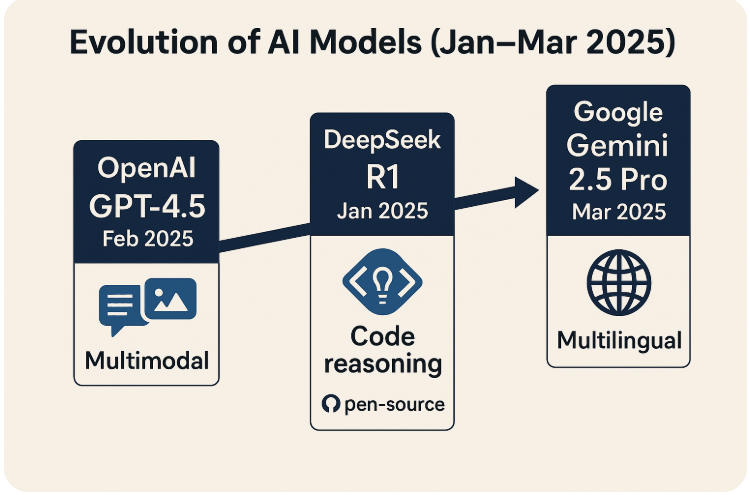
Figure: Timeline of major AI model releases in Q1 2025 – OpenAI’s GPT-4.5 (Feb 2025), DeepSeek’s R1 (Jan 2025), and Google’s Gemini 2.5 Pro (Mar 2025). Each model introduced key advancements: multimodal inputs (text+images), code reasoning, multilingual abilities, and in the case of DeepSeek R1, open-source accessibility. The timeline illustrates the progression from earlier models (left) to these new releases (right), highlighting the improved capabilities and broader access.
OpenAI GPT-4.5 (Feb 2025)
OpenAI’s GPT-4.5, released as a research preview in late February 2025, is an improved version of GPT-4 focused on enhanced performance and flexibility reuters.com reuters.com. Notable features of GPT-4.5 include:
- Multimodal input: GPT-4.5 supports both text and image inputs (e.g. file and image uploads) for more versatile interactionsreuters.com. This builds on GPT-4’s vision capabilities and allows users to provide images alongside text prompts.
- Strong code reasoning: It can handle complex writing and coding tasks, useful for code generation and debugging assistancereuters.com. Developers found GPT-4.5 effective on programming challenges, reflecting improved logical reasoning in code.
- Creative and fluent outputs: The model shows an improved ability to recognize patterns and generate creative insights, with greater emotional intelligence in its responsesreuters.com. It produces more contextually coherent and nuanced replies.
- Reliability improvements: OpenAI reduced GPT-4.5’s tendency to hallucinate (fabricate incorrect facts). Its hallucination rate was measured at ~37%, significantly lower than GPT-4’s ~61.8%reuters.com, indicating a more grounded model.
GPT-4.5 remained a proprietary model (accessible via OpenAI’s API and ChatGPT Pro), not open-sourced. It was initially rolled out to ChatGPT Plus users and developers, with capacity limited by GPU availability reuters.com. Overall, GPT-4.5 represented an evolutionary step from GPT-4, expanding multimodality and reliability in a large language model.
DeepSeek R1 (Jan 2025)
DeepSeek R1, released in January 2025, marked a major milestone as an open-source advanced reasoning model api-docs.deepseek.com. Developed by the Chinese startup DeepSeek, R1 was noteworthy for offering high-end capabilities comparable to Western proprietary models, but under an open MIT license api-docs.deepseek.com. Key characteristics of DeepSeek R1 include:
- Reasoning-centric design: R1 specializes in logical inference, step-by-step problem solving, and mathematical reasoningfireworks.ai. Its architecture uses large-scale reinforcement learning in post-training to self-improve its reasoning strategiesapi-docs.deepseek.com. Independent benchmarks showed R1 performing on par with top models in math, code, and reasoning tasksapi-docs.deepseek.com.
- Code generation and problem-solving: Like GPT-4.5, DeepSeek R1 is adept at coding challenges and complex problem breakdowns. It can generate sophisticated code and tackle advanced scientific questions using chain-of-thought reasoningfireworks.ai.
- Open-source accessibility: Unlike the closed models from OpenAI and Google, R1’s weights and code were released under an MIT License, encouraging community use and adaptationapi-docs.deepseek.comapi-docs.deepseek.com. This open-source model democratized access to cutting-edge AI, allowing researchers and developers globally to fine-tune and deploy it without restriction.
- Multilingual potential: R1 was primarily optimized for English reasoning tasks at launch. DeepSeek signaled plans for the next model (R2) to extend reasoning to languages beyond Englishreuters.com, highlighting the push for multilingual fluency. Even so, R1’s open design meant the community could train or translate it for other languages over time.
DeepSeek R1’s release was significant in that it challenged the major players by providing an advanced, cost-effective AI model openly reuters.com reuters.com. Its emergence spurred competition and innovation, and was quickly embraced by developers – even becoming available on platforms like Amazon’s Bedrock for integration aws.amazon.com. R1 underscored a trend toward openness and collaboration in AI evolution.
Google Gemini 2.5 Pro (Mar 2025)
Google’s Gemini 2.5 Pro, introduced in late March 2025, is a state-of-the-art AI model that pushed the frontier in both capability and scale blog.google. Part of Google DeepMind’s Gemini series, 2.5 Pro is described as a “thinking” model with advanced reasoning built-in blog.google blog.google. Its notable features include:
- Native multimodality: Gemini 2.5 Pro can process multiple types of input – not just text, but also images, and even audio or video in this generationmedium.com. This multimodal ability, combined with an enormous context window of up to 1 million tokens, allows it to handle very large documents or long conversations and diverse data formatsblog.googlemedium.com.
- Chain-of-thought reasoning: The model “reasons through its thoughts before responding,” meaning it can internally generate and evaluate step-by-step solutionsblog.google. This yields highly accurate and context-aware answers on complex tasks. It achieved top-tier performance on challenging benchmarks (e.g. leading in math and science tasks like GPQA and AIME 2025) without needing extra techniques like majority votingblog.googlemedium.com.
- Strong coding capabilities: Gemini 2.5 Pro excels at code-related tasks. Google reported it set a high score (63.8%) on the SWE-Bench coding challenge, indicating proficiency in generating correct, functional codemedium.com. Demonstrations showed it creating interactive simulations and web apps from simple prompts, showcasing its ability to integrate reasoning with codingdeepmind.googledeepmind.google.
- High-quality language fluency: As a flagship Google model, Gemini is trained on a broad multilingual corpus. It can converse or answer questions in multiple languages (a core strength of its predecessor Gemini 2.0 as well), making it multilingually fluent for global users. (For example, earlier Gemini versions were noted for strong performance on diverse language taskslunabot.ai.)
- Proprietary deployment: While extremely powerful, Gemini 2.5 Pro remains a closed model available through Google’s services (Google AI Studio, Gemini app, Vertex AI) rather than open-sourceblog.google. Google provides API access for developers to use Gemini, but the model weights are not publicly released.
Gemini 2.5 Pro debuted at the top of human preference leaderboards like LMArena, outperforming other leading models including OpenAI’s latest blog.google. Its introduction signified a leap in AI capabilities – combining multimodal understanding, advanced reasoning, and coding skill in one system. This model exemplifies the rapid progression in early 2025, as companies raced to build more general and powerful AI.
Key Trends in Early 2025
In the first quarter of 2025, AI model development accelerated with a few clear trends:
- Multimodal and Beyond: Both OpenAI and Google released models (GPT-4.5 and Gemini 2.5) that handle more than just text – integrating images (and in Gemini’s case audio/video) into their understanding. This reflects a move toward truly general AI that can take in the same modalities humans do.
- Reasoning and Coding Improvements: All three major models placed emphasis on reasoning abilities and coding. Gemini’s chain-of-thought and GPT-4.5’s pattern recognition improvements led to better problem-solving performancereuters.comblog.google. DeepSeek R1 similarly focused on logical inference and even allowed the AI community to inspect and build on these reasoning techniquesfireworks.ai. Coding capability became a standard benchmark – from GPT-4.5’s coding projects to R1’s code benchmarks and Gemini’s software generation, showing that writing code is now a core competency of cutting-edge modelsfireworks.aimedium.com.
- Accessibility and Ecosystem: A major development was the contrast in accessibility. DeepSeek R1’s open-source release api-docs.deepseek.com broadened AI access and spurred open innovation, while OpenAI and Google continued with large proprietary models offered via cloud APIs. This dual approach – open models (fostering community-driven progress) versus closed models (integrated into tech giants’ platforms) – defined the AI landscape in 2025.
- Performance Leap: Each model raised the bar in some way. GPT-4.5 improved reliability (fewer hallucinations) and maintained strong multilingual fluency and creativityreuters.com. R1 demonstrated that top-tier performance is achievable even with smaller compute budgets by clever training (it shocked the industry by matching more expensive models)reuters.comreuters.com. Gemini 2.5 Pro set new state-of-the-art levels on many benchmarks, indicating the rapid pace of advancementblog.googlemedium.com. The timeline from January to March 2025 thus shows a significant evolution from already powerful 2024 models to even more capable and feature-rich 2025 models.
Overall, the period of January–March 2025 was transformative in the AI field. The releases of GPT-4.5, DeepSeek R1, and Gemini 2.5 Pro illustrate how AI models were becoming more versatile (handling images and code), more intelligent in reasoning, and more widely available – either through open source or broad cloud deployment. This evolution set the stage for further breakthroughs, with each model learning from the successes and shortcomings of its predecessors, propelling AI toward greater heights.
Sources: The information and statistics above are sourced from official announcements and reports on each model. OpenAI’s statements on GPT-4.5’s features and performance were reported by Reuters reuters.com reuters.com. Details on DeepSeek R1 come from DeepSeek’s release notes and coverage in Reuters, highlighting its open-source license and technical capabilities api-docs.deepseek.com fireworks.ai. Google’s Gemini 2.5 Pro features and benchmark results are drawn from Google’s blog and a Q1 2025 AI recap, which describe its multimodal input, 1M-token context, and top-tier reasoning/coding performance medium.com blog.google. These models collectively demonstrate the rapid progression of AI at the start of 2025.

Sources
 tada@aicritique.org