
LucidSim: Transforming Robotics Training with AI and Simulation

November 13 2024

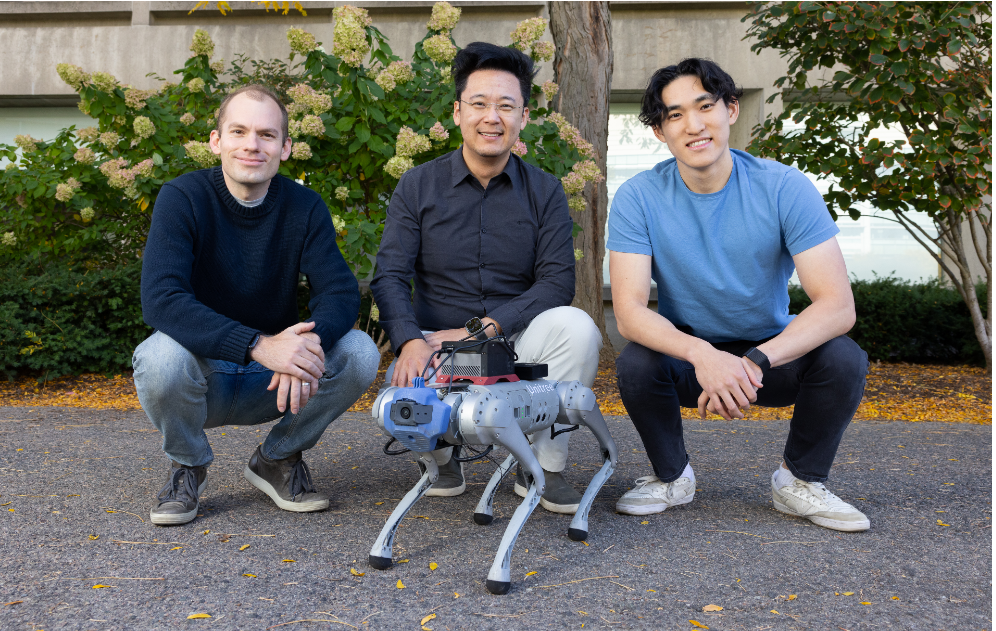
MIT CSAIL researchers have introduced LucidSim, a revolutionary system that uses generative AI and physics simulation to train robots in diverse and realistic virtual environments without relying on real-world data. LucidSim bridges the “sim-to-real gap” by generating structured descriptions of environments with large language models, converting them into images using generative models, and ensuring physical accuracy via simulation. It addresses key challenges in robotics, including skill transfer and data diversity.

Inspired by a casual discussion in Cambridge, LucidSim employs innovative techniques like Dreams In Motion (DIM) to create dynamic, realistic training videos. By synthesizing diverse prompts through ChatGPT and combining depth maps and semantic masks, the system produces data that is both realistic and varied. Robots trained with LucidSim outperformed traditional methods, achieving an 88% success rate, compared to 15% using expert demonstration data.

LucidSim’s potential extends beyond tasks like quadruped locomotion to areas such as mobile manipulation. The system offers scalability by eliminating the need for real-world scene setups, paving the way for intelligent machines to learn complex skills virtually. Researchers will present their findings at the Conference on Robot Learning, highlighting the promise of this groundbreaking framework to accelerate real-world robotic deployment.

https://www.csail.mit.edu/news/can-robots-learn-machine-dreams
  • Related Posts

    Akita University and Take Robo have developed three medical AI systems

    Akita University and Take Robo have developed three medical AI systems aimed at enhancing rehabilitation for patients with motor impairments. These systems include: These AI-driven systems are designed to alleviate the burden on therapists by providing consistent and tailored rehabilitation…

    Leave a Reply

    Your email address will not be published. Required fields are marked *

    You Missed

    Data Science and Buddhism: The Ugly Duckling Theorem and the Middle Way

    Data Science and Buddhism: The Ugly Duckling Theorem and the Middle Way

    Google’s Gemini 3: Launch and Early Reception

    Google’s Gemini 3: Launch and Early Reception

    AI Governance in Corporate AI Utilization: Frameworks and Best Practices

    AI Governance in Corporate AI Utilization: Frameworks and Best Practices

    AI Mentor and the Problem of Free Will

    AI Mentor and the Problem of Free Will

    The AI Bubble Collapse Is Not the The End — It Is the Beginning of Selection

    The AI Bubble Collapse Is Not the The End — It Is the Beginning of Selection

    Notable AI News Roundup: ChatGPT Atlas, Company Knowledge, Claude Code Web, Pet Cameo, Copilot 12 Features, NTT Tsuzumi 2 and 22 More Developments

    Notable AI News Roundup: ChatGPT Atlas, Company Knowledge, Claude Code Web, Pet Cameo, Copilot 12 Features, NTT Tsuzumi 2 and 22 More Developments

    KJ Method Resurfaces in AI Workslop Problem

    KJ Method Resurfaces in AI Workslop Problem

    AI Work Slop and the Productivity Paradox in Business

    AI Work Slop and the Productivity Paradox in Business

    OpenAI’s “Sora 2” and its impact on Japanese anime and video game copyrights

    OpenAI’s “Sora 2” and its impact on Japanese anime and video game copyrights

    Claude Sonnet 4.5: Technical Evolution and Practical Applications of Next-Generation AI

    Claude Sonnet 4.5: Technical Evolution and Practical Applications of Next-Generation AI

    Global AI Development Summary — September 2025

    Global AI Development Summary — September 2025

    Comparison : GPT-5-Codex V.S. Claude Code

    Comparison : GPT-5-Codex V.S. Claude Code

    【HRM】How a Tiny Hierarchical Reasoning Model Outperformed GPT-Scale Systems: A Clear Explanation of the Hierarchical Reasoning Model

    【HRM】How a Tiny Hierarchical Reasoning Model Outperformed GPT-Scale Systems: A Clear Explanation of the Hierarchical Reasoning Model

    GPT‑5‑Codex: OpenAI’s Agentic Coding Model

    GPT‑5‑Codex: OpenAI’s Agentic Coding Model

    AI Adoption Slowdown: Data Analysis and Implications

    AI Adoption Slowdown: Data Analysis and Implications

    Grokking in Large Language Models: Concepts, Models, and Applications

    Grokking in Large Language Models: Concepts, Models, and Applications

    AI Development — August 2025

    AI Development — August 2025

    Agent-Based Personal AI on Edge Devices (2025)

    Agent-Based Personal AI on Edge Devices (2025)

    Ambient AI and Ambient Intelligence: Current Trends and Future Outlook

    Ambient AI and Ambient Intelligence: Current Trends and Future Outlook

    Comparison of Auto-Coding Tools and Integration Patterns

    Comparison of Auto-Coding Tools and Integration Patterns

    Comparing the Coding Capabilities of OpenAI Codex vs GPT-5

    Comparing the Coding Capabilities of OpenAI Codex vs GPT-5

    Comprehensive Report: GPT-5 – Features, Announcements, Reviews, Reactions, and Impact

    Comprehensive Report: GPT-5 – Features, Announcements, Reviews, Reactions, and Impact

    July 2025 – AI Development Highlights

    July 2025 – AI Development Highlights

    ConceptMiner -Creativity Support System, Integrating qualitative and quantitative data to create a foundation for collaboration between humans and AI

    ConceptMiner -Creativity Support System, Integrating qualitative and quantitative data to create a foundation for collaboration between humans and AI

    ChatGPT Agent (Agent Mode) – Capabilities, Performance, and Security

    ChatGPT Agent (Agent Mode) – Capabilities, Performance, and Security