
Why Conceptual Investigation?

Kunihiro Tada / Mindware Research Institute

A Methodology for Thinking in the Age of Innovation

We are living in the midst of a profound wave of innovation.
Technological advances—especially in AI—are transforming not only industries, but the very structure of reality in which businesses and societies operate.

Innovation is not merely incremental improvement; it is a transformation of reality itself.
As a result, the “facts” observed before and after an innovation are fundamentally different.

This leads to a critical implication:

No matter how accurately we observe pre-innovation facts,
they do not allow us to know post-innovation reality.

In this sense, the future cannot be predicted.
At least, it cannot be derived deterministically from past data or existing facts.

However, this does not mean we are powerless.
We can imagine desirable futures and act toward realizing them.

Thinking is not merely an internal process;
it has the potential to shape reality.
What we think can become real.

Yet when multiple, competing visions of the future exist,
it is not obvious which one will materialize.
In general, the outcome depends on which vision is “more natural” or more aligned with underlying conditions.

However, determining this “naturalness” is far from trivial.
Human decision-making is inherently constrained.

We cannot evaluate all possible conditions with perfect rationality.
Instead, we operate under bounded rationality
a limitation that is also fundamental to machine learning itself.

Under such constraints, how do innovation winners emerge?

Historically, successful innovators are those who happened to envision a “correct” future.
Yet it remains unclear whether their reasoning process was inherently superior,
or whether they possessed unique abilities unavailable to others.

In practice, we can only say that their vision was validated by outcomes.

This suggests a shift in perspective.

The future is not represented by a single line of reasoning.
Rather, there may be hundreds, thousands, or even tens of thousands of possible ways of thinking about it.

Not all of these possibilities will materialize,
but it is reasonable to assume that some of them are realizable.

Therefore, the problem can be reframed as follows:

The question is not which idea is correct,
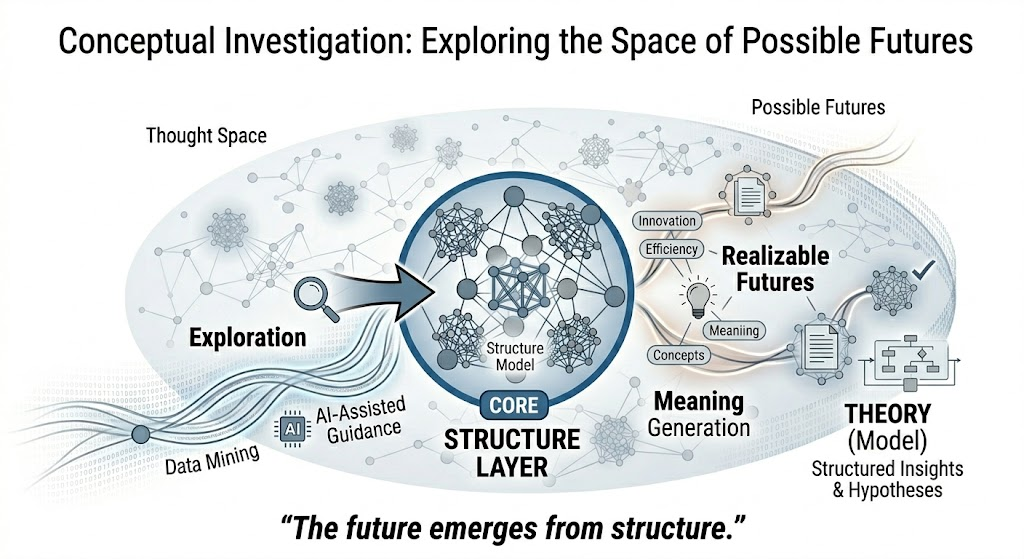
but whether we can explore the space of possible ideas itself.

If we could systematically explore this space of thought,
we might be able to identify “better” ideas—
those with higher potential for realization.

This is precisely what Conceptual Investigation aims to achieve.

Conceptual Investigation does not analyze isolated facts.
Instead, it explores the space formed by concepts and ideas,
and derives meaning and theory from its structure.

Exceptional individuals such as Steve Jobs may have performed such exploration intuitively.
However, for most of us, navigating a vast, high-dimensional space of thought within our own minds is extremely difficult.

Therefore, external tools are required.

Specifically:

A combination of large language models (LLMs) for processing text,
and data mining techniques for extracting structure.

Conceptual Investigation is built upon this technological foundation.
It extends human cognitive capabilities and enables the exploration of thought spaces that were previously inaccessible.

In doing so, it provides a new framework for decision-making in the age of innovation.
  • tada@aicritique.org
    He has been a watcher of the industrial boom from the early 1980s to the present day. 1982, planner of high-tech seminars at the Japan Technology and Economy Centre, and of seminars and research projects at JMA Consulting; in 1986 he organised AI chip seminars on fuzzy inference and other topics, triggering the fuzzy boom; after freelance writing on CG and multimedia, he founded the Mindware Research Institute, selling the Japanese version of Viscovery SOMine since 2000, and Hugin and XLSTAT since 2003 in Japan. The AI portal site, www.aicritique.org was started in 2024 after losing the rights to XLSTAT due to a hostile takeover in 2023.

    Related Posts

    Current Research Trends in Latent Space

    Executive Summary As of April 2026, “latent space” is no longer a single technical object. Recent surveys now treat it as a broad research landscape rather than a single definition, and the fact that ICLR 2026 hosts a dedicated workshop…

    AI Patents from Google Patents Search

    ch, and a conceptual structure network model was constructed. By reviewing similar patents clusters, trends in related topics can be identified. Cluster 0: Virtual Assistant Functionality Overview The Virtual Assistant Functionality cluster encompasses various methods, systems, and computer program products…

    You Missed

    AI News Briefing for April 13–20, 2026

    AI News Briefing for April 13–20, 2026

    Current Research Trends in Latent Space

    Current Research Trends in Latent Space

    AI Patents from Google Patents Search

    AI Patents from Google Patents Search

    AI Articles from IEEE Xplore

    AI Articles from IEEE Xplore

    AI articles from OpenAlex

    AI articles from OpenAlex
    AI News from NewsAPI
    AI News from Google News

    Idea of New AI services

    Idea of New AI services

    Problem to use AI services

    Problem to use AI services

    AI Services Market Structure 2026

    AI Services Market Structure 2026

    Why Conceptual Investigation?

    Why Conceptual Investigation?

    AI Development in March 2026

    AI Development in March 2026

    GPT-5.4 and the March 2026 ChatGPT Upgrade Cycle: Official Release, Media Narratives, and Real-World Reactions

    GPT-5.4 and the March 2026 ChatGPT Upgrade Cycle: Official Release, Media Narratives, and Real-World Reactions

    AI Agent Startups Trends 2023–2026

    AI Agent Startups Trends 2023–2026

    The Rise of Generative UI Frameworks in 2025–26

    The Rise of Generative UI Frameworks in 2025–26

    Will OpenAI Prism accelerate scientific research?

    Will OpenAI Prism accelerate scientific research?

    Considering AI and Communism

    Considering AI and Communism

    Order in the Age of AI

    Order in the Age of AI

    Where Should AI Memory Live?

    Where Should AI Memory Live?

    2026 Will Be the First Year of Enterprise AI

    2026 Will Be the First Year of Enterprise AI

    Does the Age of Local LLMs Democratize AI?

    Does the Age of Local LLMs Democratize AI?

    Data Science and Buddhism: The Ugly Duckling Theorem and the Middle Way

    Data Science and Buddhism: The Ugly Duckling Theorem and the Middle Way

    Google’s Gemini 3: Launch and Early Reception

    Google’s Gemini 3: Launch and Early Reception

    AI Governance in Corporate AI Utilization: Frameworks and Best Practices

    AI Governance in Corporate AI Utilization: Frameworks and Best Practices

    AI Mentor and the Problem of Free Will

    AI Mentor and the Problem of Free Will