
Establishment of AI Safety Institutes

In response to the rapid development of AI technologies, several countries, including Japan, have established AI Safety Institutes. These institutes aim to evaluate and ensure the safety of advanced AI models, fostering international cooperation in AI safety standards.

In recent years, the establishment of AI Safety Institutes (AISIs) has become a pivotal strategy for nations aiming to ensure the safe and ethical development of artificial intelligence technologies. These institutes are dedicated to evaluating and mitigating the risks associated with advanced AI systems, fostering international collaboration, and setting safety standards.

Key Developments:

  1. United Kingdom:
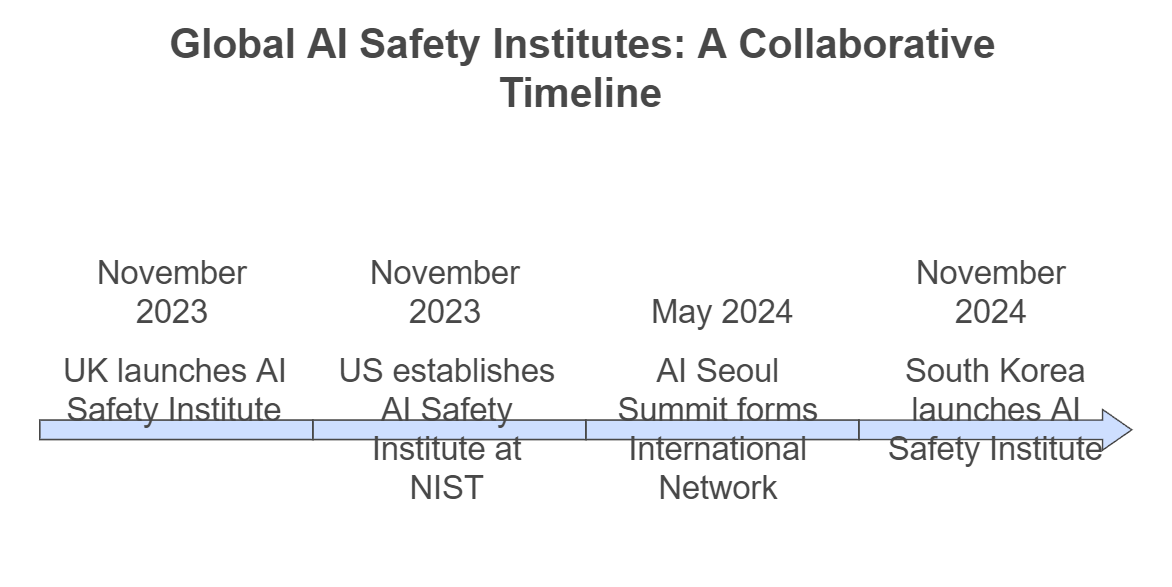
    • In November 2023, the UK launched its AI Safety Institute, evolving from the Frontier AI Taskforce. This institute focuses on independent safety evaluations of AI models, emphasizing that AI companies should not “mark their own homework.” The UK aims to position itself as a leader in global AI safety regulation.
  2. United States:
    • Following the UK’s initiative, the U.S. established its AI Safety Institute within the National Institute of Standards and Technology (NIST) in November 2023. This institute advances the science and practice of AI safety across various risks, including those to national security and individual rights. NIST
  3. International Collaboration:
    • In May 2024, during the AI Seoul Summit, global leaders agreed to form an International Network of AI Safety Institutes. This network includes institutes from the UK, US, Japan, France, Germany, Italy, Singapore, South Korea, Australia, Canada, and the European Union, aiming to strengthen global cooperation for safe AI. GOV.UK
  4. South Korea:
    • In November 2024, South Korea launched its AI Safety Institute (AISI) within the Electronics and Telecommunications Research Institute (ETRI). The AISI serves as a hub for AI safety research, fostering collaboration among industry, academia, and research institutes. It also participates actively in the International Network of AI Safety Institutes. EurekaAlert!

Functions and Objectives:

  • Risk Assessment: AISIs systematically evaluate potential risks posed by advanced AI models, including technological limitations, human misuse, and loss of control over AI systems.
  • Policy Development: These institutes contribute to the formulation and refinement of AI safety policies, ensuring alignment with international norms and scientific research data.
  • International Cooperation: By participating in global networks, AISIs facilitate the sharing of best practices, research findings, and safety standards to promote the responsible development of AI technologies worldwide.

Implications:

  • Standardization of Safety Protocols: The establishment of AISIs contributes to the development of standardized safety protocols, ensuring consistent evaluation and mitigation of AI-related risks across different jurisdictions.
  • Enhanced Public Trust: By proactively addressing AI safety concerns, these institutes help build public trust in AI technologies, which is crucial for their widespread adoption and integration into society.
  • Promotion of Responsible Innovation: AISIs play a critical role in balancing innovation with safety, ensuring that the development of AI technologies does not compromise ethical standards or public welfare.

In summary, the creation of AI Safety Institutes represents a significant global effort to address the challenges and risks associated with the rapid advancement of AI technologies. Through national initiatives and international collaboration, these institutes aim to ensure that AI development proceeds in a manner that is safe, ethical, and beneficial to all.

  • Related Posts

    OpenAI’s “Sora 2” and its impact on Japanese anime and video game copyrights

    The Emergence of Sora 2 On October 1, 2025, OpenAI announced the video generation model “Sora 2” and a social app for iOS that uses the same model. forest.watch This app allows users to generate videos with realistic textures and…

    While the West Hesitates, China Advances: The AI Race Explained

    As we witness the rapid advancements in artificial intelligence (AI) within China, it’s crucial to understand the stark contrast between China’s proactive approach and the West’s ongoing deliberations. This blog delves into the implications of this technological race and highlights…

    Leave a Reply

    Your email address will not be published. Required fields are marked *

    You Missed

    Data Science and Buddhism: The Ugly Duckling Theorem and the Middle Way

    Data Science and Buddhism: The Ugly Duckling Theorem and the Middle Way

    Google’s Gemini 3: Launch and Early Reception

    Google’s Gemini 3: Launch and Early Reception

    AI Governance in Corporate AI Utilization: Frameworks and Best Practices

    AI Governance in Corporate AI Utilization: Frameworks and Best Practices

    AI Mentor and the Problem of Free Will

    AI Mentor and the Problem of Free Will

    The AI Bubble Collapse Is Not the The End — It Is the Beginning of Selection

    The AI Bubble Collapse Is Not the The End — It Is the Beginning of Selection

    Notable AI News Roundup: ChatGPT Atlas, Company Knowledge, Claude Code Web, Pet Cameo, Copilot 12 Features, NTT Tsuzumi 2 and 22 More Developments

    Notable AI News Roundup: ChatGPT Atlas, Company Knowledge, Claude Code Web, Pet Cameo, Copilot 12 Features, NTT Tsuzumi 2 and 22 More Developments

    KJ Method Resurfaces in AI Workslop Problem

    KJ Method Resurfaces in AI Workslop Problem

    AI Work Slop and the Productivity Paradox in Business

    AI Work Slop and the Productivity Paradox in Business

    OpenAI’s “Sora 2” and its impact on Japanese anime and video game copyrights

    OpenAI’s “Sora 2” and its impact on Japanese anime and video game copyrights

    Claude Sonnet 4.5: Technical Evolution and Practical Applications of Next-Generation AI

    Claude Sonnet 4.5: Technical Evolution and Practical Applications of Next-Generation AI

    Global AI Development Summary — September 2025

    Global AI Development Summary — September 2025

    Comparison : GPT-5-Codex V.S. Claude Code

    Comparison : GPT-5-Codex V.S. Claude Code

    【HRM】How a Tiny Hierarchical Reasoning Model Outperformed GPT-Scale Systems: A Clear Explanation of the Hierarchical Reasoning Model

    【HRM】How a Tiny Hierarchical Reasoning Model Outperformed GPT-Scale Systems: A Clear Explanation of the Hierarchical Reasoning Model

    GPT‑5‑Codex: OpenAI’s Agentic Coding Model

    GPT‑5‑Codex: OpenAI’s Agentic Coding Model

    AI Adoption Slowdown: Data Analysis and Implications

    AI Adoption Slowdown: Data Analysis and Implications

    Grokking in Large Language Models: Concepts, Models, and Applications

    Grokking in Large Language Models: Concepts, Models, and Applications

    AI Development — August 2025

    AI Development — August 2025

    Agent-Based Personal AI on Edge Devices (2025)

    Agent-Based Personal AI on Edge Devices (2025)

    Ambient AI and Ambient Intelligence: Current Trends and Future Outlook

    Ambient AI and Ambient Intelligence: Current Trends and Future Outlook

    Comparison of Auto-Coding Tools and Integration Patterns

    Comparison of Auto-Coding Tools and Integration Patterns

    Comparing the Coding Capabilities of OpenAI Codex vs GPT-5

    Comparing the Coding Capabilities of OpenAI Codex vs GPT-5

    Comprehensive Report: GPT-5 – Features, Announcements, Reviews, Reactions, and Impact

    Comprehensive Report: GPT-5 – Features, Announcements, Reviews, Reactions, and Impact

    July 2025 – AI Development Highlights

    July 2025 – AI Development Highlights

    ConceptMiner -Creativity Support System, Integrating qualitative and quantitative data to create a foundation for collaboration between humans and AI

    ConceptMiner -Creativity Support System, Integrating qualitative and quantitative data to create a foundation for collaboration between humans and AI

    ChatGPT Agent (Agent Mode) – Capabilities, Performance, and Security

    ChatGPT Agent (Agent Mode) – Capabilities, Performance, and Security