
EU’s Artificial Intelligence Act Enters into Force

The European Union’s Artificial Intelligence Act officially came into effect, establishing comprehensive regulations for AI systems across member states. The Act aims to ensure transparency, safety, and ethical standards in AI development and deployment.

The European Union’s Artificial Intelligence Act (AI Act), which entered into force on August 1, 2024, represents the world’s first comprehensive legal framework for artificial intelligence. This legislation aims to promote the development and adoption of safe and trustworthy AI systems across the EU, addressing potential risks to citizens’ health, safety, and fundamental rights.

European Commission

Key Features of the AI Act:

  1. Risk-Based Classification:
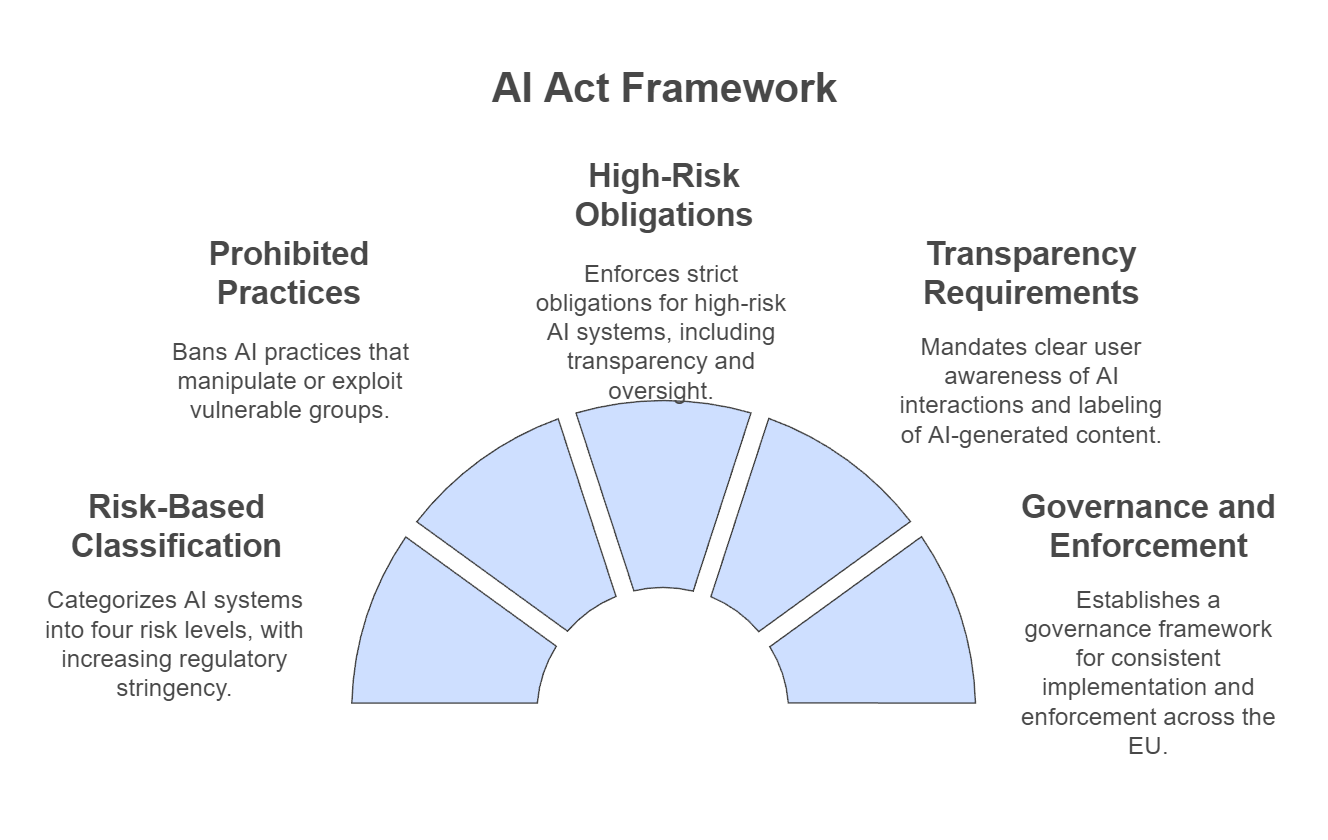
    • The AI Act employs a risk-based approach, categorizing AI systems into four levels: minimal, limited, high, and unacceptable risk. The stringency of regulatory requirements increases with the potential risk associated with the AI system. Artificial Intelligence Act
  2. Prohibited AI Practices:
    • Certain AI practices are outright banned under the AI Act, including:
      • AI systems that deploy subliminal, manipulative, or deceptive techniques to distort behavior and impair informed decision-making, causing significant harm.
      • Exploitation of vulnerabilities related to age, disability, or socio-economic circumstances to distort behavior, causing significant harm. Artificial Intelligence Act
  3. High-Risk AI Systems:
    • AI systems classified as high-risk are subject to strict obligations, such as:
      • Rigorous risk assessments and mitigation measures.
      • High standards of transparency, including clear information about the system’s capabilities and limitations.
      • Ensuring human oversight to prevent or minimize risks. Artificial Intelligence Act
  4. Transparency Requirements:
    • AI systems with specific transparency risks, such as chatbots, must clearly inform users that they are interacting with a machine. Additionally, certain AI-generated content must be labeled as such to ensure transparency. European Commission
  5. Governance and Enforcement:
    • The AI Act establishes a robust governance framework, including:
      • The creation of the European Artificial Intelligence Board to facilitate consistent implementation across the EU.
      • Designation of national supervisory authorities responsible for enforcing the regulations within their respective member states. ArXiv

Implications for Businesses and AI Developers:

  • Compliance Obligations: Organizations operating within the EU or providing AI systems to the EU market must ensure their AI technologies comply with the AI Act’s requirements, particularly if their systems are classified as high-risk.
  • Innovation and Competitiveness: While the AI Act aims to foster innovation by providing clear guidelines, businesses must balance compliance with maintaining competitiveness, especially in rapidly evolving AI sectors.
  • Global Influence: The AI Act is expected to set a global standard for AI regulation, influencing international norms and potentially impacting non-EU companies that offer AI products and services within the EU.

In summary, the EU’s AI Act establishes a pioneering regulatory framework designed to ensure the ethical and safe deployment of AI technologies, balancing innovation with the protection of fundamental rights and societal values.

  • Related Posts

    OpenAI’s “Sora 2” and its impact on Japanese anime and video game copyrights

    The Emergence of Sora 2 On October 1, 2025, OpenAI announced the video generation model “Sora 2” and a social app for iOS that uses the same model. forest.watch This app allows users to generate videos with realistic textures and…

    While the West Hesitates, China Advances: The AI Race Explained

    As we witness the rapid advancements in artificial intelligence (AI) within China, it’s crucial to understand the stark contrast between China’s proactive approach and the West’s ongoing deliberations. This blog delves into the implications of this technological race and highlights…

    Leave a Reply

    Your email address will not be published. Required fields are marked *

    You Missed

    Data Science and Buddhism: The Ugly Duckling Theorem and the Middle Way

    Data Science and Buddhism: The Ugly Duckling Theorem and the Middle Way

    Google’s Gemini 3: Launch and Early Reception

    Google’s Gemini 3: Launch and Early Reception

    AI Governance in Corporate AI Utilization: Frameworks and Best Practices

    AI Governance in Corporate AI Utilization: Frameworks and Best Practices

    AI Mentor and the Problem of Free Will

    AI Mentor and the Problem of Free Will

    The AI Bubble Collapse Is Not the The End — It Is the Beginning of Selection

    The AI Bubble Collapse Is Not the The End — It Is the Beginning of Selection

    Notable AI News Roundup: ChatGPT Atlas, Company Knowledge, Claude Code Web, Pet Cameo, Copilot 12 Features, NTT Tsuzumi 2 and 22 More Developments

    Notable AI News Roundup: ChatGPT Atlas, Company Knowledge, Claude Code Web, Pet Cameo, Copilot 12 Features, NTT Tsuzumi 2 and 22 More Developments

    KJ Method Resurfaces in AI Workslop Problem

    KJ Method Resurfaces in AI Workslop Problem

    AI Work Slop and the Productivity Paradox in Business

    AI Work Slop and the Productivity Paradox in Business

    OpenAI’s “Sora 2” and its impact on Japanese anime and video game copyrights

    OpenAI’s “Sora 2” and its impact on Japanese anime and video game copyrights

    Claude Sonnet 4.5: Technical Evolution and Practical Applications of Next-Generation AI

    Claude Sonnet 4.5: Technical Evolution and Practical Applications of Next-Generation AI

    Global AI Development Summary — September 2025

    Global AI Development Summary — September 2025

    Comparison : GPT-5-Codex V.S. Claude Code

    Comparison : GPT-5-Codex V.S. Claude Code

    【HRM】How a Tiny Hierarchical Reasoning Model Outperformed GPT-Scale Systems: A Clear Explanation of the Hierarchical Reasoning Model

    【HRM】How a Tiny Hierarchical Reasoning Model Outperformed GPT-Scale Systems: A Clear Explanation of the Hierarchical Reasoning Model

    GPT‑5‑Codex: OpenAI’s Agentic Coding Model

    GPT‑5‑Codex: OpenAI’s Agentic Coding Model

    AI Adoption Slowdown: Data Analysis and Implications

    AI Adoption Slowdown: Data Analysis and Implications

    Grokking in Large Language Models: Concepts, Models, and Applications

    Grokking in Large Language Models: Concepts, Models, and Applications

    AI Development — August 2025

    AI Development — August 2025

    Agent-Based Personal AI on Edge Devices (2025)

    Agent-Based Personal AI on Edge Devices (2025)

    Ambient AI and Ambient Intelligence: Current Trends and Future Outlook

    Ambient AI and Ambient Intelligence: Current Trends and Future Outlook

    Comparison of Auto-Coding Tools and Integration Patterns

    Comparison of Auto-Coding Tools and Integration Patterns

    Comparing the Coding Capabilities of OpenAI Codex vs GPT-5

    Comparing the Coding Capabilities of OpenAI Codex vs GPT-5

    Comprehensive Report: GPT-5 – Features, Announcements, Reviews, Reactions, and Impact

    Comprehensive Report: GPT-5 – Features, Announcements, Reviews, Reactions, and Impact

    July 2025 – AI Development Highlights

    July 2025 – AI Development Highlights

    ConceptMiner -Creativity Support System, Integrating qualitative and quantitative data to create a foundation for collaboration between humans and AI

    ConceptMiner -Creativity Support System, Integrating qualitative and quantitative data to create a foundation for collaboration between humans and AI

    ChatGPT Agent (Agent Mode) – Capabilities, Performance, and Security

    ChatGPT Agent (Agent Mode) – Capabilities, Performance, and Security