
The AI Assessment Scale (AIAS) in Action: A Pilot Implementation of GenAI Supported Assessment

by Leon Furze, Mike Perkins, Jasper Roe, and Jason MacVaugh

Summary: This study explores the implementation of the AI Assessment Scale (AIAS), a framework for incorporating Generative AI into educational assessments. The pilot study indicates a significant reduction in academic misconduct related to AI, an increase in student attainment, and higher module passing rates.

Importance: The AIAS facilitates the effective integration of Generative AI in higher education, promoting academic integrity while leveraging technology to enhance learning experiences.

The study addresses concerns related to academic integrity and explores the potential benefits of GenAI technologies in educational settings.

Key Components of the AI Assessment Scale (AIAS):

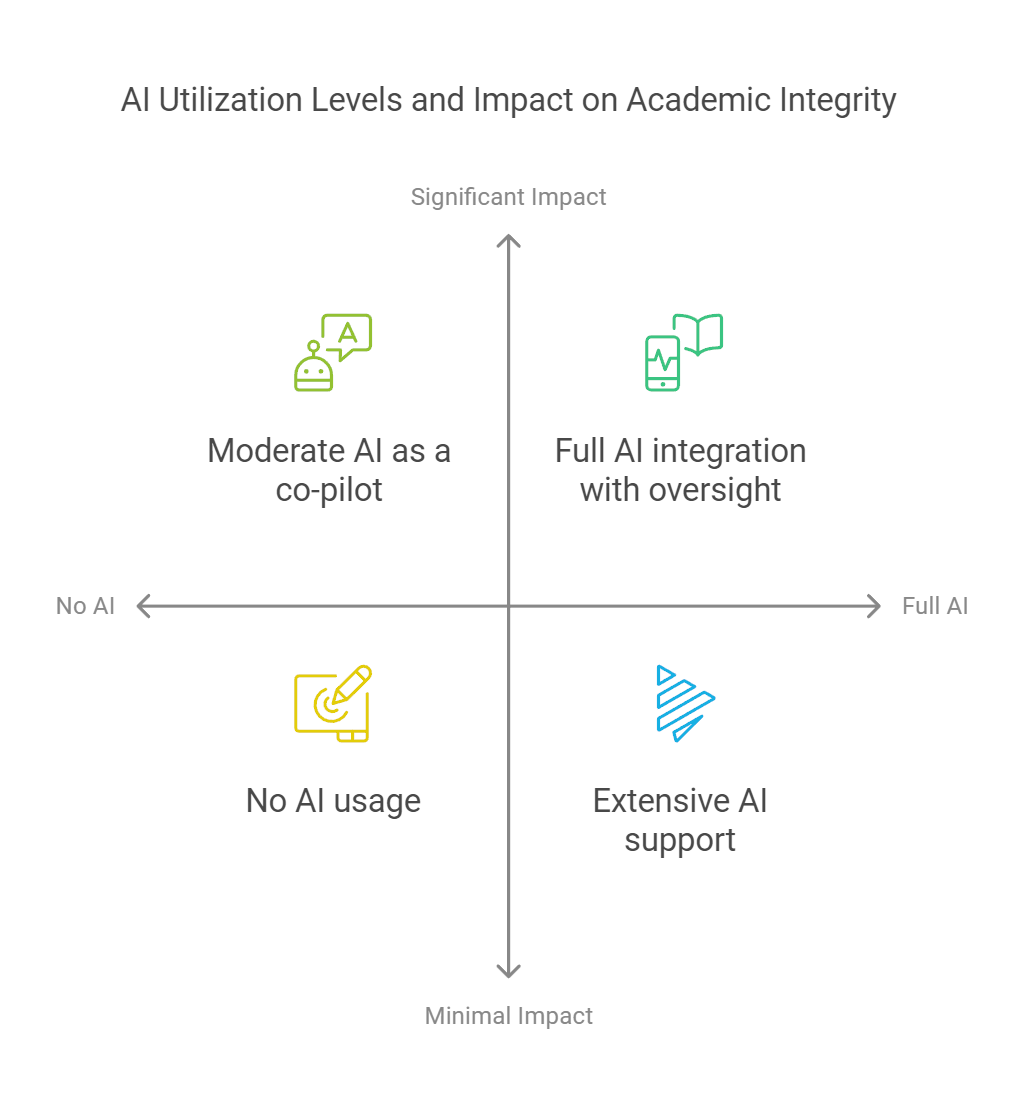
The AIAS is a flexible framework comprising five levels, each defining the extent of AI utilization in assessments:

  1. No AI: Completion of assessments without any AI assistance.
  2. Minimal AI: Limited use of AI for specific tasks, with AI-generated content requiring citation.
  3. Moderate AI: AI serves as a “co-pilot,” collaborating with students to enhance creativity.
  4. Extensive AI: AI is used throughout the assessment to support the student’s work, without the need to specify AI-generated content.
  5. Full AI: AI plays a central role in completing the assessment, with students overseeing and refining the output.

Pilot Study Implementation and Findings:

Conducted at the British University Vietnam (BUV), the pilot study implemented the AIAS across various modules. The results indicated:

  • A significant reduction in academic misconduct cases related to GenAI.
  • A 5.9% increase in student attainment across the university.
  • A 33.3% increase in module passing rates.

These outcomes suggest that the AIAS effectively integrates GenAI into higher education assessments, promoting academic integrity while leveraging AI’s potential to enhance learning experiences.

Implications for Higher Education:

The study advocates for a balanced approach to GenAI in education, moving away from punitive measures towards frameworks that incorporate AI ethically and transparently. The AIAS provides educators with a structured method to design assessments that foster critical thinking and human input, ensuring that AI serves as a tool to augment, rather than undermine, educational objectives.

For a comprehensive understanding, the full paper is accessible here.
  • Related Posts

    AI Governance in Corporate AI Utilization: Frameworks and Best Practices

    Executive Summary 1. Definition and Purpose of AI Governance In a corporate context, AI governance refers to the established set of processes, policies, and organizational structures that guide how AI systems are developed and used, to ensure they align with…

    AI Adoption Slowdown: Data Analysis and Implications

    Introduction The recent U.S. Census Bureau data revealed an unexpected dip in AI tool usage among large enterprises. Specifically, the biweekly Business Trends and Outlook Survey (BTOS) found that the share of companies with over 250 employees using AI dropped…

    Leave a Reply

    Your email address will not be published. Required fields are marked *

    You Missed

    Data Science and Buddhism: The Ugly Duckling Theorem and the Middle Way

    Data Science and Buddhism: The Ugly Duckling Theorem and the Middle Way

    Google’s Gemini 3: Launch and Early Reception

    Google’s Gemini 3: Launch and Early Reception

    AI Governance in Corporate AI Utilization: Frameworks and Best Practices

    AI Governance in Corporate AI Utilization: Frameworks and Best Practices

    AI Mentor and the Problem of Free Will

    AI Mentor and the Problem of Free Will

    The AI Bubble Collapse Is Not the The End — It Is the Beginning of Selection

    The AI Bubble Collapse Is Not the The End — It Is the Beginning of Selection

    Notable AI News Roundup: ChatGPT Atlas, Company Knowledge, Claude Code Web, Pet Cameo, Copilot 12 Features, NTT Tsuzumi 2 and 22 More Developments

    Notable AI News Roundup: ChatGPT Atlas, Company Knowledge, Claude Code Web, Pet Cameo, Copilot 12 Features, NTT Tsuzumi 2 and 22 More Developments

    KJ Method Resurfaces in AI Workslop Problem

    KJ Method Resurfaces in AI Workslop Problem

    AI Work Slop and the Productivity Paradox in Business

    AI Work Slop and the Productivity Paradox in Business

    OpenAI’s “Sora 2” and its impact on Japanese anime and video game copyrights

    OpenAI’s “Sora 2” and its impact on Japanese anime and video game copyrights

    Claude Sonnet 4.5: Technical Evolution and Practical Applications of Next-Generation AI

    Claude Sonnet 4.5: Technical Evolution and Practical Applications of Next-Generation AI

    Global AI Development Summary — September 2025

    Global AI Development Summary — September 2025

    Comparison : GPT-5-Codex V.S. Claude Code

    Comparison : GPT-5-Codex V.S. Claude Code

    【HRM】How a Tiny Hierarchical Reasoning Model Outperformed GPT-Scale Systems: A Clear Explanation of the Hierarchical Reasoning Model

    【HRM】How a Tiny Hierarchical Reasoning Model Outperformed GPT-Scale Systems: A Clear Explanation of the Hierarchical Reasoning Model

    GPT‑5‑Codex: OpenAI’s Agentic Coding Model

    GPT‑5‑Codex: OpenAI’s Agentic Coding Model

    AI Adoption Slowdown: Data Analysis and Implications

    AI Adoption Slowdown: Data Analysis and Implications

    Grokking in Large Language Models: Concepts, Models, and Applications

    Grokking in Large Language Models: Concepts, Models, and Applications

    AI Development — August 2025

    AI Development — August 2025

    Agent-Based Personal AI on Edge Devices (2025)

    Agent-Based Personal AI on Edge Devices (2025)

    Ambient AI and Ambient Intelligence: Current Trends and Future Outlook

    Ambient AI and Ambient Intelligence: Current Trends and Future Outlook

    Comparison of Auto-Coding Tools and Integration Patterns

    Comparison of Auto-Coding Tools and Integration Patterns

    Comparing the Coding Capabilities of OpenAI Codex vs GPT-5

    Comparing the Coding Capabilities of OpenAI Codex vs GPT-5

    Comprehensive Report: GPT-5 – Features, Announcements, Reviews, Reactions, and Impact

    Comprehensive Report: GPT-5 – Features, Announcements, Reviews, Reactions, and Impact

    July 2025 – AI Development Highlights

    July 2025 – AI Development Highlights

    ConceptMiner -Creativity Support System, Integrating qualitative and quantitative data to create a foundation for collaboration between humans and AI

    ConceptMiner -Creativity Support System, Integrating qualitative and quantitative data to create a foundation for collaboration between humans and AI

    ChatGPT Agent (Agent Mode) – Capabilities, Performance, and Security

    ChatGPT Agent (Agent Mode) – Capabilities, Performance, and Security