
What is the future that AI will bring?

This site is not only about tracking trends in AI technology, but also about discussing the relationship between AI technology, humans, and society. AI technology seems to have the potential to fundamentally change the structure of society. Some people are already predicting that humans will be liberated from labor in the age of AI, and some have begun to call for the introduction of basic income.

If such a thing could be realized, it would be a utopia, but does it correctly assess the true nature of human beings? It is true that the advancement of science and technology will make life more convenient. For example, if you live in a country like Japan, you can find even ordinary people can enjoy a convenient and comfortable life that even royalty and aristocrats could not achieve in the past. However, at the same time, ordinary people are tied to their companies, tied to rent or mortgages, and have an aspect of being slaves with no freedom. This is the reality.

In other words, we are now faced with two possibilities: one in which the advancement of AI will completely free us commoners from labor and give us the same freedom as royalty and nobility, and the other in which commoners, abandoned by capitalists, lose their jobs and starve to death in large numbers.

It is believed that human classes emerged after agriculture began. When agriculture began and grains were stockpiled, reducing the risk of starvation, food should have been distributed equally to everyone, but this did not happen. When productivity improved dramatically with the Industrial Revolution, people should have been able to live on about three hours of work a day, but this did not happen.

It has been believed that classes exist in human society, and that it is “common sense” for ordinary workers who are not wealthy to receive wages in exchange for labor and use them to cover their food, clothing, and shelter. Those who cannot provide labor could not receive wages and had no choice but to beg. And workers have been forced to work much more than was actually necessary.

Therefore, if AI makes it possible to produce without human labor, isn’t it more likely that capitalists will simply abandon workers? In reality, we may be in a near future where many workers who have been abandoned by capitalists will starve to death, even though there should be enough produced for everyone to live. In this way, when the population has shrunk to about one-third, we will finally realize that we need to maintain the population, and wealth distribution may begin.

Rather than smoothly transitioning to utopia due to the development of AI, it is possible that a major disaster-level tragedy will occur at one point. If such a tragedy occurs, it may be better for people if AI technology is less successful than expected, and ends up with a slight increase in efficiency, not much different from before.

When discussing what kind of future the development of AI will bring, we cannot estimate it based on technological possibilities alone, and we cannot discuss it without asking the question of what kind of social system we humans can build. For example, the following points can be considered:

  • Is capitalism an ideal social system?
  • Is the current system in which private banks essentially create money through credit creation appropriate? Is it possible to democratize money?
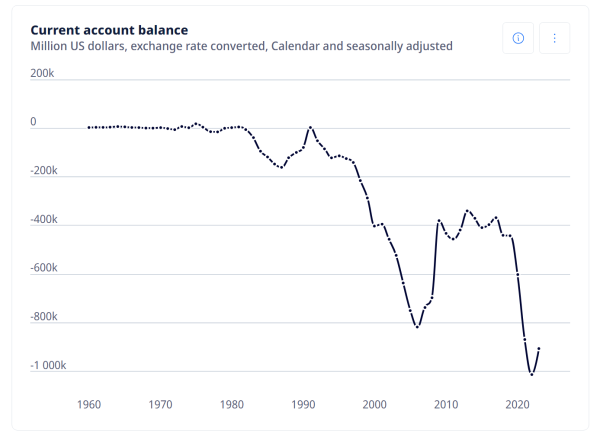
  • The United States has accumulated a huge external deficit, so is it okay for the US dollar to continue to be the key currency?
  • ​​Is the military superiority of the United States and the West sustainable?
  • This world follows a law of karma. If Western countries were to pay back the consequences of their exploitation of Africa and Asia over the past 500 years, how heavy would it be?
  • Can democracies deal on an equal footing with authoritarian countries such as Russia, China, and Iran?
  • Even in democracies, as long as there is state power, classes will emerge. And classes will become fixed. What is the wisdom to prevent class fixation?
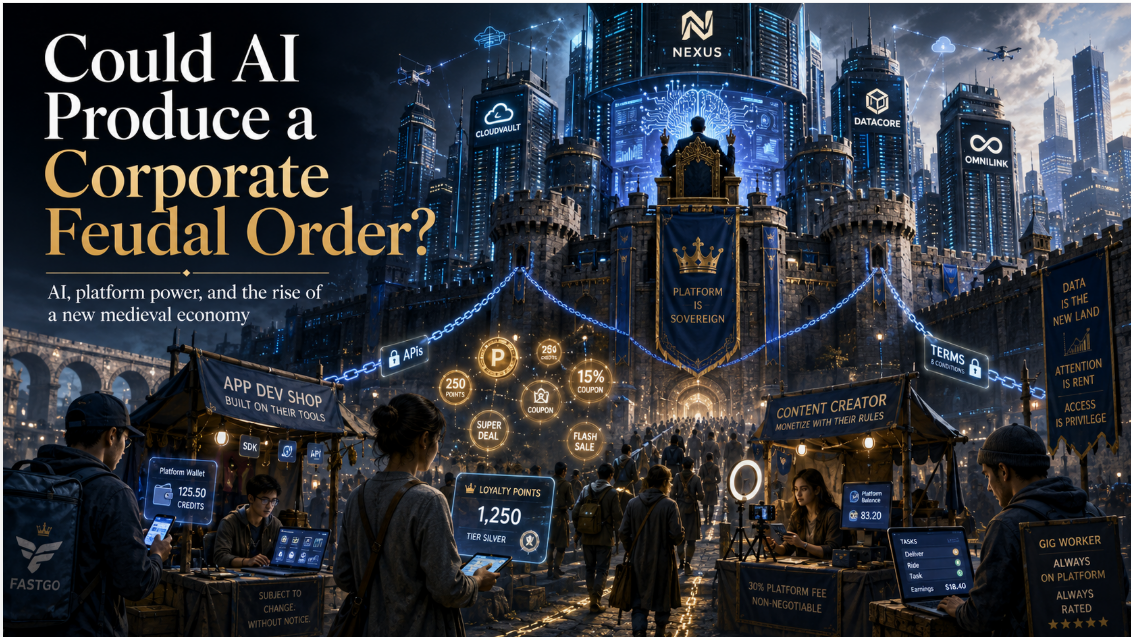
  • Won’t large global corporations that exceed the national budget become a new threat to humanity?
  • Are freedom and welfare contradictory?
  • What is tax? Are taxes necessary? What is the ideal tax system?
  • Will the current system in which educational background and social status are linked continue to be effective in the future?
  • Is labor essential for humans to live?
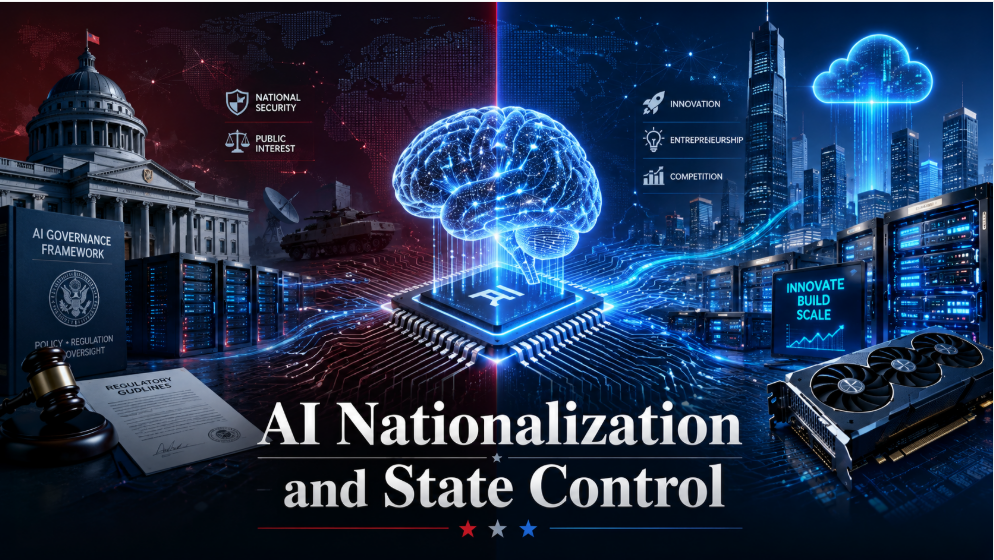
  • What kind of inconveniences will arise if powers such as nations or capitalists use AI?

If any of these change from the current situation, it could fundamentally change the international and social order. It is necessary to carefully consider that AI technology has emerged in such a situation. We will start threads for each topic in due course. Here, please write your opinions on what kind of discussion is needed as an overall framework. Let’s get started!

  • tada@aicritique.org

    He has been a watcher of the industrial boom from the early 1980s to the present day. 1982, planner of high-tech seminars at the Japan Technology and Economy Centre, and of seminars and research projects at JMA Consulting; in 1986 he organised AI chip seminars on fuzzy inference and other topics, triggering the fuzzy boom; after freelance writing on CG and multimedia, he founded the Mindware Research Institute, selling the Japanese version of Viscovery SOMine since 2000, and Hugin and XLSTAT since 2003 in Japan. The AI portal site, www.aicritique.org was started in 2024 after losing the rights to XLSTAT due to a hostile takeover in 2023.

    Related Posts

    AI Governance in Corporate AI Utilization: Frameworks and Best Practices

    Executive Summary 1. Definition and Purpose of AI Governance In a corporate context, AI governance refers to the established set of processes, policies, and organizational structures that guide how AI systems are developed and used, to ensure they align with…

    AI Mentor and the Problem of Free Will

    —How Far Can Human Consciousness Be Externalized?— 1. Prologue: AI as a Mirror of the Mind What humanity entrusts to artificial intelligence is not mere automation or efficiency.It is, more profoundly, the externalization of self-understanding—a continuation of the ancient project…

    Leave a Reply

    Your email address will not be published. Required fields are marked *

    You Missed

    Data Science and Buddhism: The Ugly Duckling Theorem and the Middle Way

    Data Science and Buddhism: The Ugly Duckling Theorem and the Middle Way

    Google’s Gemini 3: Launch and Early Reception

    Google’s Gemini 3: Launch and Early Reception

    AI Governance in Corporate AI Utilization: Frameworks and Best Practices

    AI Governance in Corporate AI Utilization: Frameworks and Best Practices

    AI Mentor and the Problem of Free Will

    AI Mentor and the Problem of Free Will

    The AI Bubble Collapse Is Not the The End — It Is the Beginning of Selection

    The AI Bubble Collapse Is Not the The End — It Is the Beginning of Selection

    Notable AI News Roundup: ChatGPT Atlas, Company Knowledge, Claude Code Web, Pet Cameo, Copilot 12 Features, NTT Tsuzumi 2 and 22 More Developments

    Notable AI News Roundup: ChatGPT Atlas, Company Knowledge, Claude Code Web, Pet Cameo, Copilot 12 Features, NTT Tsuzumi 2 and 22 More Developments

    KJ Method Resurfaces in AI Workslop Problem

    KJ Method Resurfaces in AI Workslop Problem

    AI Work Slop and the Productivity Paradox in Business

    AI Work Slop and the Productivity Paradox in Business

    OpenAI’s “Sora 2” and its impact on Japanese anime and video game copyrights

    OpenAI’s “Sora 2” and its impact on Japanese anime and video game copyrights

    Claude Sonnet 4.5: Technical Evolution and Practical Applications of Next-Generation AI

    Claude Sonnet 4.5: Technical Evolution and Practical Applications of Next-Generation AI

    Global AI Development Summary — September 2025

    Global AI Development Summary — September 2025

    Comparison : GPT-5-Codex V.S. Claude Code

    Comparison : GPT-5-Codex V.S. Claude Code

    【HRM】How a Tiny Hierarchical Reasoning Model Outperformed GPT-Scale Systems: A Clear Explanation of the Hierarchical Reasoning Model

    【HRM】How a Tiny Hierarchical Reasoning Model Outperformed GPT-Scale Systems: A Clear Explanation of the Hierarchical Reasoning Model

    GPT‑5‑Codex: OpenAI’s Agentic Coding Model

    GPT‑5‑Codex: OpenAI’s Agentic Coding Model

    AI Adoption Slowdown: Data Analysis and Implications

    AI Adoption Slowdown: Data Analysis and Implications

    Grokking in Large Language Models: Concepts, Models, and Applications

    Grokking in Large Language Models: Concepts, Models, and Applications

    AI Development — August 2025

    AI Development — August 2025

    Agent-Based Personal AI on Edge Devices (2025)

    Agent-Based Personal AI on Edge Devices (2025)

    Ambient AI and Ambient Intelligence: Current Trends and Future Outlook

    Ambient AI and Ambient Intelligence: Current Trends and Future Outlook

    Comparison of Auto-Coding Tools and Integration Patterns

    Comparison of Auto-Coding Tools and Integration Patterns

    Comparing the Coding Capabilities of OpenAI Codex vs GPT-5

    Comparing the Coding Capabilities of OpenAI Codex vs GPT-5

    Comprehensive Report: GPT-5 – Features, Announcements, Reviews, Reactions, and Impact

    Comprehensive Report: GPT-5 – Features, Announcements, Reviews, Reactions, and Impact

    July 2025 – AI Development Highlights

    July 2025 – AI Development Highlights

    ConceptMiner -Creativity Support System, Integrating qualitative and quantitative data to create a foundation for collaboration between humans and AI

    ConceptMiner -Creativity Support System, Integrating qualitative and quantitative data to create a foundation for collaboration between humans and AI

    ChatGPT Agent (Agent Mode) – Capabilities, Performance, and Security

    ChatGPT Agent (Agent Mode) – Capabilities, Performance, and Security