
 ChatGPT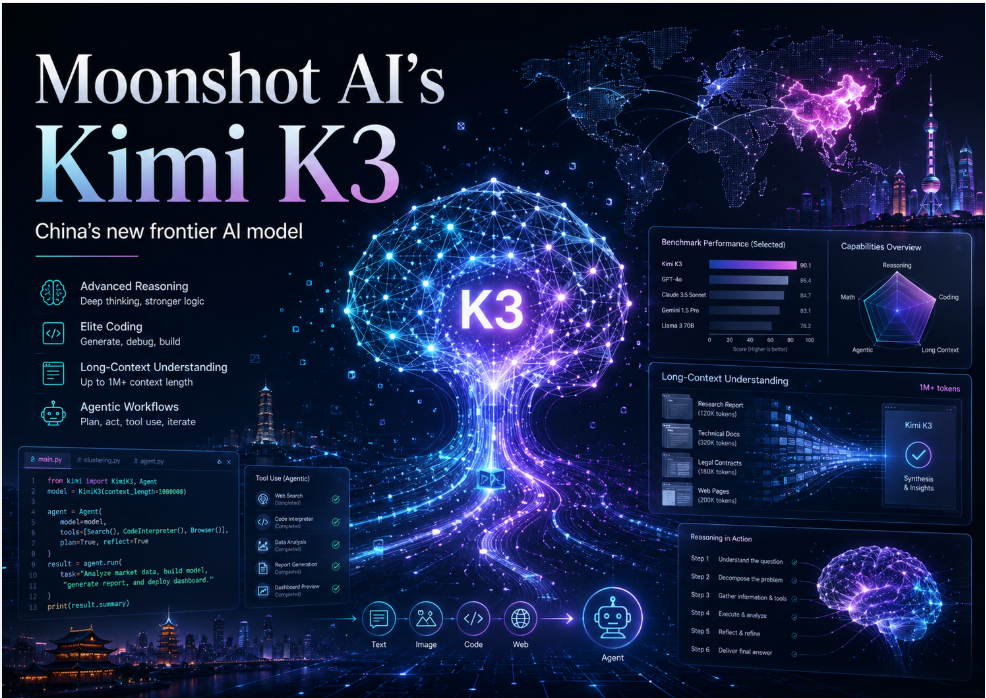
Executive summary
Research cutoff date: July 21, 2026, Asia/Tokyo. This article reflects information that was publicly available and verifiable up to that date. Where Moonshot AI had announced future steps, such as an open-weight release expected after the cutoff, those are identified as forward-looking claims rather than confirmed facts.
Kimi K3 is Moonshot AI’s newest flagship Kimi model, announced on July 16, 2026. In Moonshot’s own materials, it is presented as a 2.8-trillion-parameter, 1 million-token context model built for long-horizon coding, knowledge work, and deep reasoning. Official materials also describe it as natively multimodal, based on a new architecture using Kimi Delta Attention, Attention Residuals, and a sparse Mixture-of-Experts design that “effectively activates 16 of 896 experts.”
The biggest caution is about openness. Moonshot’s launch framing and several reputable contemporaneous writeups described K3 as an upcoming open-weight or “open-source” release, with weights expected by July 27, 2026. But as of the research cutoff, K3 was clearly available through Kimi web/app/workspace products, Kimi Code, and the API, while a public Hugging Face or GitHub weight release for K3 did not appear in the official Moonshot channels retrieved for this report. So, at the cutoff, K3 was best described as a publicly accessible Moonshot flagship service with an announced but not yet verified open-weight release.
On performance, the picture is strong but more nuanced than the launch buzz suggested. Independent sources indicate that K3 is a genuine frontier-class model, especially in coding and agentic workflows. Artificial Analysis scored it 57 on its composite Intelligence Index, with the model placed near the top tier but still behind the very strongest proprietary systems. LMArena showed preliminary results placing K3 near the top of English text chat and first on the WebDev Code Arena leaderboard. That said, benchmark comparisons are often not perfectly apples-to-apples because harnesses, reasoning settings, tool access, fallback behavior, and context-management strategies differ across vendors.
Relative to earlier Kimi generations, K3 is a substantial jump. K2 was a 1T/32B-active open MoE model optimized for agentic non-thinking tasks; K2.5 added native multimodality and agent swarms; K2.6 strengthened open-source coding and agentic performance; K2.7 Code specialized further for long-horizon software engineering. K3 extends that line by moving to a much larger architecture, a 1M-token window, new reasoning controls, and more explicit positioning as a frontier model for end-to-end work rather than just an open coding model.
K3 also arrived with practical caveats. Moonshot publicly warned that quality can become unstable if a harness fails to preserve K3’s full thinking history, and the company acknowledged that K3 can be overly proactive in ambiguous tasks. Within days of launch, Moonshot temporarily paused new subscriptions because demand exceeded available compute. Privacy-wise, Moonshot’s public privacy policy says user content may be processed to provide and improve the service, including training and optimization. Policy-wise, official docs show built-in refusal behavior for categories including terrorism, racism, and explicit violence, while broader concerns about how Chinese AI services handle politically sensitive topics remain relevant background context.
Timeline
| Date | Event | What is confirmed |
|---|---|---|
| Early 2023 | Moonshot AI is founded | Moonshot says it was founded in early 2023; company materials describe a team with strong academic and systems pedigree. |
| Late 2023 | Consumer Kimi launches | Kimi’s earlier public identity centered on long-context chat, which helped establish Moonshot’s brand. |
| July 28, 2025 | Kimi K2 paper appears on arXiv | K2 is published as a 1T total / 32B active MoE with strong agentic capabilities among non-thinking models. |
| January 27, 2026 | Kimi K2.5 released | Moonshot officially releases K2.5 as an open-source multimodal model with Agent Swarm and stronger real-world execution focus. |
| April 20, 2026 | Kimi K2.6 released | Moonshot releases K2.6 as another open model focused on coding, long-horizon execution, and agent swarms. |
| June 25, 2026 | Kimi K2.7 Code released | Moonshot launches K2.7 Code as a coding-focused open model with lower reasoning-token usage than K2.6. |
| July 16, 2026 | Kimi K3 announced | Official Kimi research pages date K3 to 2026/07/16 and present it as the new flagship. |
| July 20, 2026 | New subscriptions paused | Reuters reported Moonshot paused new K3 subscriptions because demand outstripped compute capacity. |
| July 27, 2026 | Announced future open-weight target | Multiple contemporaneous sources reported a Moonshot plan to release K3 weights by July 27, 2026; this was still future-dated at the cutoff. |
What Kimi K3 is
Kimi K3 is the newest flagship model in Moonshot AI’s Kimi family. Official API and product materials describe it as Moonshot’s most capable model so far, designed for long-horizon coding, knowledge work, and deep reasoning, with a 1M-token context window and support for reasoning effort controls. Moonshot’s Chinese homepage also markets it as “native multimodal.”
Moonshot AI itself was founded in early 2023, and its founder and chief executive is Yang Zhilin, a former Carnegie Mellon researcher and coauthor of work such as Transformer-XL and XLNet. Moonshot’s official company page says its technical team includes inventors of several important AI systems components; outside coverage identifies Yang as the public face of the company and situates Moonshot among China’s leading frontier-model startups.
The most important naming point is that “Kimi K3” is not a rumor or an unofficial nickname. It is used directly across Moonshot’s official research blog, consumer site, API docs, app-store listings, and help documentation. The real ambiguity is not the name; it is the status of the model’s claimed openness. Some official surfaces and contemporaneous coverage called K3 “open” or “open-sourced,” but at the cutoff the retrievable official channels primarily showed hosted access, not downloadable weights.
Specifications table
| Item | Kimi K3 status at cutoff | Evidence type |
|---|---|---|
| Developer | Moonshot AI | Confirmed fact. |
| Announcement date | July 16, 2026 | Confirmed fact. |
| Parameter count | 2.8 trillion total parameters | Moonshot claim, repeated across official docs and product pages. |
| Architecture | Stable LatentMoE; KDA; Attention Residuals; 16 of 896 experts active | Moonshot claim from official technical blog. |
| Context window | 1,048,576 tokens | Confirmed in official pricing/docs. |
| Modalities | Officially described as native multimodal; independent platforms confirm text and image input, text output | Mixed evidence: Moonshot claim plus independent confirmation. |
| Vision input | Official docs mention vision input with images and videos | Moonshot documentation claim. |
| Reasoning control | reasoning_effort supports low, high, max; default max | Confirmed in official API docs. |
| Tooling | ToolCalls, JSON mode, structured output, partial mode, internet search, tool-choice constraints, dynamically loaded tools | Confirmed in official API docs. |
| Training/inference notes | Quantization-aware training from SFT onward; MXFP4 weights and MXFP8 activations; Mooncake-backed inference; vLLM cache work promised | Moonshot claim from official blog/docs. |
| Recommended deployment scale | Supernodes with 64 or more accelerators | Moonshot claim from official technical blog. |
| Open-weights status | Announced / promised, but no verified public official weight drop found by July 21 in retrieved Moonshot HF/GitHub channels | Verified partial fact plus unresolved status. |
Moonshot’s architecture claims deserve modest translation for non-specialists. A Mixture-of-Experts model uses many specialized subnetworks, but only a small subset is activated for any single token, which can increase capability without paying the full compute cost of a dense model. K3’s official technical blog says the model “effectively activates 16 of 896 experts,” making routing and systems efficiency central rather than peripheral engineering concerns.
The training and inference design are also part of the K3 story. Moonshot says K3 uses quantization-aware training from the supervised fine-tuning stage onward, and that it targets broad hardware compatibility with MXFP4 weights and MXFP8 activations. The same blog ties K3 serving cost to Mooncake, Moonshot’s disaggregated serving architecture, and says KDA-specific prefix caching support would be contributed to vLLM alongside the model. Those are substantial technical claims, but Moonshot had not yet released a full K3 technical report by the cutoff, which means outside researchers could not yet audit the details at the same depth as with K2’s published paper.
Relative to earlier Kimi models, K3 appears to combine several Moonshot priorities into one product line: very large sparse scale, long context, multimodal perception, explicit reasoning, coding-agent support, and broader productivity tooling. The consumer and app-store surfaces position it not just as a chatbot, but as the intelligence layer behind website generation, slide creation, spreadsheets, deep research, and agent swarms.
Performance and benchmark evidence
K3’s launch was benchmark-heavy, but not every benchmark number is equally trustworthy or equally comparable. Some results come from Moonshot’s own evaluations, some from official benchmark leaderboards, and some from independent cross-model evaluators such as Artificial Analysis and LMArena. The right way to read them is not “higher number = universally better model,” but “higher number under a particular task definition, harness, and vendor setup.”
Moonshot’s own footnotes are unusually important here because they explicitly acknowledge that K3 was tested under different agent harnesses depending on the benchmark: KimiCode, Claude Code, or Codex. The company also says all K3 results it reports were generated with reasoning effort set to max, temperature 1.0, and top-p 1.0. That matters because harness quality and reasoning budget can swing scores materially.
Benchmark-comparison table
| Benchmark | What it measures | Kimi K3 result | Source type | Comparison caveat |
|---|---|---|---|---|
| Artificial Analysis Intelligence Index v4.1 | Composite of 9 evaluations spanning coding, reasoning, knowledge reliability, and long-context reasoning | 57 | Independent evaluator. | Composite scores are useful for a broad signal, but they compress many task types and may over-reward verbose reasoning if not read carefully. Artificial Analysis notes K3 used 130M output tokens on the index, which is unusually verbose and expensive to evaluate. |
| LMArena English Text Arena | Human preference voting in chat-style comparisons | 1500 ± 17, preliminary | Independent evaluator. | Arena scores are preference-based, not task-completion measures. They can reflect wording, style, and presentation as much as factual or agentic reliability. |
| LMArena WebDev Code Arena | Human preference on web-development coding outputs | Ranked #1 at the time retrieved | Independent evaluator. | Strong evidence of coding appeal in that arena, but still preference-based and focused on a specific coding slice rather than end-to-end software engineering. |
| DeepSWE v1.1 | Software-engineering tasks evaluated with an agent harness | 67.3 with mini-SWE-agent on the official leaderboard | Mixed: official Moonshot footnote citing official benchmark leaderboard. | Moonshot says its headline chart used the KimiCode harness, while the cited official leaderboard number is under mini-SWE-agent. Those are not identical settings. |
| BrowseComp | Multi-step browsing/search/reasoning on hard-to-find web information | 90.4 when evaluated with 1M context and no context management | Moonshot official footnote. | Moonshot explicitly says it adopted a 300K-token context-compaction strategy for the comparative setup, and also reports a no-management score. That makes casual cross-vendor reading risky. |
| Terminal-Bench v2.1 | Agentic terminal tasks spanning software engineering, sysadmin, data, training, and security | Exact K3 score not exposed in retrieved machine-readable Moonshot text | Moonshot comparisons referenced benchmark and competitor sources. | Important benchmark, but this report does not repeat a K3 number that it could not verify directly from retrieved official or leaderboard text. |
Two K3 results stand out as reasonably strong signals. The first is the Artificial Analysis score of 57, because it comes from an independent evaluator using its own cross-model methodology. Artificial Analysis also concluded that K3 is “amongst the leading models in intelligence,” while noting that the model is slow, verbose, and “somewhat expensive” relative to peers. That is a more credible reading than simply repeating Moonshot’s best chart.
The second is K3’s apparent strength in coding and agentic execution. Moonshot’s own technical footnotes emphasize DeepSWE, Terminal-Bench, Program Bench, SWE Marathon, FrontierSWE, PostTrain Bench, MLS Bench Lite, and KCB 2.0. Independent corroboration comes from LMArena’s WebDev Code Arena, where K3 was ranked first in the retrieved leaderboard snapshot. This does not prove that K3 is the best model in every software-engineering workflow, but it does support the claim that K3 is a serious competitor in long-horizon coding.
On long-context and browsing, Moonshot’s BrowseComp note is useful but should be handled carefully. BrowseComp is intended to test whether a model can browse, search, and reason over difficult real-world web information. Moonshot says K3 reached 90.4 with 1M context and no context management, while also stating that it adopted a Claude-style context-compaction strategy triggered at 300K tokens for comparison. That means any “K3 vs Claude vs OpenAI” reading depends heavily on the evaluation setup.
On multimodality, Moonshot clearly presents K3 as a native multimodal model and includes a multimodal section in its benchmark appendix, but the retrieved machine-readable text did not expose the full official K3 vision table values. Because of that, this article does not repeat exact K3 MMMU-Pro or related multimodal scores from launch charts unless independently verified. What is verified is that official materials emphasize visual reasoning, visual coding, and multimodal office/productivity workflows, and independent model catalogs confirm text-and-image input support.
The same caution applies to reasoning benchmarks such as Humanity’s Last Exam and GPQA Diamond. K3 clearly featured in Moonshot’s reasoning comparison materials, and outside summaries reported strong numbers. But because the retrievable official text did not expose those exact K3 values line-by-line for this report, the safer conclusion is qualitative: K3 appears to be a frontier-level reasoning model, but the most solid independent evidence available at the cutoff still points to its coding and agentic strengths more clearly than to a single undisputed “best in class” reasoning result.
How Kimi K3 compares
The cleanest way to compare K3 with rivals is to separate three groups: top proprietary frontier models, Chinese open or semi-open competitors, and earlier Kimi models. K3 sits in an unusual position between them. It is marketed with frontier ambitions like the proprietary leaders, but with an announced openness strategy more reminiscent of Chinese open-weight labs.
Against OpenAI, the relevant comparator is GPT-5.6 Sol, which OpenAI describes as its strongest model and explicitly highlights for coding, science, cybersecurity, and agentic work. OpenAI says GPT-5.6 Sol sets a state of the art on Terminal-Bench 2.1 and introduces both max reasoning and an ultra multi-agent-like mode. Independent coverage and Artificial Analysis suggest K3 is competitive with OpenAI’s recent models on some coding and knowledge-work tasks, but still not obviously ahead of Sol overall. Simon Willison’s early synthesis, for example, characterized K3 as close enough to matter strategically without implying a clear across-the-board overtake.
Against Anthropic, the key comparators are Claude Opus 4.8 and especially Claude Fable 5. Anthropic positions Fable 5 as a long-running, highly proactive agent model for “ambitious, long-running projects,” and K3’s own official benchmark footnotes use Anthropic’s published figures for some comparisons. The overall picture from independent summaries is that K3 can beat earlier or second-tier frontier models on some coding and agentic measures, but Claude Fable 5 still appears stronger on the very top end of general frontier performance and user experience. Moonshot’s own limitations section effectively concedes as much, stating that K3 still shows a “noticeable gap in user experience” versus Fable 5 and GPT-5.6 Sol.
Against Google, the most relevant models are Gemini 3.1 Pro and Gemini 3.5 Flash. Google describes Gemini 3.1 Pro as a model for complex tasks and Gemini 3.5 Flash as its strongest coding and agentic model at the time, with official claims of gains on Terminal-Bench 2.1, GDPval-AA, and MCP Atlas. K3’s positioning overlaps more with Gemini 3.1 Pro in ambition and more with Gemini 3.5 Flash in its focus on agentic execution. The available evidence suggests K3 is now in Google’s competitive neighborhood on serious work tasks, but Google still has stronger first-party integration and a more mature multimodal ecosystem.
Among Chinese rivals, Z.ai’s GLM-5.2 is the clearest same-generation point of comparison. Z.ai presents GLM-5.2 as a long-horizon flagship, and Moonshot’s own K3 footnotes repeatedly cite GLM-5.2 as a baseline on coding and agent benchmarks. Simon Willison described GLM-5.2 as the leading open-weights text model on Artificial Analysis shortly before K3 arrived; K3’s launch then moved Moonshot back into the top conversation by combining stronger frontier positioning with multimodality and a larger scale.
DeepSeek is harder to compare directly because its most relevant current flagship at the cutoff was DeepSeek-V4 Preview, which DeepSeek described as open-sourced, cost-efficient, and 1M-context, with a 1.6T MoE “Pro” variant. DeepSeek therefore remained a very important reference point for open Chinese frontier systems, but K3 is substantially larger on Moonshot’s reported parameter count and appears more aggressively positioned around end-to-end knowledge work and coding agents. Independent, apples-to-apples comparisons between K3 and DeepSeek-V4 Preview were still limited in the verified sources retrieved here.
For Alibaba, the relevant family is Qwen. At the API layer Alibaba’s current flagship was qwen3.7-plus, which Alibaba says supports 1M context, function calling, and built-in tools. In open weights, Alibaba’s Qwen3.5-397B-A17B was presented as a native vision-language model. K3’s claimed scale is much larger than those public open-weight Qwen models, but Alibaba still has one of the broadest deployment ecosystems and a strong record in multimodal and enterprise distribution. Again, direct third-party benchmark parity with K3 remained limited in the verified sources.
The most important differences from earlier Kimi models
The most consequential change from K2 to K3 is scale and scope. K2 was a 1T total / 32B active MoE model aimed at strong agentic performance without extended thinking. K3 moves to 2.8T total parameters, a much longer 1M context window, explicit reasoning controls, and an architecture Moonshot presents as designed for scaling “well beyond the trillion-parameter regime.”
From K2.5 to K3, the shift is from a powerful open multimodal agent model to a much larger frontier flagship. K2.5 introduced native multimodality, visual coding, and Agent Swarm with up to 100 sub-agents and 1,500 tool calls. K3 keeps the multimodal and agentic direction, but Moonshot’s product materials now talk about up to 300 sub-agents and 4,000+ tool calls in the swarm architecture, indicating a turn from “agentic capability” toward “agentic scale.”
From K2.6 and K2.7 Code to K3, the change is less about introducing coding and more about integrating coding into a much broader flagship platform. K2.6 and K2.7 Code were openly targeted at software engineering and long-horizon code tasks, with K2.7 Code especially emphasizing lower reasoning-token use and better coding efficiency. K3 instead becomes Moonshot’s “one flagship to rule most serious tasks”: coding, enterprise knowledge work, deep research, slides, websites, and multi-agent execution.
Access pricing and deployment
As of the cutoff, K3 was available through Kimi.com, the mobile app, Kimi Work on desktop, Kimi Code in terminal/IDE workflows, and the Kimi API Platform. Moonshot’s official technical blog explicitly lists those access paths and dates K3 availability to launch day.
For the API, Moonshot’s official pricing was:
| Access path | Pricing / availability status | Evidence |
|---|---|---|
| Kimi API Platform | $0.30 / 1M cache-hit input, $3.00 / 1M cache-miss input, $15.00 / 1M output | Confirmed official pricing. |
| Batch API | 60% of standard price | Confirmed official pricing. |
| Consumer subscriptions | Free tier plus paid plans at $19 / $39 / $99 / $199 monthly, with annual discounts | Confirmed official membership pricing, though these plans govern product usage rather than simple API token billing. |
| Kimi Code access to K3 | Available to Moderato and above; Allegretto and above unlock 1M context in Kimi Code | Confirmed official docs. |
Moonshot’s docs also show that K3 supports an OpenAI-like API surface, including reasoning_effort, structured output, JSON mode, and tool calling. In the broader Kimi ecosystem, Moonshot exposes both OpenAI-compatible and Anthropic-compatible endpoints for Kimi Code integrations, while the platform docs point developers to the Kimi API for product integration.
On deployment, the official technical guidance is notably demanding. Moonshot recommends supernode configurations with 64 or more accelerators for K3 inference efficiency. That recommendation does not by itself tell us the final self-hosting bill of materials, especially because the public K3 weight package had not yet surfaced by the cutoff, but it does strongly imply that K3 is not a casually self-hosted model in the way that smaller open models are.
On licensing, the honest answer is not yet fully resolved at the cutoff. Moonshot’s recent Kimi open models such as K2 used a Modified MIT License. Multiple K3 launch-period sources said Moonshot planned the same general open-weight direction for K3, with a public release target of July 27, 2026. But because the weights were not publicly available in the retrieved official model channels as of July 21, the exact final K3 licensing package should be treated as an announced intention, not a completed fact.
On supported regions, Moonshot’s public business agreement says access depends on supported countries, regions, account types, payment methods, product availability, and compliance requirements, but the retrieved public docs did not provide a comprehensive country-by-country support matrix. The web and app surfaces are available in multiple languages and appear globally visible, but exact enterprise or payment availability may still vary by jurisdiction.
In practical terms, K3’s strongest immediate use cases are easy to infer from Moonshot’s own product stack and the benchmark evidence. For developers, it is a strong candidate for repository-scale coding, debugging, and tool-using agents. For researchers and analysts, it fits literature review, competitive intelligence, browsing-heavy synthesis, and long-context reasoning. For business users, Moonshot is packaging it into documents, slides, spreadsheets, websites, and enterprise knowledge work. For general users, the gain is less “best casual chat companion” and more “more ambitious things can now be attempted in one conversation or agent run.”
Uses limitations and reactions
Strengths-and-limitations table
| Area | Strengths | Limitations / concerns |
|---|---|---|
| Coding and agentic work | Strong independent and semi-independent evidence in coding and agent contexts; #1 in retrieved WebDev Code Arena snapshot; official benchmark emphasis is unusually concentrated on end-to-end engineering tasks. | Benchmark success does not guarantee the best experience in every IDE or repo. Harness compatibility matters, and Moonshot warns that improper handling of thinking history can destabilize outputs. |
| Long context | 1M-token official context window is a major differentiator for very large codebases and long documents. | Long context only helps if the harness and caching strategy are efficient. BrowseComp notes show that context management choices materially affect reported performance. |
| Multimodality | Officially native multimodal, with strong product positioning around visual coding, slide generation, and document/image workflows. | Fully verified public multimodal benchmark numbers for K3 were incomplete in retrieved machine-readable sources, so some launch claims remain harder to audit than K2/K2.5 claims. |
| Economics | Cache-hit pricing can be attractive in repeated-context coding workflows; Moonshot says coding workloads can exceed 90% cache-hit rate on the official API. | Artificial Analysis judged K3 “somewhat expensive,” “slow,” and “very verbose” relative to peers. Total task cost is not just input price but also reasoning depth and output length. |
| Openness | If the announced open-weight release materializes, K3 could become one of the most important large open frontier models yet. | As of July 21, 2026, public downloadable K3 weights were not verified in the official Moonshot model channels reviewed for this report. |
| Reliability and UX | Competitive on many measurable tasks. | Moonshot itself says K3 can be unstable if thinking history is mishandled, can behave too proactively, and still trails Fable 5 and GPT-5.6 Sol in user experience. |
Moonshot’s own limitations section is one of the most important pieces of evidence in the K3 launch materials. The company says K3 was trained in a mode that expects preserved thinking history and warns that if an agent harness fails to pass back historical thinking content, output quality can become “highly unstable.” It also says K3 may act with excessive proactiveness on minor problems or ambiguous user intent. Those are not generic model caveats; they are specific operational warnings that matter if you plan to build agents on top of K3.
Privacy and governance are also material. Moonshot’s public privacy policy states that user content — including prompts, audio, images, videos, files, and generated content — may be processed both to provide the service and to improve it, including model training and optimization, subject to jurisdiction-specific legal bases. The policy also notes that data may be transferred internationally and retained for business, safety, dispute, and legal reasons. That is not unusual for AI consumer platforms, but it means businesses handling sensitive information should not assume K3 behaves like a no-training, no-retention enterprise enclave unless they have separately negotiated enterprise terms.
On safety and policy constraints, Moonshot’s prompt guidance gives a concrete example system prompt in which Kimi is instructed to refuse questions involving terrorism, racism, or explicit violence. Its terms also reserve broad rights to terminate service and continue storing anonymized information after account termination. For global users, the terms explicitly say overseas use must comply with foreign jurisdiction rules, while the agreement itself is governed by the law of mainland China.
On censorship, there is no retrieved official K3 model card openly listing a political-topic refusal taxonomy. Still, it would be naïve to ignore the broader context. TechCrunch summarized how Chinese model providers operate under a legal environment that forbids certain politically sensitive outputs, and this background has repeatedly influenced how Chinese frontier models are discussed and tested internationally. This does not prove a specific K3 refusal rate on sensitive political prompts in the absence of direct K3 testing in this report, but it is a legitimate unresolved concern for global adopters.
Reaction to K3 fell into three camps. First, many researchers, investors, and developers treated it as a serious geopolitical and competitive moment. Business Insider collected reactions from figures such as Russ Salakhutdinov, Vinod Khosla, Aaron Levie, and David Sacks, many of whom framed K3 as evidence that Chinese labs are closing the frontier gap and that open models are gaining strategic weight.
Second, technical analysts offered qualified respect. Simon Willison’s early essay treated K3 as a major release—particularly because it changed the price/performance/open-weights conversation—while still warning that benchmark interpretation, especially human-preference “pelican” style rankings, should not be confused with actual long-horizon agentic competence. Ethan Mollick voiced a similar caution from a different angle, arguing that some early excitement leaned too heavily on saturated benchmarks and that K3 looked strong but not like an unprecedented discontinuity.
Third, early-user commentary emphasized a familiar tradeoff: strong results, slower pace. Hacker News and Reddit commentary highlighted that K3 often appears more persistent and task-completion-oriented than some rivals, but also more token-hungry, slower, prone to looping, or difficult to run smoothly during the initial demand spike. Those reports are anecdotal rather than controlled benchmarks, but they align with Artificial Analysis’s observation that K3 is unusually verbose and with Reuters’ report that Moonshot had to pause some new subscriptions because of compute pressure.
What Kimi K3 Means for the AI Industry
Kimi K3 matters less because it “beats everyone” and more because it changes what must now be taken seriously. Before K3, it was still possible to treat Chinese open or semi-open models as either fast followers or cost-efficient but clearly second-tier alternatives. After K3, that position became much harder to defend. Independent evaluators, major tech-media coverage, and Moonshot’s own engineering disclosures all point to the same broad conclusion: a Chinese lab with constrained chip access still produced a model that belongs in the frontier conversation, especially for coding and agentic work.
The second industry significance is about open frontier pressure. If Moonshot completes the promised K3 weight release, it would push the open-weight ceiling sharply upward in both scale and ambition. That would put pressure on U.S. labs that increasingly rely on closed, premium frontier models, while also pressuring Chinese rivals such as DeepSeek, Z.ai, and Alibaba to respond at a similar or larger scale. Even before a public weight drop, K3’s launch appears to have been strong enough to affect subscription demand, media narratives, and competitor positioning.
The third significance is architectural and product-level. K3 is not just “another bigger chatbot.” Moonshot is trying to define a category in which the flagship model is simultaneously a coding agent, research agent, office-work engine, slide builder, website generator, and multi-agent orchestrator. Whether that fully works in practice remains an open question, but it is strategically important because it treats the frontier model as a work substrate, not just a conversational endpoint. That is increasingly the direction also visible at OpenAI, Anthropic, and Google.
The fourth significance is geopolitical. Reuters and other coverage placed K3 directly in the context of U.S. export controls, Chinese compute constraints, and Moonshot’s potential Hong Kong IPO path. In other words, K3 is not only a model release. It is a signal that the frontier is now structurally multipolar. Even if the absolute top proprietary U.S. systems still lead overall, China’s top labs are no longer operating in a visibly different league.
Balanced conclusion
Kimi K3 is best understood as a credible frontier model with unusually strong coding and agentic ambitions, significant technical novelty claims, and a still-unresolved openness story. The confirmed facts are impressive: official 2.8T scale, 1M context, new sparse architecture, broad product integration, frontier-adjacent independent scores, and strong signs of real developer interest. The cautions are just as important: not all launch benchmark values were equally verifiable, many comparisons rely on different harnesses and reasoning settings, Moonshot itself warns about instability and over-proactiveness, and the promised public weight release had not yet been verified at the research cutoff.
So the balanced bottom line is this: K3 is not merely marketing hype, but neither is it a settled proof that Moonshot has surpassed the very best closed U.S. models overall. It is a real, strategically important advance that narrows the gap, raises the open-model ceiling, and makes the Chinese frontier impossible to dismiss. Whether it becomes a lasting turning point will depend on three things after the cutoff: whether Moonshot actually ships the public weights, whether K3 proves reliable in broad third-party agent deployments, and whether independent evaluators continue to find that its strongest headline results hold up outside Moonshot’s own harnesses.
Source list
Primary Moonshot AI sources used for this report included the official K3 launch and technical pages, API docs, pricing docs, Kimi Code docs, company pages, privacy policy, and terms.
Primary earlier-Kimi sources used for lineage and comparison included Kimi K2’s GitHub repository and arXiv paper, K2.5’s official model pages and blog, and K2.7 Code’s official resource page.
Independent benchmark and evaluation sources used in the analysis included Artificial Analysis and LMArena.
Competitor primary sources used for comparison included OpenAI on GPT-5.6 Sol, Anthropic on Claude Fable 5 and Mythos 5, Google on Gemini 3.1 Pro and Gemini 3.5, Z.ai on GLM-5.2, DeepSeek on V4 Preview, and Alibaba/Qwen on Qwen3.5 and qwen3.7-plus.
Reputable journalism and analyst commentary used for context and reactions included Reuters, Business Insider, Simon Willison, TechCrunch, and VentureBeat.