
 ChatGPT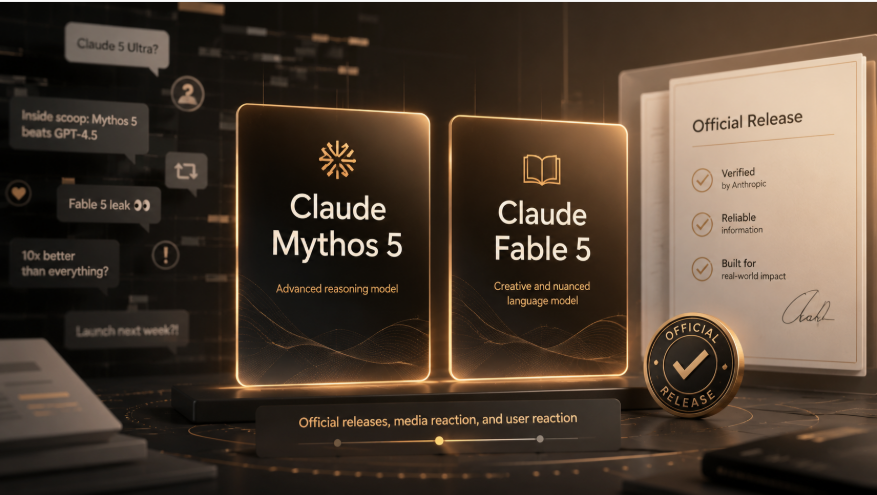
Introduction
As of June 10, 2026, Claude Fable 5 and Claude Mythos 5 are not fan labels, parody names, or mere rumors. They are now official Anthropic model names, publicly documented on Anthropic’s website, product pages, and API documentation. But that official status only dates to June 9, 2026. Before then, the Anthropic sources I reviewed referred to Claude Mythos Preview and Project Glasswing, not to “Claude Mythos 5” or “Claude Fable 5,” which means a meaningful share of the earlier online chatter was pre-release speculation, rumor, or outright misinformation rather than confirmed product information.
That distinction matters because the names drew attention in exactly the kind of internet environment where AI products are often overhyped before launch. In the days before Anthropic’s announcement, X surfaced a trending rumor page claiming a “Claude Fable 5” public release was imminent while explicitly noting there was no official confirmation yet. Separate posts on X and LinkedIn circulated unsupported claims about “Mythos 5.0 Beta,” March access, or a 10-trillion-parameter model. Anthropic’s official launch materials later confirmed the names, but they did not confirm those extra claims.
The real story, then, is not whether “Claude Mythos 5” and “Claude Fable 5” are real. They are. The more interesting story is how Anthropic turned a previously restricted “Mythos” capability tier into a two-track release: a more broadly available model called Fable 5, and a more restricted version called Mythos 5, both presented as the same underlying model with different safeguards and access rules.
Official Status and the Naming Question
Anthropic’s own materials now make the official status plain. On June 9, 2026, Anthropic published a launch post titled “Claude Fable 5 and Claude Mythos 5,” alongside dedicated product pages for Claude Fable 5 and Claude Mythos 5, and API documentation listing the model IDs claude-fable-5 and claude-mythos-5. Anthropic’s docs describe Fable 5 as its “most capable widely released model” and Mythos 5 as the successor to Claude Mythos Preview, available only in limited access through Project Glasswing.
The timeline is useful for separating official fact from rumor. On April 7, 2026, Anthropic announced Project Glasswing and introduced Claude Mythos Preview as an unreleased frontier model for defensive cybersecurity work. On June 2, 2026, Anthropic expanded Project Glasswing to roughly 150 additional organizations in more than 15 countries, but still spoke in terms of Mythos Preview. Only on June 9, 2026 did Anthropic officially unveil the specific names Claude Fable 5 and Claude Mythos 5. That means any earlier uses of those exact names were, by definition, ahead of formal confirmation.
Anthropic also explains why the names differ. In the June 9 announcement, it says Fable 5 and Mythos 5 are the same underlying model, but that “the safeguards are what distinguish the two models” and “are why we’ve given them different names.” Anthropic’s footnote adds that “Fable” derives from the Latin fabula and is akin to the Greek mythos. In other words, the names are not internal codenames that accidentally leaked into public discourse; Anthropic is deliberately using them as branded, public-facing names for two differently gated versions of one capability tier.
That said, the names’ late appearance did create ambiguity that fed online speculation. Before June 9, Anthropic’s public materials emphasized Mythos Preview rather than Mythos 5, and there was no official Anthropic page I found that used Fable 5 before the launch day. So while the names are now unquestionably official, some of the excitement around them was fueled by leaks, anticipation, and community guesswork before the company itself spoke clearly.
What Anthropic Officially Released
Anthropic’s official positioning is straightforward. Claude Fable 5 is the generally available release, aimed at “the hardest knowledge work and coding problems,” while Claude Mythos 5 is positioned as Anthropic’s most capable model for cybersecurity and biology research and is limited to a small group of vetted partners. Anthropic says both models became available on June 9, 2026, but in very different ways: Fable 5 broadly across first-party and cloud/API surfaces, Mythos 5 only through restricted programs such as Project Glasswing.
The official technical and commercial details are also unusually explicit. Anthropic’s docs list a 1 million token context window, up to 128,000 output tokens, and pricing of $10 per million input tokens and $50 per million output tokens for both Fable 5 and Mythos 5. Anthropic also says adaptive thinking is always on for both models, that raw reasoning traces are not returned, and that the June 9 launch included availability for Fable 5 on the Claude API, Claude Platform on AWS, Amazon Bedrock, Vertex AI, and Microsoft Foundry. Mythos 5, by contrast, is not generally available and requires approved access.
Anthropic’s most unusual design choice is the safety split between the two names. According to the company, Fable 5 is the “safe for general use” version. When its classifiers detect requests in areas such as cybersecurity, biology and chemistry, or distillation, the system routes the response to Claude Opus 4.8 instead. Anthropic says this happens in less than 5 percent of sessions on average, and its help center explains that users are informed when the model switches. Anthropic frames this fallback system as the key enabling mechanism for public release.
Anthropic has also attached additional operational conditions to this model family. Its help center says Mythos-class models require 30-day data retention for trust and safety purposes, even on surfaces that otherwise support zero data retention, and that this policy took effect on June 9, 2026. Anthropic says the data is not used to train new Claude models and is retained to monitor patterns of misuse, including multi-request jailbreak attempts and other attacks that cannot be detected from one prompt in isolation.
In capability terms, Anthropic’s announcement is ambitious. It says Fable 5 exceeds every model it had previously made generally available and that its lead grows on longer, more complex tasks. The Fable product page highlights software engineering, multi-day agentic work, enterprise workflows, and vision-heavy document tasks. The Mythos page makes even stronger claims in restricted domains, calling Mythos 5 “state-of-the-art at cybersecurity, biology research, and healthcare.” Those should still be understood primarily as vendor claims and partner testimonials at launch, not as broad independent consensus.
How the Media Has Covered the Release
The mainstream and specialist technology press did not ignore these names once the official launch happened. On the contrary, coverage quickly clustered around a few recurring themes: public release with guardrails, cybersecurity risk, the strange two-name rollout, and whether Anthropic’s safeguards are credible or mostly a distribution strategy. Reuters described Fable 5 as the public version of Mythos with its controversial cybersecurity capability removed or constrained, emphasizing both the model’s strength and the risk logic behind the restriction.
TechCrunch treated the launch as the public arrival of a previously restricted capability tier, but it consistently put safety and governance questions at the center. Its June 9 coverage said Anthropic was bringing its most powerful model to the general public “with guardrails.” Earlier TechCrunch reporting on Mythos Preview framed the April debut as a tightly controlled cybersecurity preview, later questioned whether Anthropic’s limited release was protecting the internet or protecting Anthropic, and also reported claims of unauthorized access to the restricted Mythos system. Taken together, TechCrunch’s tone has been interested but persistently skeptical.
The Verge and Wired focused on the novelty of Anthropic shipping what is effectively a safe public model and a less-restricted trusted-access model at the same time. The Verge described Fable 5 as Anthropic’s first publicly released Mythos-class model and highlighted the under-5-percent fallback statistic, while Wired framed the launch as Anthropic offering “a safe version for the rest of you” while reserving the stronger cyber and biology behavior for trusted partners. That framing captures much of the broader media mood: fascination with the capability jump, but just as much interest in the governance experiment around it.
Ars Technica landed in a more openly critical register. Its coverage zeroed in on what Fable 5 cannot or will not discuss, the broadness of the blocked categories, the probability of false positives, the awkwardness of Anthropic deciding who deserves access to the less-restricted model, and the higher price relative to some rivals. This is less cheerleading than a reminder that frontier-model launches are now being judged as much on restrictions, routing, and social trust as on benchmark leadership.
Financial Times coverage around the April unauthorized-access incident showed another strand of the media reaction: even before Fable 5’s public release, some outlets were less focused on benchmark drama than on Anthropic’s ability to keep a supposedly sensitive model secure. That concern did not disappear with the June 9 launch; it became part of the background against which the public Fable 5 release was interpreted.
The broad pattern, then, is not media silence and not blanket enthusiasm. It is admiring but cautious attention. Journalists were clearly interested in the model’s reported performance, but the dominant story across serious outlets was about safeguards, cyber misuse, trusted access, cost, and governance, not just “Anthropic has a better chatbot now.”
What Users and Developers Are Saying
Among users and developers, the immediate reaction was broad and noisy rather than settled. On Hacker News, “Claude Fable 5” reached the front page with 1,682 points and 1,337 comments on June 9, while the earlier Mythos Preview system-card discussion had already drawn 848 points and 658 comments. That volume alone suggests that these names were not niche curiosities once they became official; they became one of the day’s main AI discussion topics among technically engaged users.
Reddit showed the same pattern. Anthropic’s announcement cross-posted into r/Anthropic, r/ClaudeAI, and r/ClaudeCode drew from hundreds to thousands of upvotes, and the top comments quickly converged on a few themes: excitement that the rumors were real, irritation about the temporary inclusion window for paid plans, concern that Anthropic might be moving its best models away from flat subscriptions, and immediate curiosity about whether the public safeguards would make Fable feel meaningfully weaker than the Mythos people had been hearing about for weeks.
The most useful high-signal user reactions came from people who appears to have actually tested the model. Ethan Mollick wrote that early access to Fable 5 felt like “a very real leap” over other public models and described it as capable of working for many hours on ambitious tasks. Simon Willison, after more than five hours of hands-on testing, called Fable 5 “something of a beast,” praising its knowledge and end-to-end project performance while also stressing that it is slow and expensive. Those are not official benchmark claims; they are first-person reactions from sophisticated users, which makes them particularly valuable as early evidence of genuine interest rather than mere launch-page hype.
But the user reaction was far from uniformly celebratory. A recurring critical line was that Anthropic’s branding sounded theatrical or self-serious. On Reddit and related communities, some users mocked the phrase “Mythos-class”, joked that “Fable” was an oddly telling name for an AI product, or accused Anthropic of turning safety language into marketing language. Other commenters were less interested in style than substance, arguing that if the same model is useful for secure software development and for offensive security, then routing cyber-related requests to a weaker model may frustrate legitimate defenders as much as attackers.
Skepticism also centered on self-reported performance. Hacker News threads about Mythos Preview and follow-on research repeatedly challenged whether Anthropic’s cyber demos and benchmark narratives were being presented with enough context, or whether some claims leaned too heavily on scaffolding, favorable task setup, or unpublished methodology. That does not invalidate Anthropic’s claims, but it shows that one of the dominant community reactions has been “impressive, but prove it.”
Just as important, the online conversation contained a visible layer of misinformation and exaggeration. Before the official launch, X’s own trending page described a possible Fable 5 release and explicitly said there was no confirmation yet. Other posts claimed that “Claude Mythos 5.0 Beta” was already live in March, or that Anthropic had unveiled a 10-trillion-parameter Mythos 5. LinkedIn posts amplified the same parameter-count story. Anthropic’s official launch materials and docs, however, confirm the names while not disclosing any parameter count. So the user conversation has included real firsthand testing, but also classic AI-release folklore: leaked screenshots, invented specs, and confident claims outrunning the evidence.
What Remains Unclear
The biggest unresolved question is not whether these models exist. That part is settled. What remains unclear is how much of Anthropic’s reported launch-day advantage will survive independent testing over time. Much of the evidence available on June 10 still comes from Anthropic’s own announcement, Anthropic-selected customer testimonials, or closely adjacent reporting. Even positive independent testers such as Mollick and Willison are still describing early impressions, not months of broad production data.
A second open issue is the practical effect of the safeguard layer. Anthropic says fewer than 5 percent of sessions trigger fallback, but its help center also states that benign cybersecurity work, legitimate biology research, medical imaging, and even safe educational material may be blocked because the classifiers are intentionally broad. That means one of the most important real-world questions is not “Is Fable powerful?” but “How often will legitimate users hit the guardrails in ways that change whether the model is actually useful for them?”
There is also some fresh controversy around claims that Anthropic’s new system card describes invisible restrictions on AI-research-related assistance, distinct from the transparent fallback system used for cyber and biology topics. Business Insider reported on June 10 that this had already angered some developers and researchers online. I was not able to independently inspect the full PDF system card text directly in this session, so that specific dispute should be treated as a reported controversy rather than a fully independently verified fact here.
Finally, there are straightforward commercial uncertainties. Anthropic says Fable 5 is included in paid plans only through June 22, 2026, after which it will require usage credits, though the company says it wants to restore standard subscription availability once capacity allows. That introduces a short-term ambiguity around how “widely available” the model will feel in practice for ordinary paying users versus enterprises and API customers.
Conclusion
The strongest conclusion is also the simplest one: Claude Mythos 5 and Claude Fable 5 are now real, official Anthropic model names. They are not parody labels, community nicknames, or fabricated titles. Anthropic formally launched them on June 9, 2026, documented them in official product pages and API docs, and positioned them as two differently governed versions of the same underlying Mythos-class model.
But that does not mean all the surrounding discourse has been trustworthy. Before launch, the names circulated in rumor channels without official confirmation. After launch, unsupported claims about architecture, parameter counts, and secret beta access continued to spread. And even the confirmed official story leaves open serious questions about independent benchmark validation, practical false positives, long-term pricing, and the broader wisdom of a two-tier “safe public model / trusted restricted model” distribution strategy.
So the balanced assessment is this: the names are legitimate, the release is official, and the industry reaction is real. But the deeper significance lies not in the names themselves. It lies in Anthropic’s attempt to turn one frontier model into two products with different permissions, and in the uneasy mixture of excitement, skepticism, and governance anxiety that experiment has already produced.
Source List
- Anthropic, “Claude Fable 5 and Claude Mythos 5,” June 9, 2026. Primary source and the definitive official confirmation of both names, their relationship, launch framing, and Anthropic’s explanation for the naming split.
- Anthropic product pages for Claude Fable 5 and Claude Mythos 5, June 9, 2026. Primary product pages useful for availability, positioning, FAQ language, safeguards, and pricing.
- Claude API Docs, “Models overview” and “Introducing Claude Fable 5 and Claude Mythos 5,” current as indexed on June 10, 2026. Primary technical sources for model IDs, context window, output limits, pricing, availability, fallback, and API behavior.
- Anthropic Help Center articles on Fable 5 model switching and Mythos-class data retention, updated June 9–10, 2026. Primary operational sources for fallback behavior, blocked categories, billing behavior, and 30-day retention policy.
- Anthropic, “Project Glasswing,” April 7, 2026; “Project Glasswing: An initial update,” May 22, 2026; “Expanding Project Glasswing,” June 2, 2026. Primary context for the pre-Fable history of Mythos Preview, partner counts, vulnerability claims, and the timeline showing when the later names were not yet official.
- Reuters, June 9, 2026. High-reliability independent wire reporting; useful for a concise outside framing of the public launch and its guardrail/risk emphasis.
- TechCrunch, April 7–June 9, 2026. Independent reporting that combines launch coverage with skepticism about rollout strategy and security controls; strong for tracking the media arc from preview to public release.
- The Verge, June 9, 2026, and related Verge coverage. Independent tech reporting that clearly captured the unusual two-tier release structure and public framing around safeguards.
- Wired and Ars Technica, June 9, 2026. Independent reporting with a more critical or policy-focused lens, especially around blocked topics, trust boundaries, and safety tradeoffs.
- Financial Times and Reuters reporting on the April unauthorized-access episode. High-reliability reporting for the governance and security backdrop around Mythos before Fable’s public release.
- Ethan Mollick, “What it feels like to work with Mythos,” June 9, 2026, and Simon Willison, “Initial impressions of Claude Fable 5,” June 9, 2026. Valuable firsthand early-user reactions from credible practitioners, but still anecdotal and not substitutes for broad independent benchmarking.
- Hacker News and Reddit threads from June 9–10, 2026. Useful sentiment snapshots showing what technically engaged users were excited, confused, or angry about; good for reaction mapping, not for establishing technical facts.
- X/LinkedIn rumor and trend results from March–June 2026. Low-reliability but useful evidence of the pre-launch rumor cycle and post-launch misinformation, especially around unsupported claims such as parameter counts or early beta availability.
Update: The U.S. Government’s June 12 Export-Control Order
Just days after Anthropic formally launched Claude Fable 5 and Claude Mythos 5, the story changed dramatically. On Friday evening, June 12, 2026, Anthropic received a U.S. government export-control directive requiring it to suspend access to Fable 5 and Mythos 5 for foreign nationals, citing national security concerns. Because Anthropic could not immediately separate eligible and ineligible users across all deployment channels, the company said the practical effect was that it had to disable both models for all customers, while leaving access to other Claude models unaffected. [1]
The order appears to have focused less on the existence of the models themselves than on who could access them. According to Reuters, a U.S. official confirmed that the Commerce Department directive was aimed at foreign-national access to Fable 5 and Mythos 5. Anthropic said the government had not provided specific details of its national-security concern, but the company understood the issue to involve a possible jailbreak method that might bypass Fable 5’s safeguards and allow use in identifying software vulnerabilities. [1]
Anthropic publicly disagreed with the decision. The company argued that the government had given it only verbal evidence of a narrow, non-universal jailbreak, and that the relevant findings were minor, previously known, and not unique to Mythos-class models. It warned that applying the same standard across the industry would effectively halt new frontier-model deployments. [1]
Subsequent reporting suggested that Amazon may have played a role in triggering the government response. Axios reported that Amazon researchers had alerted the White House after finding a way to jailbreak Anthropic’s new model family and access capabilities linked to Mythos. Axios also quoted outside criticism that the government’s response seemed disproportionate to the risks described in the report. [2]
The episode reframes the Fable 5 / Mythos 5 launch. What initially looked like a carefully managed two-tier release — Fable 5 for broad public use, Mythos 5 for trusted restricted access — quickly became a test case for whether frontier AI models themselves can become export-controlled objects. Until now, U.S. AI export controls have mostly focused on chips, infrastructure, and cloud access. This directive suggests a possible shift toward controlling access to model capabilities directly. [1]
For users and developers, the immediate result was confusion and disruption. Some reports emphasized that the order could affect not only overseas users, but also foreign nationals inside the United States and even non-U.S. Anthropic employees. That makes the case more than a product-access controversy: it raises difficult questions about citizenship-based AI access, global research collaboration, cloud deployment, and whether frontier AI firms can operate internationally when their most capable systems are treated as national-security assets. [1][3]
This does not invalidate the article’s core conclusion that Claude Fable 5 and Claude Mythos 5 are official Anthropic releases. It adds a second conclusion: their official launch was almost immediately overtaken by a government intervention that turned them from product news into an export-control and national-security precedent.
[1] Reuters reported that Anthropic disabled Fable 5 and Mythos 5 after a U.S. government export-control directive restricting access by foreign nationals; Reuters also quotes Anthropic’s objections and notes that other Claude models were unaffected.
[2] Axios reported that Amazon alerted White House officials after its researchers found a jailbreak path, helping trigger the government response.
[3] Business Insider reported that the order applied to foreign individuals and entities, including foreign-national Anthropic employees, and framed the move as an escalation in the conflict between Anthropic and the Trump administration.