
 ChatGPT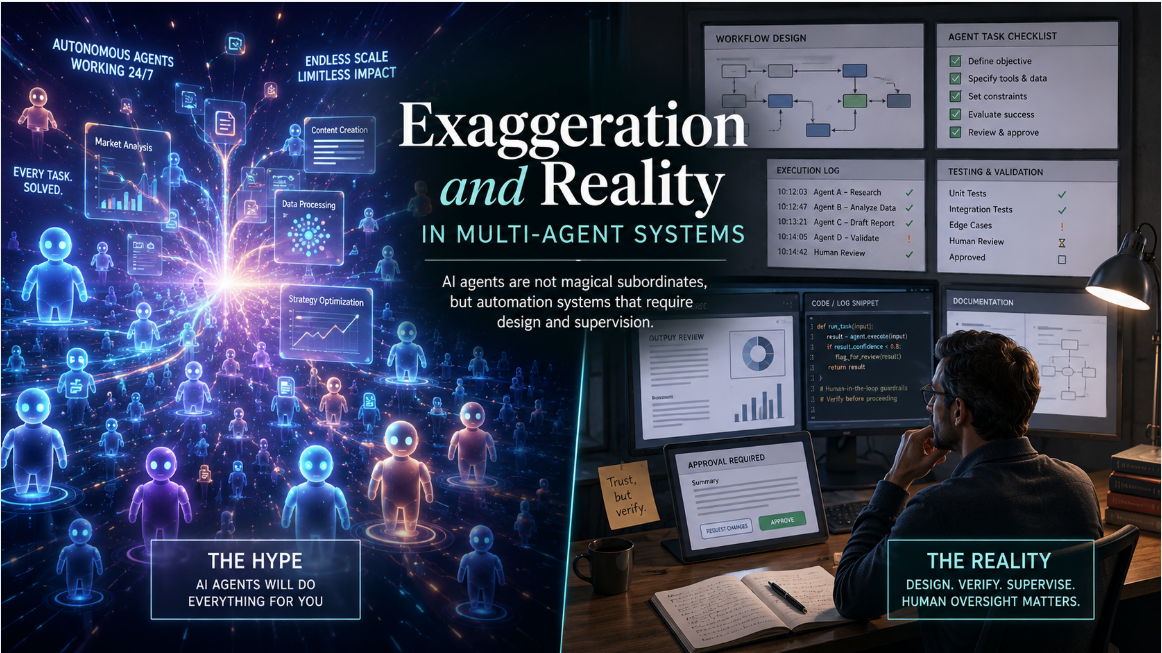
Introduction: The Fantasy of “AI Subordinates”
In recent months, a particular narrative has spread across YouTube, X, blogs, and business-oriented AI commentary: with tools such as ChatGPT Codex, Claude Code, Cursor, Devin, and other agent-based systems, a user can now simply give a rough instruction, and multiple AI agents will work like a team of subordinates.
This story is attractive. It suggests that programming, research, documentation, marketing, spreadsheet work, internal operations, and even business decision-making can be delegated to autonomous AI workers. In this view, the human manager only needs to say, “Build this,” “Research that,” or “Prepare a proposal,” and a group of AI agents will divide the work, coordinate with one another, execute the task, check the result, and deliver a finished product.
The reality is more complicated.
Multi-agent systems are not magic teams of digital employees. They are better understood as structured automation environments in which large language models are assigned roles, tools, memory, permissions, and workflows. They can be powerful, but they do not eliminate the need for clear requirements, careful supervision, verification, domain knowledge, or human judgment.
The core misunderstanding is this: people often confuse “multiple agents” with “multiple competent workers.” In practice, an AI agent is not a subordinate with independent responsibility. It is an execution process driven by a probabilistic language model, operating under constraints designed by humans. When the task is well-defined, verifiable, and supported by appropriate tools, agents can produce impressive results. When the task is vague, high-risk, politically sensitive, legally consequential, or strategically ambiguous, the system still requires strong human control.
What “Multi-Agent” Actually Means
The term “multi-agent system” is used in several different ways, which is one reason the public discussion becomes exaggerated.
In some cases, “multi-agent” simply means that one AI system assigns different roles to different prompts: planner, researcher, coder, reviewer, tester, critic, or summarizer. These are not independent people. They are role-conditioned language model calls.
In other cases, it means that separate agent sessions operate in different contexts. For example, one agent might inspect a codebase, another might write tests, and another might review the pull request. This can be useful, but it also creates coordination costs.
In more advanced systems, agents can use tools: browsers, terminals, APIs, calendars, email, documents, spreadsheets, code repositories, issue trackers, or internal databases. This moves them closer to workflow automation. However, tool access also introduces risk. The system may click the wrong button, misunderstand a page, overwrite a file, expose sensitive information, or take an action that should have required human approval.
Finally, some systems provide orchestration frameworks. These define how agents hand tasks to one another, when they stop, how they report intermediate results, how failures are handled, and what guardrails are applied. This is the part that is often hidden in casual explanations. A useful agent system is not created merely by saying, “Use several agents.” It requires workflow design.
The Source of the Exaggeration
The hype around multi-agent systems comes from several understandable but misleading impressions.
First, demonstrations are often carefully selected. A video may show an AI agent building a small app, fixing a bug, summarizing research, or preparing a slide deck. These examples can be real, but they are usually chosen because the task is suitable for the system. The viewer may not see the failed attempts, the prompt engineering, the retries, the manual corrections, or the hidden preparation.
Second, coding tasks are unusually well suited to agentic workflows. Code can often be tested. Errors can be detected by compilers, linters, unit tests, integration tests, or runtime logs. This makes coding more compatible with autonomous iteration than many business tasks. If an AI agent breaks a test, it can try again. If it produces an invalid function, the system can detect that failure.
By contrast, many non-engineering tasks do not have such clear validation mechanisms. A market analysis may sound persuasive but still be shallow. A sales proposal may be fluent but strategically wrong. A legal or financial summary may omit a crucial exception. A slide deck may look polished while missing the real business issue. The absence of an obvious error does not mean the work is correct.
Third, the word “agent” itself creates a misleading image. In ordinary language, an agent is someone who acts on behalf of another person. In AI, however, an agent is usually a model-driven process that can choose actions within a defined environment. It does not possess professional responsibility, organizational awareness, moral accountability, or reliable common sense.
Fourth, people often mistake parallel execution for managerial delegation. Running several agents at once does not automatically create a competent team. Without clear task boundaries, shared context, conflict resolution, and final validation, multiple agents can produce duplicated work, inconsistent assumptions, or mutually incompatible outputs.
Coding Agents: Powerful, but Not Autonomous Engineers
Tools such as Codex, Claude Code, Cursor, and Devin show that AI coding agents are becoming genuinely useful. They can inspect repositories, propose changes, write tests, generate documentation, explain unfamiliar code, refactor modules, and prepare pull requests. For experienced engineers, these tools can reduce routine work and accelerate exploration.
However, the claim that they replace engineering teams is premature.
A coding agent still needs a clear task. “Improve this product” is not enough. The agent needs to know the intended behavior, constraints, dependencies, acceptance criteria, and deployment environment. If these are missing, it may make plausible but incorrect assumptions.
A coding agent also needs verification. Tests, code review, security review, and deployment checks remain essential. In fact, as agents generate more code faster, the burden of review may become more important, not less. The bottleneck shifts from writing code to defining the right problem and judging whether the generated solution is safe, maintainable, and aligned with the product.
There is also a difference between a coding assistant and a software engineer. Software engineering includes requirements negotiation, architecture, maintainability, trade-off decisions, security, user needs, team coordination, incident response, and long-term ownership. AI agents can support parts of this work, but they do not assume responsibility for the system.
The realistic view is not that coding agents replace engineers. It is that they change the structure of engineering work. Human engineers may spend less time typing boilerplate and more time specifying intent, reviewing outputs, designing tests, managing architecture, and deciding what should not be automated.
Non-Engineering Agents: Useful, but Even Easier to Overhype
The same exaggeration now extends beyond coding. Some commentators suggest that multi-agent systems can handle general office work, research, marketing, consulting, sales support, documentation, project management, and even management decision-making.
There is some truth here. AI agents can already help with many non-engineering tasks:
- collecting and summarizing information;
- drafting reports, emails, proposals, and slide outlines;
- comparing products or competitors;
- extracting information from documents;
- organizing meeting notes;
- generating FAQ or knowledge-base content;
- preparing spreadsheet formulas or cleaning tabular data;
- drafting internal procedures;
- monitoring routine updates when connected to appropriate tools.
These are valuable capabilities. But they are not the same as replacing a professional worker.
The key issue is validation. In coding, tests can often reveal whether something works. In business work, the quality standard is more ambiguous. Is the analysis strategically meaningful? Are the assumptions realistic? Does the proposal fit the customer’s hidden concerns? Is the tone appropriate for a particular executive? Does the report omit important context? Does the recommendation conflict with company policy or legal constraints?
These questions cannot be answered by fluency alone.
AI agents are especially weak when the task depends on tacit knowledge, organizational politics, ethical judgment, negotiation, accountability, or the ability to understand what is not written down. They can imitate the surface form of professional work, but they may not understand the real stakes behind it.
This is why the phrase “AI subordinates” is dangerous. A subordinate can be trained, evaluated, held accountable, and integrated into an organization. An AI agent cannot be accountable in the same sense. It can execute, but it cannot own responsibility.
The Difference Between Automation and Delegation
The most important distinction is between automation and delegation.
Automation means that a system performs a defined process under specified conditions. Delegation means that responsibility is transferred to another competent actor.
AI agents provide automation that resembles delegation. They can receive instructions, take intermediate steps, use tools, and return results. But responsibility remains with the human user or organization.
This distinction matters in practice. If an AI agent sends an incorrect email to a customer, the company is responsible. If it generates misleading financial analysis, the human decision-maker is responsible. If it exposes confidential data, the organization is responsible. If it writes insecure code, the engineering team is responsible.
Therefore, the question is not “Can agents do the work?” The better question is: “Which parts of the work can be safely automated, under what constraints, with what verification, and with whose final approval?”
Why More Agents Do Not Automatically Mean Better Results
Another common misconception is that increasing the number of agents improves performance. This is not necessarily true.
Multiple agents can help when the task can be meaningfully divided. For example, one agent can research, another can draft, another can criticize, and another can revise. In coding, one agent can implement while another writes tests or reviews the patch.
However, more agents also create problems:
- duplicated effort;
- inconsistent assumptions;
- context fragmentation;
- higher token and tool costs;
- longer execution time;
- unclear responsibility;
- difficulty tracing why a decision was made;
- false confidence from apparent internal agreement.
If all agents are based on similar models, they may share similar blind spots. Having three agents agree with one another does not guarantee correctness. It may simply mean that three language model instances converged on the same plausible but wrong answer.
A useful multi-agent system needs orchestration. It must define who does what, what information each agent receives, when agents should challenge one another, how conflicts are resolved, and how final outputs are verified. Without this design, “multi-agent” can become an expensive way to produce confusion.
Where Multi-Agent Systems Are Genuinely Useful
A balanced critique should not deny the real value of agent systems. Their potential is significant, especially in structured, repeatable, information-heavy work.
They are useful when:
- the task can be decomposed into clear steps;
- the inputs and outputs are well defined;
- the system has access to the necessary tools and data;
- mistakes can be detected through tests, checks, or human review;
- the cost of failure is manageable;
- the workflow is repeated often enough to justify design effort.
For software development, this includes bug fixing, test generation, documentation, migration support, codebase exploration, and prototype implementation.
For business work, this includes research assistance, first-draft writing, knowledge-base construction, routine reporting, document comparison, customer-support draft preparation, and internal process automation.
For management, agents can support thinking by surfacing options, summarizing evidence, identifying contradictions, and preparing scenarios. But they should not be treated as independent decision-makers.
The best use of agents is not to remove humans from the loop. It is to improve the quality and speed of human work by handling lower-level execution while humans retain judgment.
Exaggerated Claims vs. Reality
| Exaggerated Claim | Reality |
|---|---|
| “Just give a rough instruction and agents will do the rest.” | Agents need clear requirements, context, constraints, and success criteria. Vague instructions produce vague or risky results. |
| “Multiple agents work like a team of subordinates.” | Most systems are role-based model calls or orchestrated workflows, not accountable human-like workers. |
| “AI agents can replace engineers.” | They can assist with coding, testing, refactoring, and documentation, but architecture, review, security, and responsibility remain human tasks. |
| “AI agents can automate all office work.” | They can support routine information work, but judgment-heavy tasks still require human supervision. |
| “More agents mean better output.” | More agents can increase coordination cost, inconsistency, and false confidence. |
| “Agents can check each other, so human review is unnecessary.” | AI review can help, but it cannot replace independent human verification in high-risk work. |
| “If the output looks polished, it is probably correct.” | Fluency is not reliability. Reports, proposals, and analyses may sound convincing while being incomplete or wrong. |
| “The system understands the business context.” | Agents only know the context they are given or can access. Tacit organizational knowledge is often missing. |
| “Once configured, agents keep improving automatically.” | Workflows require maintenance, evaluation, updated data, permission management, and error analysis. |
| “Multi-agent systems are digital employees.” | They are automation layers. Responsibility remains with the human user or organization. |
Implementation Checklist for Realistic Use
Before introducing a multi-agent system, organizations should ask the following questions.
1. Task Definition
Is the task clearly defined?
Can it be decomposed into steps?
What is the expected output?
What counts as success?
What should the agent not do?
2. Context and Data
What information does the agent need?
Is the information current and reliable?
Does the system have access to confidential data?
Are permissions properly limited?
3. Tool Access
Can the agent browse, edit files, send messages, run code, or access internal systems?
Which actions require human approval?
Can dangerous actions be blocked?
4. Verification
How will the output be checked?
Are there tests, validation rules, review procedures, or approval workflows?
Who is responsible for final judgment?
5. Failure Handling
What happens if the agent makes a mistake?
Can actions be rolled back?
Are logs available?
Can the process be audited?
6. Cost and Efficiency
Does the agent system actually save time?
Does running multiple agents cost more than the value of the output?
Is the workflow repeated often enough to justify automation?
7. Organizational Responsibility
Who owns the result?
Who approves customer-facing communication?
Who checks legal, financial, security, or reputational risks?
Without answers to these questions, a multi-agent system may create the appearance of productivity while increasing hidden risk.
The Coming Shift: From Chatbots to Workflow Systems
The importance of multi-agent systems should not be underestimated. The direction is real. AI tools are moving from chat interfaces toward workflow execution environments. They will increasingly connect to browsers, terminals, documents, calendars, email, repositories, databases, and business applications.
This means that AI will no longer be limited to answering questions. It will act inside work environments.
That shift is significant. It may change software development, research, consulting, customer support, internal operations, and knowledge management. But the shift also makes governance more important. The more an AI system can do, the more carefully its authority must be designed.
The future will not be “humans give vague orders and AI workers handle everything.” A more realistic future is that organizations will build structured human-AI workflows. Humans will define goals, constraints, values, and final judgments. AI agents will perform research, drafting, checking, transformation, and routine execution. The boundary between human judgment and machine execution will become one of the central design problems of knowledge work.
Conclusion: Agents Are Not Subordinates; They Are Structured Automation
The public discussion around multi-agent systems often jumps too quickly from impressive demonstrations to unrealistic conclusions. Yes, AI agents are becoming more capable. Yes, they can already support coding, research, documentation, and business workflows. Yes, multi-agent architectures will likely become an important layer of future work systems.
But the image of AI agents as obedient digital subordinates is misleading.
A subordinate can understand responsibility, learn from organizational context, negotiate ambiguity, and be held accountable. An AI agent cannot do these things in the same way. It can execute tasks, use tools, and generate outputs, but it remains dependent on human-designed context, constraints, and verification.
The practical value of multi-agent systems lies not in pretending that managers can replace teams with rough prompts. It lies in designing workflows where AI handles structured execution and humans retain responsibility for meaning, judgment, ethics, and strategy.
The real question is not whether AI agents can “work like subordinates.” The real question is whether humans can design reliable systems that use AI execution without surrendering human responsibility.
That is where the serious discussion should begin.
Reference Notes
This article is based on publicly available information and documentation concerning AI coding agents, browser/computer-use agents, and agent orchestration frameworks, including OpenAI Codex, ChatGPT Agent, Operator, the OpenAI Agents SDK, Anthropic Claude Code, Claude Code subagents, Anthropic computer-use documentation, Devin documentation, and recent benchmark research on agent performance in software and workspace environments.
The central conclusion is consistent across these sources: AI agents are becoming useful execution tools, but they still require clear task design, controlled permissions, supervision, validation, and human accountability.

 tada@aicritique.org