
 tada@aicritique.org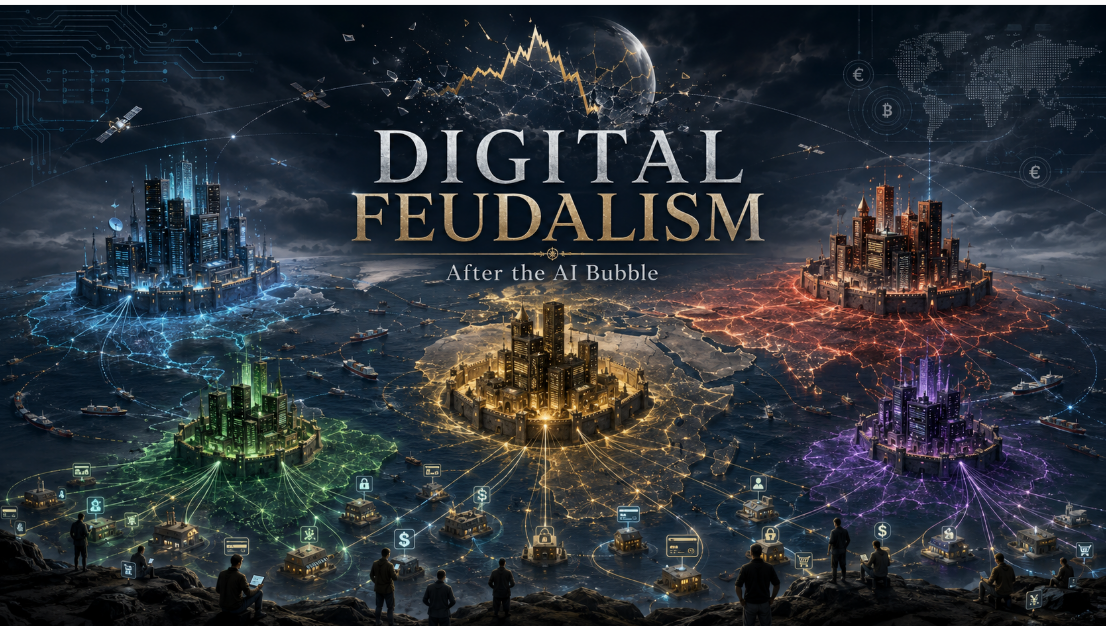
Introduction: This Is a Thought Experiment, Not a Prediction
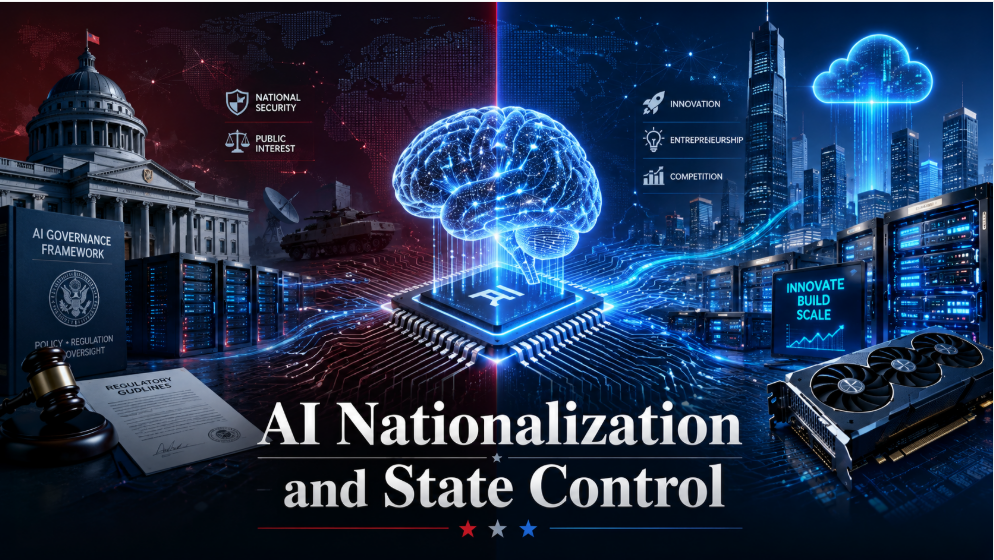
The rapid spread of generative AI has encouraged a powerful vision of the future: a small number of AI companies may eventually dominate the world.
In this scenario, corporations that develop enormous foundation models and control vast computing resources acquire intellectual and economic power that may exceed that of many nation-states.
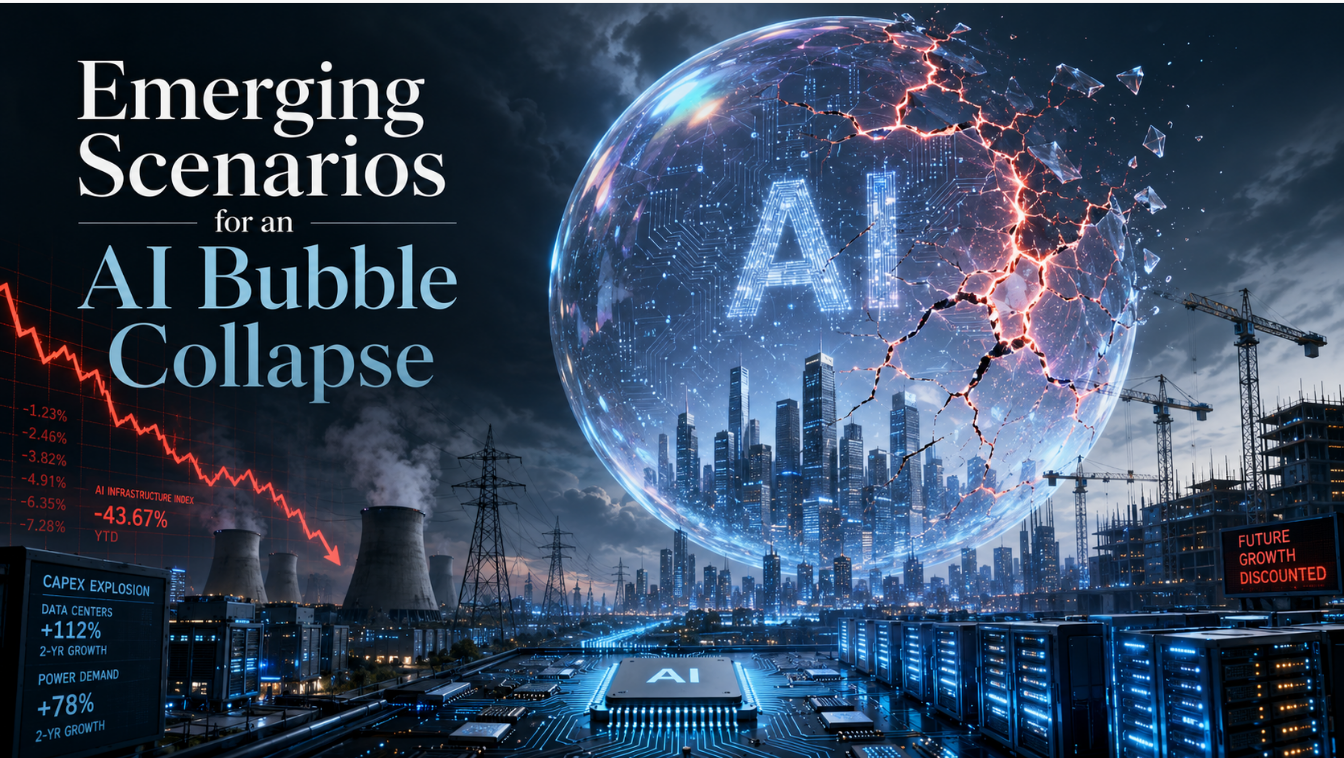
However, if excessive investment in AI fails to generate sufficient returns and the so-called AI bubble bursts, this scenario will have to be revised.
AI itself will not disappear. Just as the internet became social infrastructure after the collapse of the dot-com bubble, AI will continue to spread through every part of society. What may decline is the likelihood that a handful of emerging model companies will become the direct rulers of the global economy.
Power may instead shift toward companies that already control the foundations of modern economic life: cloud infrastructure, semiconductors, communications, payments, logistics, customer access, identity systems, and enterprise software.
This article considers a possible future in which the collapse of the AI bubble is followed by economic, military, and technological reorganization, eventually producing multiple geopolitical and corporate economic spheres.
It is not intended as a prophecy.
It is a thought experiment that asks what kind of social order might emerge if several changes already under way were extended in the same general direction.
The AI Bubble May Burst Without Weakening Corporate Power
The companies most vulnerable to an AI bubble collapse would be those attempting to sell foundation models themselves as highly profitable standalone products.
As Chinese models and open-weight systems become capable of delivering comparable performance with fewer computing resources, model prices are likely to fall. Users will be able to switch among multiple models according to price, performance, security, and purpose.
Large language models may gradually become interchangeable components, much like databases, electricity, or communication services.
But even if models become interchangeable, the infrastructure required to operate them will remain difficult to replace.
Practical AI depends on computing capacity, cloud services, networks, identity, payments, data management, enterprise applications, and access to customers. Companies that own these systems will retain enormous power even if individual model providers disappear.
An AI downturn may even strengthen incumbent platform companies.
Startups dependent on continuous funding may collapse, while their engineers, models, intellectual property, customers, and computing contracts are acquired by corporations with established cash flows.
The future in which one AI company becomes a global empire may recede. Yet the dominance of existing platforms may become even more entrenched.
Power will shift from the company with the most intelligent model to the company that controls access to the infrastructure through which intelligence is delivered.
The End of Unipolar American Power and the Reorganization of the World
This transformation would not take place only within the technology industry.
If the relative decline of the United States, the rise of China, confrontation with Russia, instability in the Middle East, European rearmament, and the growing autonomy of India and Southeast Asia all continue, the world may move from an American-centered unipolar order toward a system of multiple spheres of influence.
This would not necessarily produce a simple division between an American bloc and a Chinese bloc.
A country might depend on the United States for security, China for trade, the Middle East or Russia for energy, the dollar for finance, and Southeast Asia for manufacturing.
States would not belong entirely to a single camp. They would connect to different military, monetary, technological, resource, and information systems at the same time.
Companies would do the same.
A corporation might use American cloud infrastructure, Japanese or European manufacturing equipment, Chinese or open-source AI models, and domestic financial institutions for payments.
The world would not be divided on a single map. It would consist of overlapping networks of dependence.
State-Corporate Alliances as Digital Principalities
In this world, corporations would not simply replace governments and rule independently.
States and large companies would become increasingly interdependent.
Governments would provide electricity, spectrum, subsidies, procurement contracts, military protection, intellectual property rights, legal enforcement, and monetary systems.
Corporations would provide cloud infrastructure, AI, telecommunications, semiconductors, payments, logistics, surveillance, and information analysis.
Future conflict may therefore take the form of:
one state-corporate complex
competing against
another state-corporate complex.
An American sphere might combine government institutions with cloud, semiconductor, AI, financial, and defense companies.
A Chinese sphere might combine the state with telecommunications, payment, commerce, logistics, and AI platforms.
A European sphere might be built around regulation, the euro, industrial policy, and a partially independent technology ecosystem.
These formations would resemble modern principalities.
Their territories, however, would not consist primarily of land. Their domains would be cloud platforms, data, digital identity, payments, communications, logistics, and credit systems.
Why This Structure Resembles Feudalism
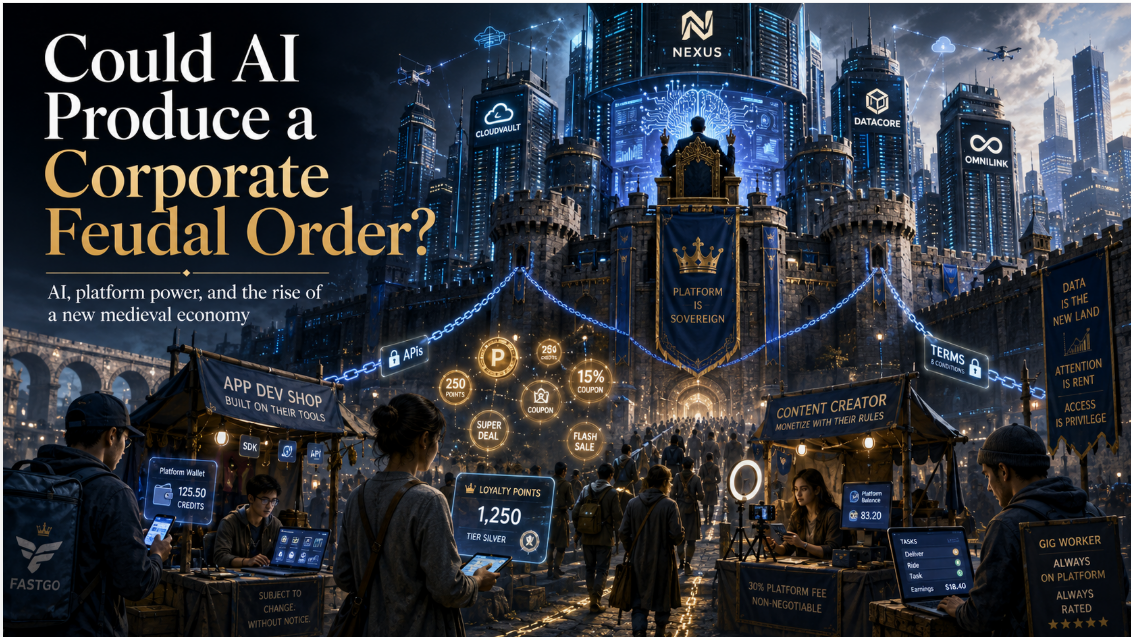
The feudal analogy does not arise simply because some corporations are very large.
It arises when individuals and companies become unable to leave the platforms on which their economic survival depends.
A business that relies on one ecosystem for sales, advertising, payments, logistics, AI, and customer management may remain legally independent while becoming economically incapable of operating outside the platform’s rules.
If the platform controls customer access, a change in search ranking or recommendation algorithms can make a product effectively invisible.
As sales increase, so do marketplace fees, advertising costs, payment charges, logistics expenses, cloud bills, and AI usage fees.
The platform collects rent at every stage of commercial activity.
Terms are not negotiated as ordinary business contracts. They are modified through standardized platform rules. Account suspension can become the equivalent of an order to cease trading.
The platform also has access to a wider field of information than any individual participant.
It can observe which products are growing, which prices customers will accept, which companies are losing credibility, and which supply chains are under stress. With AI, it can analyze the entire economic sphere and use that information for forecasting, pricing, lending, ranking, and supplier selection.
Member companies, by contrast, see only their own limited data.
This asymmetry allows the platform to evolve from a neutral intermediary into a governor of economic allocation.
Large Corporations as Intermediate Lords
Even large companies would not be fully sovereign in this structure.
They would depend on higher-level providers of cloud infrastructure, operating systems, semiconductors, payments, advertising, and AI.
At the same time, they would exercise authority over their own suppliers, distributors, contractors, and franchisees.
Automotive companies, trading houses, retailers, financial institutions, and telecommunications firms could require their partners to use designated procurement systems, comply with cybersecurity certifications, share emissions data, provide traceability records, integrate with AI forecasting systems, and accept specified payment or logistics arrangements.
Large corporations would therefore function as intermediate lords.
They would pay rent upward to global platforms while imposing standards and extracting data downward from smaller companies.
Medium-sized companies would face the difficult question of which economic spheres to join.
Concentrating on one platform may increase efficiency, but it also creates vulnerability to rule changes, pricing changes, or exclusion.
Supporting multiple platforms may preserve autonomy, but it increases the cost of certification, software development, data integration, and compliance.
Small businesses would face an even sharper trade-off.
Joining a platform would provide low-cost access to sales, payments, logistics, advertising, and AI. Yet over time, the company might lose direct customer relationships, pricing power, brand independence, and control of transaction data.
Maintaining independence would require direct customers, specialized knowledge, local trust, physical capabilities, or expertise that is difficult to replace.
Individuals would be subject to the same logic.
If work, credit, payment, purchasing, education, healthcare, insurance, and communication were integrated into a single corporate ecosystem, a person would remain a citizen of a state while also becoming a user, worker, debtor, customer, and data source within a platform domain.
Account suspension or a reduced credit score could affect an entire life.
AI Agents as Gatekeepers of Economic Life
The widespread use of AI agents could deepen this feudal structure.
In the future, consumers and businesses may no longer search for products and suppliers themselves. They may delegate selection to AI agents.
An agent could compare price, quality, delivery time, creditworthiness, contractual conditions, and environmental impact before choosing a supplier.
For companies, the central problem would no longer be how to attract human attention. It would be how to appear on the candidate list generated by an AI system.
Businesses would be required to publish data in approved formats, provide APIs, integrate inventory and pricing systems, obtain specified certifications, and accept compatible payment methods.
Companies that cannot meet these requirements may become invisible to machine-mediated markets.
If the platform company also controls the dominant AI agent, it could decide which products are recommended and which suppliers receive orders.
The platform would move from controlling search rankings to controlling the allocation of transactions themselves.
A Strategy for Survival: Multiple Affiliations Rather Than Total Independence
The rational response to such a society would not be to reject all major platforms.
That would mean exclusion from the market.
A more realistic strategy would be:
trade with multiple digital lords while refusing to surrender one’s core assets.
This would not amount to complete independence. It would be a strategy of diversified dependence.
A company could avoid placing its cloud infrastructure, AI models, payment systems, and sales channels under the control of a single provider.
It could retain its own copies of customer data, operating history, knowledge, decision rules, contracts, and data structures.
It could ensure that changing an external service would not require rebuilding the company’s entire organizational memory from the beginning.
Individuals could apply the same principle.
They could avoid concentrating work, income, payments, communication, and personal data in a single corporate account. They could maintain multiple clients, income sources, communication channels, and payment methods.
In a digital feudal order, freedom would not mean depending on no one.
It would mean retaining the ability to negotiate among several powers.
Data Alone Is Not Enough to Preserve Sovereignty
Digital sovereignty is often understood as the ability to store data on one’s own servers or within a domestic cloud.
But corporate sovereignty cannot be protected by preserving files alone.
The most important assets of an organization include:
- which customers it considers important,
- how it handles exceptional situations,
- which information sources it trusts,
- which risks it is willing to accept,
- what it has learned from success and failure,
- how it conceptualizes its business,
- and under what conditions it makes particular decisions.
These are the organization’s distinctive structures of perception and judgment.
If they become embedded inside an external AI system or SaaS platform, the organization may lose its accumulated experience when the service is changed or terminated.
The real requirement is therefore not merely a backup.
It is a mechanism for preserving organizational knowledge, concepts, processes, decisions, and episodes independently of external platforms.
The Idea of an Organizational Sovereignty Layer
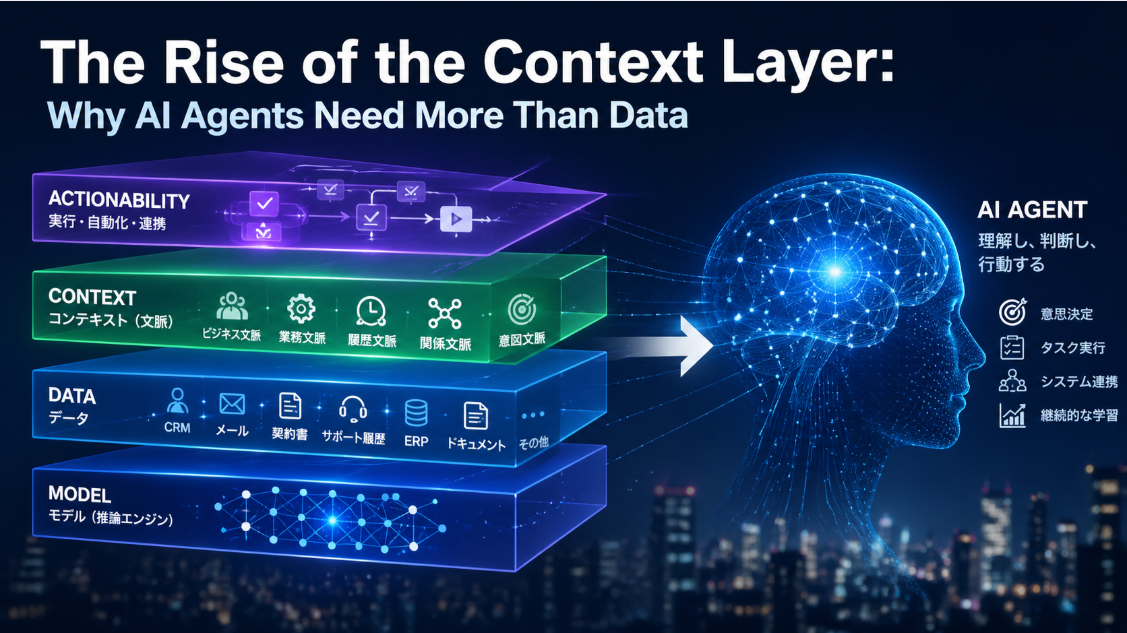
Future enterprise systems may need to separate two layers.
One layer would use external AI models, cloud services, and digital platforms.
The other would preserve the organization’s own memory, concepts, processes, and judgment.
External AI systems should be replaceable.
A company might use an American model for one task, a Chinese or open-weight model for another, and combine cloud and local computing environments.
But the organization’s knowledge and decision structures should not become the property of a specific model provider or cloud platform.
This independent layer could be described as an organizational sovereignty layer.
It would preserve:
- documents and knowledge bases,
- business processes,
- relationships among customers, cases, and events,
- decision patterns,
- exceptional procedures,
- records of success and failure,
- organization-specific conceptual structures,
- and the context and long-term memory used by AI systems.
As long as this layer remains intact, an organization can change its external tools without losing its identity and accumulated experience.
AI as a Component Rather Than a Ruler
Within this future, the large language model would not be a sovereign intelligence governing the world.
It would be a component that interprets external information, connects it to organizational memory, and supports operations and decisions.
The critical advantage would not be ownership of the most powerful model.
It would be the ability to preserve and reuse the organization’s context, concepts, memory, and decision logic regardless of which model is currently used.
The value that remains after the AI bubble bursts would be:
organizational capability that survives changes in AI technology.
This is very different from attempting to build yet another giant platform and become a new digital lord.
It is a strategy of creating the technical means to work with several lords without losing oneself.
Conclusion: In the New Order, Freedom Will Depend on the Ability to Exit
This thought experiment describes a future in which complete independence becomes increasingly difficult for states, companies, and individuals.
States would belong simultaneously to several military, monetary, technological, and resource networks.
Companies would depend on multiple cloud, payment, sales, and AI platforms.
Individuals would live within several corporate economic spheres.
In such a society, freedom could not be preserved by abstract legal rights alone.
It would also depend on whether one could:
- export one’s data,
- retain direct customer relationships,
- replace AI models,
- continue operating when a payment, communication, or cloud provider failed,
- and preserve one’s own experience and decision-making capacity.
The new meaning of freedom would not be the absence of dependence.
It would be:
the ability to choose one’s dependencies,
the ability to move among several economic spheres,
the ability to exit when necessary,
and the ability to leave without losing oneself.
No one can know whether the post-bubble world will actually become a multi-polar digital feudal order.
But as cloud infrastructure, AI, payments, communications, and logistics become concentrated in a small number of companies—and as governments become increasingly dependent on those companies—the question of where organizations and individuals store their sovereignty has already become unavoidable.
Preparing for that question would remain worthwhile even if the thought experiment itself never fully comes true.
 ChatGPT