
 ChatGPT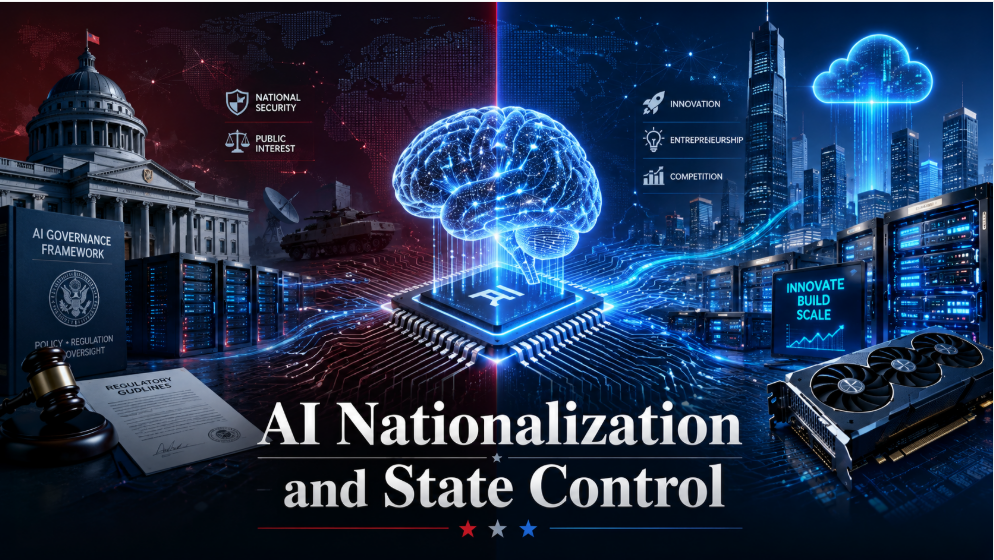
Executive summary
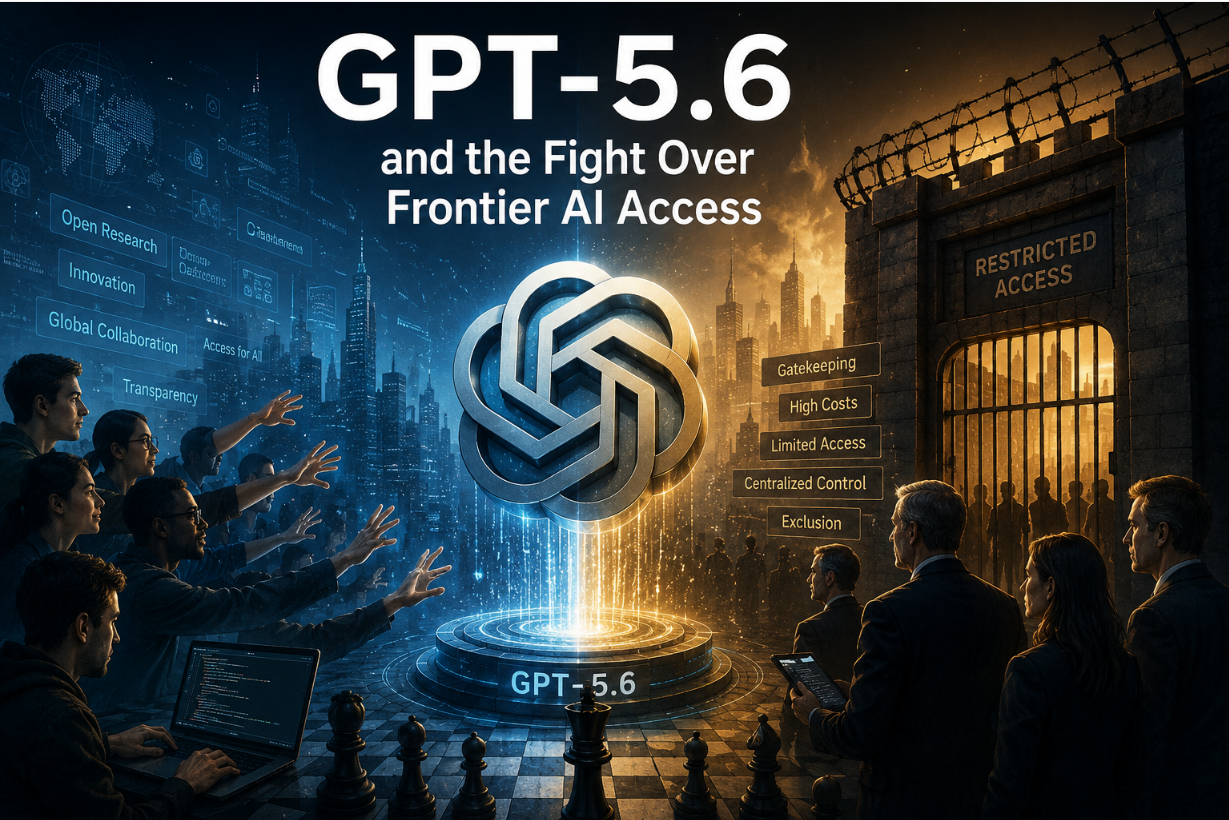
The practical policy question is no longer whether governments will literally own AI companies. It is whether states will control the strategic chokepoints of AI: the chips, data centers, cloud clusters, safety evaluations, model releases, procurement rules, export permissions, and liability regimes that determine who can build and deploy frontier systems. Across the United States, European Union, United Kingdom, Japan, and multilateral forums such as the G7, OECD, and United Nations, the policy trend is toward hybrid governance rather than full nationalization: private-sector development remains central, but public authorities are increasingly asserting control over security-sensitive infrastructure, high-risk uses, and frontier-model oversight. China is the clearest example of a more state-led model, combining industrial promotion with filing requirements, content controls, and national-security governance.
This shift is being driven by three realities. First, frontier AI is increasingly tied to national power: advanced chips, high-bandwidth memory, semiconductor tooling, large clusters of GPUs, electricity, and specialized data centers have become geopolitical assets. U.S. export controls explicitly treat advanced compute and large AI clusters as national-security sensitive, while the International Energy Agency now estimates that data centers consumed about 415 TWh in 2024 and could reach about 945 TWh by 2030, making AI infrastructure look more like energy and telecom infrastructure than ordinary software. Second, frontier model development is concentrated in private industry: Stanford’s 2025 AI Index reports that nearly 90% of notable AI models in 2024 came from industry. Third, both governments and frontier labs now openly discuss catastrophic-risk governance, evaluations, security of model weights, and threshold-based safeguards as policy issues rather than purely internal corporate matters.
The strongest case for stronger state control is not ideological. It is strategic. Governments argue that AI is becoming critical infrastructure; that a small number of firms can shape information flows, labor markets, military capabilities, and cyber offense; that catastrophic misuse risks may outstrip voluntary self-governance; and that public institutions need visibility into frontier training runs, secure model weights, incident reporting, and compute distribution. These arguments now appear not only in government documents but also in company statements from OpenAI, Microsoft, Anthropic, and Google DeepMind, all of which have endorsed some combination of frontier-evaluation regimes, safety frameworks, or licensing-like oversight for the most capable models.
The strongest case against nationalization or excessive state control is also substantial. Critics warn that heavy-handed public control could slow innovation, entrench incumbent firms by raising compliance costs, centralize surveillance power, weaken open-source ecosystems, and intensify techno-national rivalry. The current U.S. administration has explicitly framed “overly burdensome regulation” as a threat to American AI leadership, Google has argued for risk-based and innovation-friendly rules rather than a patchwork of heavy restrictions, and Meta has made open-weight AI a direct argument against concentrated control by either dominant companies or gatekeeping platforms. China’s system also shows the political downside of state-led governance: filing, content controls, and “core socialist values” requirements can easily blur safety regulation with censorship and state information control.
For an article aimed at general readers and business professionals, the most evidence-based conclusion is this: full AI nationalization is neither the dominant global trend nor the most plausible near-term policy outcome in market democracies. The real debate is over how far states should go in controlling the AI stack’s strategic layers. The most likely medium-term outcome is a mixed model: privately led innovation, public regulation of high-risk uses, public-private safety testing, tighter control over compute and chips, and a growing category of “sovereign AI” infrastructure built with state support or under state conditions.
Background of the debate
The modern debate over AI nationalization began when generative AI moved from a research topic to a mass-market capability and then, very quickly, to a national-security issue. Large language models and multimodal foundation models now sit at the intersection of software, cloud infrastructure, semiconductor supply chains, electricity systems, and geopolitical competition. U.S. export controls explicitly link advanced chips and large compute clusters to concerns about adversaries obtaining the capability to develop or run advanced AI models; the rules describe “large clusters of advanced computing ICs” as essential to advanced AI development and treat their location and access as policy levers.
The economic structure of AI magnifies the debate. Stanford’s 2025 AI Index reports that nearly 90% of notable AI models in 2024 came from industry, a sharp increase from 60% in 2023, which means that control of the frontier has moved decisively into corporate hands even as the public consequences of those models have widened. The same report says training compute continues to scale rapidly, while the number of AI-related incident reports reached 233 in 2024, a record high. That combination—commercial concentration plus rising public risk—helps explain why calls for stronger public oversight have proliferated.
At the same time, AI increasingly looks like infrastructure. The IEA estimates that data centers accounted for around 1.5% of global electricity consumption in 2024, or roughly 415 TWh, and projects that data center electricity consumption could more than double to around 945 TWh by 2030. The United States alone accounted for 45% of global data center electricity use in 2024, and nearly half of U.S. data center capacity is concentrated in five regional clusters. Once a technology becomes this physically concentrated and energy intensive, the analogy shifts away from “just software” and toward electricity grids, telecom networks, shipping routes, and defense-industrial capacity.
That is why policymakers increasingly compare AI with older strategic sectors. In the United Kingdom’s 2023 paper on frontier AI safety, the government explicitly framed AI as a field where frontier organizations might need safety processes analogous to those used in other high-consequence settings, while RAND’s 2025 report on frontier AI security drew case studies from nuclear, chemical, and health-care compliance regimes. Anthropic’s Responsible Scaling Policy borrows from U.S. biosafety levels, and Microsoft has argued that licensing-like approaches may be appropriate once highly capable models operate critical infrastructure. In other words, historical analogies are no longer rhetorical decoration; they are shaping live policy design.
A second background shift is conceptual. The debate has moved from “ownership of AI” to “control of the AI stack.” Full nationalization would mean state ownership of labs or model providers. But current policy fights focus more often on who controls: access to top-end GPUs, advanced semiconductor equipment, hyperscale data centers, cloud regions, training data governance, public-sector procurement, independent evaluations, and the threshold for releasing model weights. The most important political question is therefore not “Should the state own ChatGPT or Gemini?” but “Who gets to authorize, monitor, limit, or prioritize the systems that increasingly mediate work, public information, cyber defense, and state capacity?”
This is also why international institutions have entered the field. The Bletchley Declaration said AI should be “designed, developed, deployed, and used” in ways that are safe, human-centric, trustworthy, and responsible. The UN’s March 2024 General Assembly resolution called on member states and stakeholders to develop governance approaches for safe, secure, and trustworthy AI, while also emphasizing equitable access and support for developing countries, including infrastructure, procurement capacity, and access to data and compute resources. The OECD’s Hiroshima AI Process and updated AI Principles similarly frame AI governance as a matter of transparency, risk management, interoperability, and international coordination rather than simple public-versus-private ownership.
What the term nationalization should mean in this debate
For this topic, “AI nationalization” is best understood as a spectrum rather than a binary. At one end is full state ownership of labs, compute facilities, or cloud providers. In the middle are softer but still powerful forms of control: licensing rules for frontier models, mandatory incident reporting, public audits, compute thresholds, export controls, regulated sovereign clouds, and state-led safety institutes. At the lighter end are procurement preferences, public funding for national AI infrastructure, and voluntary codes backed by public evaluation and market pressure. The user’s framing is therefore exactly right: the true debate is over ownership, control, oversight, and chokepoint governance across the whole AI stack.
Arguments in favor of stronger state control
The most persuasive argument for stronger state control is national security. U.S. policy now treats advanced AI chips, semiconductor manufacturing tools, and large compute clusters as strategic assets. BIS has repeatedly tightened controls on advanced computing items and semiconductor manufacturing equipment tied to China, and its January 2025 AI Diffusion framework explicitly linked export policy to preventing countries and end users of concern from obtaining the most advanced AI capabilities. Even after the specific January 2025 diffusion rule was later rescinded, the replacement direction still emphasized keeping advanced AI technology out of adversaries’ hands and tightening chip-related export controls. The policy message is clear: compute is not being treated like an ordinary commodity.
A second pro-control argument is market power. When frontier models, cloud capacity, data-center leases, and top-end GPU supply are concentrated in a small number of firms, private incentives alone may not align with public needs. The AI Now Institute has argued that the field is increasingly shaped by the concentration of economic and political power in Big Tech, while the UK Competition and Markets Authority has spent two years examining the market structure around foundation models and their implications for competition and consumer protection. Stanford’s finding that industry now produces nearly 90% of notable frontier models gives this concern empirical weight.
A third argument turns on catastrophic risk and loss-of-control concerns. Anthropic’s Responsible Scaling Policy commits the company not to train or deploy models capable of catastrophic harm unless safeguards are adequate. OpenAI’s Preparedness Framework tracks risks including cybersecurity, CBRN, persuasion, and model autonomy. Google DeepMind’s Frontier Safety Framework is built around severe-harm capabilities such as sophisticated cyber capabilities or exceptional agency. And the Seoul Summit commitments, signed by 16 companies from the U.S., China, Europe, the Middle East, and Asia, say firms should be prepared in extreme circumstances to “not develop or deploy a model or system at all” if risks cannot be adequately mitigated. When the firms themselves describe frontier models in these terms, the case for public backstop institutions becomes much stronger.
The public-good argument is broader. The UN General Assembly’s 2024 AI resolution explicitly ties safe and trustworthy AI to sustainable development, equitable access, capacity building, digital infrastructure, procurement capacity, and the closing of AI divides between countries. This matters because AI’s inputs—data, compute, specialized talent, power, and cloud access—are distributed very unevenly. If AI raises productivity and public-administration capacity but only a handful of companies and countries control the infrastructure, then the political pressure for redistribution and public-interest governance will likely grow.
Labor and social-stability concerns reinforce that case. The OECD Employment Outlook 2023 estimated that occupations at the highest automation risk account for about 27% of employment in the countries studied, and that three in five workers worried about losing their jobs entirely to AI in the next ten years. Anthropic’s recent labor-market work similarly finds that users who report the largest speedups from AI also report more concern about job displacement, especially in more exposed and earlier-career roles. Even if those fears prove overstated, they strengthen the argument that states cannot leave the distributional consequences of AI entirely to market forces.
Disinformation, cyber offense, and incident growth are another part of the pro-control case. Stanford’s AI Index reports 233 reported AI-related incidents in 2024, up 56.4% from 2023. China’s 2025 labeling rules now require explicit and implicit marking of AI-generated text, images, audio, video, and virtual scenes, while the EU AI Act creates transparency obligations for AI-generated content and deepfakes. The spread of labeling rules across very different political systems suggests a common judgment: AI-mediated information environments generate harms that markets alone do not reliably internalize.
The strongest institutional version of the pro-control case is therefore not classic state ownership. It is state capacity: governments need the ability to audit, test, procure, restrict, and prioritize AI systems when public safety or national security is at stake. Microsoft’s 2023 blueprint called for government-led safety frameworks, “safety brakes” for AI controlling critical infrastructure, a national registry for high-risk AI, and eventually a multitier licensing regime for highly capable models involved in safety-critical functions. OpenAI told the U.S. Senate it supports registration, disclosure, and licensing requirements for future generations of the most highly capable foundation models. RAND’s 2025 report likewise proposed several credible governance models, including government-enforced standards for high-risk developers and government authorization for federal use.
Comparison table for the pro-control case
| Claim for stronger control | Core rationale | Evidence base |
|---|---|---|
| National security requires public control of AI chokepoints | Advanced chips, HBM, semiconductor tools, and large clusters are now treated as strategic assets | BIS export-control rules and related guidance explicitly link advanced AI compute to U.S. national-security concerns. Official sources: |
| Frontier labs cannot be left to self-regulate alone | Labs themselves describe severe cyber, CBRN, autonomy, and catastrophic-risk concerns | OpenAI, Anthropic, and Google DeepMind all maintain frontier-risk governance frameworks; Seoul commitments add a public pledge not to deploy intolerable-risk systems. Official sources: |
| AI’s economic benefits should not be captured by a few firms | Frontier model development and compute access are highly concentrated | Stanford AI Index shows industry dominance in notable model production; AI Now and CMA have focused on concentration and competition risks. Sources: |
| AI is becoming public infrastructure | Physical dependence on electricity, data centers, and public services makes AI an infrastructure policy issue | IEA data center demand projections and UK/Japan public-compute planning both point in this direction. Official sources: |
| State-led audits, licensing, or authorization may be necessary | High-risk systems require external verification, not only internal compliance | Microsoft, OpenAI, and RAND all describe licensing/authorization-style approaches for the most capable systems. Sources: |
Arguments against nationalization or excessive state control
The strongest argument against nationalization is that AI is still moving too quickly for direct state ownership or centralized command to outperform private experimentation. The current U.S. administration has explicitly argued that the United States leads in AI because it refuses to “stifle this innovation with overly burdensome regulation,” and the January 2025 executive order on AI similarly framed American leadership as the product of free markets, world-class research institutions, and entrepreneurial energy. Google’s comments on the U.S. AI Action Plan likewise favored risk-based rules, access to data for fair learning, and nationally consistent but pro-innovation frameworks rather than broad restrictions that might reduce investment or slow infrastructure buildout.
A related objection is that heavy state control can quietly become incumbent protection. OpenAI itself has supported licensing for the most capable future foundation models, but it also warned that licensing mechanisms must avoid unduly burdening smaller firms. RAND similarly warns that overly stringent requirements could limit innovation, create barriers for small firms, and harm competitiveness. This is one reason civil-society critics sometimes view frontier-licensing proposals ambivalently: the same rule that increases safety can also favor the largest labs that already have legal teams, compute budgets, and regulator access.
The surveillance and censorship objection is even more serious. China’s generative AI rules require providers to uphold “core socialist values,” prohibit a wide range of politically sensitive outputs, and combine innovation policy with filing, content controls, and enforcement powers. China’s regulatory system also uses filings and public registration for models with public-opinion or social-mobilization capacity, and its 2025 labeling rules require AI-generated content to carry explicit and implicit identifiers. It is reasonable to infer from this system that stronger state control can drift from safety governance into political information control, especially where speech protections are weak.
There is also a democratic-liberties version of this concern outside China. If governments obtain broad authority over model licensing, model release, infrastructure access, and content provenance systems, they may gain de facto leverage over speech systems, search intermediaries, news ecosystems, and public-sector decision tools. The EU AI Act’s bans on certain manipulative, social-scoring, and biometric practices reflect a European attempt to draw constitutional boundaries around state and private AI power alike. That framework is not nationalization; it is rights-constraining regulation designed precisely because too much centralized control—public or private—can be dangerous.
Another counterargument is that private and open-source ecosystems matter for resilience and competition. Meta’s case for open-weight AI is that broader access lowers barriers to entry, improves cost-performance, and prevents a handful of proprietary providers from acting as gatekeepers. EFF, from a civil-liberties angle, has likewise argued that requiring rightsholder authorization for AI training would raise barriers and limit competition to companies with the largest data troves or most bargaining power. These arguments do not reject regulation altogether, but they oppose governance models that turn AI into a permissioned club for a few firms or a few governments.
Finally, state-centric control can worsen international rivalry. The United States now openly prioritizes “global AI dominance,” while China’s AI Plus agenda and government-use policies are integrating AI into industrial modernization and public administration. In the UK, the AI Opportunities Action Plan explicitly argues for domestic and sovereign compute; NVIDIA markets “sovereign AI” as a national capability; and OpenAI’s “OpenAI for Countries” seeks to help governments build in-country AI infrastructure. A world in which every major state seeks sovereign AI capacity is not one of nationalization in the classic sense. But it is a world of techno-nationalism, subsidy races, and strategic fragmentation.
Comparison table for the anti-control case
| Critique of stronger state control | Why critics raise it | Evidence or illustration |
|---|---|---|
| Innovation could slow | AI capability and infrastructure are moving faster than public bureaucracies | U.S. White House and Google documents stress avoiding burdensome rules and preserving investment incentives. Official sources: |
| Rules may entrench incumbents | Large firms can absorb compliance costs better than startups and open communities | OpenAI and RAND both flag the design problem of avoiding unnecessary burdens on smaller firms. Sources: |
| State control can become censorship or surveillance | AI regulation can be fused with ideology, speech control, and mandatory filing | China’s CAC framework provides the clearest live example. Official sources: |
| Open-source ecosystems could be weakened | High barriers can reduce competition and transparency from outside the biggest labs | Meta’s open-source argument and EFF’s competition concerns about training restrictions both point this way. Sources: |
| Techno-nationalism may intensify | States may respond to AI risk by hoarding compute and building rival sovereign stacks | U.S., China, UK, NVIDIA, and OpenAI all now speak in sovereignty or strategic-competition terms. Sources: |
Country and regional policy comparison
The most important comparative finding is that the major jurisdictions are not converging on a single model. The United States prioritizes private-sector leadership within an increasingly national-security framework. The European Union prioritizes rights, transparency, and risk-based regulation. China combines state-led industrial strategy with harder controls over public-facing AI outputs and registrations. The United Kingdom emphasizes frontier testing, safety diplomacy, and public compute capacity. Japan remains more soft-law oriented but is moving toward state-supported evaluation, procurement governance, and advisory oversight for higher-risk public-sector deployments.
Comparison table by jurisdiction
| Jurisdiction | Dominant model | What it is doing now | What this means for the nationalization debate |
|---|---|---|---|
| United States | Private-sector leadership with strategic-state controls | The White House in 2025–2026 shifted toward pro-innovation policy, while BIS kept tightening chip and semiconductor controls and NIST’s CAISI was set up to evaluate national-security risks in commercial AI. Official sources: | The U.S. is not nationalizing AI firms, but it is clearly asserting state control over the most strategic inputs and evaluations. |
| European Union | Risk-based regulation with central oversight for GPAI systemic risk | The AI Act applies a four-tier risk model, bans certain practices, imposes strict obligations on high-risk systems, and centralizes oversight of systemic-risk GPAI at the Commission level, supported by the AI Office and the GPAI Code of Practice. Official sources: | The EU is the strongest case of robust regulation without ownership. |
| China | State-led industrial development plus hard content and filing controls | China’s 2023 generative AI measures combine support for innovation with national-security regulation, “core socialist values,” filing and registration mechanisms, and content-labeling obligations. Official sources: | China is closest to a state-control model, though even there private firms remain major developers. |
| United Kingdom | Safety diplomacy, evaluation capacity, and selective sovereign compute | The UK launched the AI Safety Summit, created the AI Safety Institute, later renamed the AI Security Institute, secured company safety commitments, and proposed a portfolio that includes sovereign AI compute owned or allocated by the public sector. Official sources: | The UK favors state capability and public testing more than direct ownership of firms. |
| Japan | Soft law, business guidelines, and public-sector governance scaffolding | Japan established an AI Safety Institute, updated AI business guidelines, and issued detailed government procurement and utilization rules that require risk assessment, Chief AI Officers, and advisory review for higher-risk public-sector use cases. Official sources: | Japan remains market-oriented, but public oversight is becoming more structured. |
| Other notable cases | Sovereign AI and infrastructure partnerships | OpenAI’s “OpenAI for Countries,” Microsoft’s UAE investment with G42, NVIDIA’s sovereign-AI push, and Anthropic’s cooperation with Australia, Korea, and Japan show a broader move toward state-backed AI infrastructure and evaluation partnerships. Official sources: | These cases suggest the rise of public-private “sovereign AI” rather than classic nationalization. |
Short country notes
In the United States, the deepest form of state control is not ownership but security leverage. Export controls, federal procurement, national labs, and evaluation bodies such as CAISI are the operative tools. The January 2025 AI Diffusion framework would have extended this even further by controlling the global location of large compute clusters, though it was later rescinded and replaced by a differently framed but still security-centered approach.
In the European Union, the center of gravity is law and rights, not industrial secrecy or national-security dominance alone. The AI Act’s structure is explicitly risk-based, and for general-purpose AI models with systemic risk it moves toward model evaluation, risk assessment, and Commission-centered supervision. This is perhaps the cleanest contemporary example of “regulation, not nationalization.”
China stands apart because it integrates industrial policy, state supervision, and speech control. The same state that promotes AI as an industrial priority also requires filings, enforces labeling, and mandates ideological compliance in public-facing outputs. That makes China highly relevant to the debate not because it has nationalized all AI, but because it shows how quickly safety and security arguments can be merged with direct state information power.
Japan’s approach is important because it is often described as “light-touch,” yet its actual trajectory is more structured than that phrase suggests. Japan’s business guidelines, AI Safety Institute, and public-sector procurement rules show a model in which law remains relatively soft, but state coordination, evaluation methods, and use-case governance gradually intensify. For business readers, Japan is a good example of how a country can move from soft law to operational oversight without leaping to hard licensing first.
Positions of major companies, researchers, and policy institutions
The corporate story is striking: the leading AI companies do not generally advocate outright laissez-faire. Most of them now support some version of safety evaluation, structured reporting, or selective oversight for frontier systems. The differences lie in scope and design. Many companies want rules focused on the frontier, where they already operate, rather than broad obligations that would weigh equally on the whole ecosystem.
Comparison table of major actors
| Actor | Main position | What it implies |
|---|---|---|
| OpenAI | Supports preparedness governance, high-risk evaluations, and for future highly capable foundation models, “registration, disclosure, and licensing requirements.” It is also actively promoting country-level infrastructure partnerships through OpenAI for Countries. Sources: | OpenAI is not arguing for nationalization; it is arguing for selective state oversight at the frontier, alongside public-private infrastructure deals. |
| Anthropic | Uses a Responsible Scaling Policy tied to capability thresholds and has expanded cooperation with U.S., UK, Japanese, Korean, and Australian government bodies on evaluations and safety research. Sources: | Anthropic is one of the clearest examples of a company accepting frontier-specific governance and public evaluation. |
| Google DeepMind | Uses a Frontier Safety Framework and argues for pro-innovation but risk-based regulation, standards, and protocols for frontier AI risks. Sources: | DeepMind favors structured oversight, but within an innovation-oriented framework. |
| Meta | Argues that “open source AI is the path forward,” emphasizes broader access and competition, and has promoted open-weight releases plus open safety tooling. Sources: | Meta is the leading large-company counterweight to tightly closed or licensing-heavy models of control. |
| Microsoft | Calls for government-led AI safety frameworks, safety brakes for critical infrastructure, transparency mechanisms, public-private partnerships, and ultimately a licensing-style regime for highly capable systems in safety-critical contexts. Sources: | Microsoft’s approach is one of the strongest corporate arguments for structured state oversight without public ownership. |
| NVIDIA | Promotes “sovereign AI” and works directly with governments and national champions to build AI factories, sovereign clouds, and national GPU infrastructure. Sources: | NVIDIA’s framing normalizes the idea that states will want national AI infrastructure even if they do not own model companies. |
| UK AI Security Institute | Conducts frontier evaluations and presents itself as a research organization within government focused on national security and public safety. Sources: | A model of state testing capacity rather than state ownership. |
| OECD and G7 | Promote transparency, comparability, voluntary reporting frameworks, interoperable AI principles, and codes of conduct for advanced AI. Sources: | A multilateral route toward governance short of nationalization. |
| UN | Frames AI policy around safe and trustworthy systems, equitable access, capacity building, closing AI divides, and public-interest infrastructure in developing countries. Sources: | The UN debate is less about state ownership than about fair access and global public governance. |
| Civil-society and public-interest groups | AI Now emphasizes concentration of tech power and “public AI”; EPIC presses for privacy, data minimization, and stronger safeguards; EFF warns against regulatory choices that lock in dominant firms or restrict open innovation. Sources: | Civil society often wants stronger oversight than companies do, but not necessarily in the same form. |
Where companies and public-interest groups diverge
The most important divergence is not “regulation versus no regulation.” It is which regulation, applied to whom, and for what purpose. OpenAI, Anthropic, Microsoft, and Google have all endorsed some form of frontier-risk governance, standardized evaluations, or licensing-style accountability for highly capable systems. Those proposals often focus on the largest, most advanced model developers and on safety, security, and critical-infrastructure risks.
Public-interest groups tend to ask for a wider lens. AI Now emphasizes concentration of power and the need for “public AI,” EPIC emphasizes privacy, data minimization, and social harms, and EFF often warns against policy choices that inadvertently strengthen dominant incumbents or undermine open development. The CMA’s work on foundation-model markets also reflects a quasi-public-interest concern that competition policy, not just safety policy, belongs in this debate. For an article, this is a key distinction: companies often want frontier-risk rules; civil society often wants political-economy rules.
Important quotes that can be used in the article
| Quote | Why it matters | Source |
|---|---|---|
| “support the development of registration, disclosure, and licensing requirements” | Shows that even a leading lab sees a public role for frontier-model oversight | OpenAI Senate QFR. |
| “not develop or deploy a model or system at all” | Encapsulates the Seoul Summit’s strongest safety commitment | UK government on Frontier AI Safety Commitments. |
| “open source AI is the path forward” | Captures the strongest big-tech argument against concentrated control | Meta. |
| “Sovereign AI refers to a nation’s capabilities” | Shows how infrastructure nationalism has entered the mainstream AI vocabulary | NVIDIA. |
| “safe, secure and trustworthy artificial intelligence systems” | The multilateral consensus phrase now shaping global policy language | UN resolution and G7/OECD process. |
Nationalization, regulation, and public-private partnership
The clearest way to deconfuse the debate is to separate eight distinct governance models. These are often bundled together in public discussion even though they imply very different levels of state power.
Comparison table of governance models
| Model | What it means | Real-world examples | Degree of state power |
|---|---|---|---|
| Full nationalization | State ownership of frontier labs, model IP, or hyperscale AI infrastructure | No major democracy is currently pursuing this as the main model. The evidence gathered for this report does not show a leading state fully nationalizing frontier AI firms. | Very high |
| Public control of critical infrastructure | State ownership or direct allocation power over part of national compute, cloud, data-center, or public-sector AI capacity | UK discussion of sovereign AI compute; Japan’s public-sector AI governance buildout; government AI environments. Sources: | High |
| Licensing for AGI-level or frontier systems | Developers must register, disclose, or obtain authorization above defined capability thresholds | OpenAI’s Senate position; Microsoft’s multitier licensing discussion; RAND’s authorization models. Sources: | High, but narrower than nationalization |
| Model audits and safety evaluations | Mandatory or quasi-mandatory third-party testing, red-teaming, incident reporting, or state evaluations | CAISI, UK AISI, AISI Japan, company cooperation with public evaluators. Sources: | Medium to high |
| Compute-resource governance | Rules tied to GPU clusters, advanced chips, data centers, or training thresholds | U.S. export controls and January 2025 diffusion framework; compute-governance literature. Sources: | Medium to high |
| Export controls | Restrict chips, tools, software, cloud access, or model diffusion for security purposes | U.S. BIS measures on advanced computing, HBM, SME, and related guidance. Sources: | Medium |
| Government procurement and standards | State shapes the market by deciding what public agencies can buy, with what safeguards | Japan’s government procurement guideline; U.S. federal authorization concepts; UK public-resource plans. Sources: | Medium |
| Public-private partnerships | State and companies co-build AI infrastructure, evaluation capacity, or national services | OpenAI for Countries; Microsoft-UAE-G42; Anthropic government MOUs; NVIDIA sovereign AI projects. Sources: | Variable |
| Regulation of open-source or open-weight AI | Rules focus on what may be released openly, with what safeguards or exceptions | EU GPAI duties apply across general-purpose models, including open-source debates; NTIA debate drew company comments from Meta and OpenAI. Sources: | Medium |
The central analytical point is that regulation is not nationalization. A licensing regime for frontier models, an audit requirement for high-risk systems, or an export-control policy for top-end GPUs does not mean the state owns AI. It means the state claims authority over a strategic layer of the stack. Conversely, public-private partnerships do not mean laissez-faire either. In many cases they are a form of delegated statecraft: the government sets conditions, funding structures, risk rules, procurement standards, or geopolitical limits, while private firms do the building.
This matters for article writing because debate participants often talk past each other. One side says “nationalization” when it really means “frontier licensing” or “compute controls.” The other side hears “regulation” and responds as if the proposal were state ownership of all AI labs. The facts show a much more granular landscape.
Future scenarios and article toolkit
Future scenarios
A continuation of private-sector leadership remains the baseline scenario in the United States and, in different forms, in most advanced economies. Frontier labs continue to drive model innovation; cloud providers and chip firms continue to capture infrastructure rents; and public policy focuses on procurement, safety guidance, selective export controls, and soft-law standards. This is the logic visible in the current U.S. executive branch stance, Google’s comments, and Japan’s still-soft-law environment.
A second scenario is that only AI infrastructure becomes subject to stronger public control. This would mean sovereign compute clusters, state-supported data-center campuses, public-interest cloud allocation, energy-priority rules, and tighter control over chip exports and advanced manufacturing inputs, while application-layer innovation remains private. The UK’s sovereign-compute language, NVIDIA’s “sovereign AI,” and OpenAI for Countries all point toward this possibility.
A third scenario is frontier-model licensing. Under this model, firms can generally build AI systems without prior permission, but once a model crosses certain capability or compute thresholds it triggers mandatory disclosure, external evaluation, incident reporting, cyber safeguards, and perhaps deployment licensing. This is the direction implied by OpenAI’s Senate position, Microsoft’s blueprint, and much of the frontier-risk literature.
A fourth scenario is hardened U.S.-China techno-nationalism. In that world, AI becomes more like a defense-industrial sector: export controls intensify, allied compute zones emerge, sovereign stacks multiply, and large public subsidies shape domestic chip, cloud, and model ecosystems. Existing U.S. export controls, current “AI dominance” language, and China’s AI Plus program all support the plausibility of this path.
A fifth scenario is that open-weight AI complicates every national model. Meta’s strategy, falling costs of fine-tuning, and wider diffusion of capable models mean that governments may find it easier to regulate large closed labs than the broader model ecosystem. This could push policy toward compute governance, chip traceability, and deployment-side rules rather than trying to nationalize or centrally license all model development.
A sixth scenario is stronger international governance. The G7 Hiroshima process, updated OECD AI Principles, Bletchley process, Seoul commitments, and UN resolutions all point to a world in which states retain authority but increasingly rely on common reporting frameworks, shared evaluations, and interoperable standards. This would look less like a nationalized AI future than like a layered international governance regime for a privately led but publicly constrained technology.
Proposed article structure
A strong article could open with the false binary: readers hear “nationalize AI” and imagine the state taking over OpenAI or Google DeepMind, when the real fight is about who controls AI’s chokepoints. It can then move to the infrastructure turn—chips, data centers, electricity, cloud—and explain why AI now resembles a strategic utility. Next, it can present the strongest pro-control arguments: national security, catastrophic risk, market power, public-good access, and labor disruption. After that, it should present the strongest anti-control arguments: innovation slowdown, censorship risk, bureaucratic overreach, and the value of open ecosystems. The article can then compare the United States, Europe, China, the UK, and Japan, before ending on the most plausible conclusion: not full nationalization, but a hybrid era of public control over compute, safety, and state-critical use cases.
Ten possible article titles
- Who Should Control AI
- The Real AI Nationalization Debate
- AI Is Not Being Nationalized, but It Is Being Strategized
- From Chatbots to Critical Infrastructure
- Should Governments Control the AI Stack
- The Coming Fight Over Sovereign AI
- Why the AI Debate Is Shifting From Innovation to Control
- AI as a Utility, a Weapon, or a Market
- The State Versus Big AI
- Nationalize AI or Regulate Its Chokepoints
Reusable comparison tables for the article
The three tables already included in this report are designed for direct reuse: the pro-control table, the anti-control table, and the jurisdiction comparison table. If space allows, a fourth reusable table is the governance-model table in the previous section, because it helps readers distinguish nationalization from licensing, infrastructure control, and public-private partnership. Those distinctions are often the article’s biggest clarifying service to readers.
Suggested diagrams or visual explanations
A useful first diagram would be a layered AI stack: semiconductors at the bottom, then data centers and power, then cloud and clusters, then foundation models, then applications, then public-sector uses. The caption should explain that policy power can attach at any layer. The factual basis for this visualization comes from export-control policy, IEA electricity analysis, and the country-level focus on sovereign compute and public procurement.
A second diagram would be a spectrum from ownership to oversight. At one end: full nationalization. In the middle: public cloud allocation, sovereign GPU clusters, licensing, audits, and export controls. At the lighter end: procurement rules, voluntary codes, and public-private partnerships. This helps readers see that most current policy is in the middle, not at the far-left end of ownership.
A third diagram would be a world map of governance styles: U.S. private-led security state; EU risk-based legal regime; China state-led control plus industrial policy; UK evaluation-state plus sovereign compute; Japan soft law plus administrative buildout. That would give the article an intuitive geopolitical frame.
Important statistics and case studies
| Item | Why it is useful | Source |
|---|---|---|
| Nearly 90% of notable AI models in 2024 came from industry | Shows why concentration and private power are central to the debate | Stanford AI Index 2025. |
| Data centers used about 415 TWh in 2024 and could reach about 945 TWh by 2030 | Makes AI’s infrastructure character tangible for readers | IEA. |
| 233 reported AI incidents in 2024, up 56.4% year over year | Supports the case that stronger governance pressure is linked to rising incidents | Stanford AI Index 2025. |
| Occupations at highest automation risk account for about 27% of employment, and three in five workers worry about losing jobs to AI | Grounds the social-distribution argument in widely cited labor data | OECD Employment Outlook 2023. |
| China had more than 190 registered public-use generative AI service models by August 2024 and over 600 million registered users | Shows how state-led control can coexist with broad-scale commercialization | Chinese government sources. |
| UK proposal for “sovereign AI compute, owned and/or allocated by the public sector” | Strong evidence that even pro-market countries are considering public compute control | UK AI Opportunities Action Plan. |
| OpenAI for Countries and Microsoft’s G42/UAE partnership | Good case studies of public-private “sovereign AI” rather than classical nationalization | OpenAI and Microsoft. |
Bottom-line editorial judgment
If the article needs a concise thesis, the strongest one is this: AI is unlikely to be widely nationalized, but it is increasingly being treated like a strategic industry whose key bottlenecks will not be left entirely to the market. The world is moving toward a mixed model in which private firms build frontier systems, but governments increasingly supervise chips, compute, critical infrastructure uses, public procurement, and catastrophic-risk thresholds.
Bibliography and source list
The sources below are the most useful primary and high-confidence references for drafting the article.
Government and multilateral sources
- The White House, Removing Barriers to American Leadership in Artificial Intelligence (January 2025).
- The White House, Promoting Advanced Artificial Intelligence Innovation and Security (June 2026).
- U.S. BIS, Framework for Artificial Intelligence Diffusion (January 2025) and related export-control releases.
- NIST, Center for AI Standards and Innovation.
- European Commission, AI Act overview and General-Purpose AI Code of Practice.
- European Parliament Research Service, Enforcement of the AI Act (2026).
- UK Government, Bletchley Declaration, Frontier AI Safety Commitments, and AI Opportunities Action Plan.
- UK AI Security Institute, Frontier AI Trends Report (2025).
- Japan METI, Launch of AI Safety Institute.
- Japan Digital Agency, Guideline for Japanese Government Procurements and Utilizations of Generative AI.
- China CAC, Interim Measures for the Management of Generative AI Services, model filing announcements, and AI-generated content labeling rules.
- OECD, AI Principles; Hiroshima AI Process materials; How are AI developers managing risks?
- UN General Assembly, A/RES/78/265 on safe, secure and trustworthy AI for sustainable development.
Corporate and institutional sources
- OpenAI, Preparedness Framework, OpenAI for Countries, and Senate QFRs on licensing.
- Anthropic, Responsible Scaling Policy and government cooperation posts.
- Google DeepMind, Frontier Safety Framework and Google’s AI Action Plan comments.
- Meta, Open Source AI Is the Path Forward and NTIA response.
- Microsoft, Governing AI: A Blueprint for the Future.
- NVIDIA, What Is Sovereign AI? and sovereign-AI public-sector materials.
Research and policy reports
- Stanford HAI, AI Index Report 2025.
- IEA, Energy and AI and follow-up 2026 updates.
- RAND, Governance Approaches to Securing Frontier AI (2025).
- OECD, Employment Outlook 2023: Artificial Intelligence and the Labour Market.
- Daron Acemoglu, The Simple Macroeconomics of AI and Building Pro-Worker Artificial Intelligence.
- AI Now Institute, 2023 Landscape: Confronting Tech Power, Computational Power and AI, and The Openness Imperative.
- CMA, AI Foundation Models initial and update papers.
Open questions and limitations
A few issues remain unsettled. First, no major economy has yet implemented a mature, comprehensive frontier-model licensing regime, so much of the debate concerns proposals and early frameworks rather than completed systems. Second, the U.S. policy line is unusually fluid: the January 2025 AI Diffusion framework was issued and then rescinded, which means any article should distinguish between announced rules, rescissions, and current direction. Third, “AGI-level” thresholds remain contested technically and politically, so any article should be careful not to write as if there were a settled regulatory definition. Finally, there is still limited public evidence on how well current safety institutes and private frameworks actually reduce catastrophic-risk probabilities in practice.