

Microsoft Launches Multi-Agent AI System Magentic-One

On November 4, Microsoft announced “Magentic-One,” an AI system composed of five agents. This system can plan and execute complex multi-step tasks, such as writing code or ordering food, offering capabilities beyond traditional generative AI chatbots.

Magentic-One consists of the following five agents:

  • Orchestrator: The lead agent that divides tasks and manages progress.
  • WebSurfer: An agent capable of operating a browser.
  • FileSurfer: Capable of reading local files.
  • Coder: Performs code creation and information analysis.
  • ComputerTerminal: Provides access to a console shell.

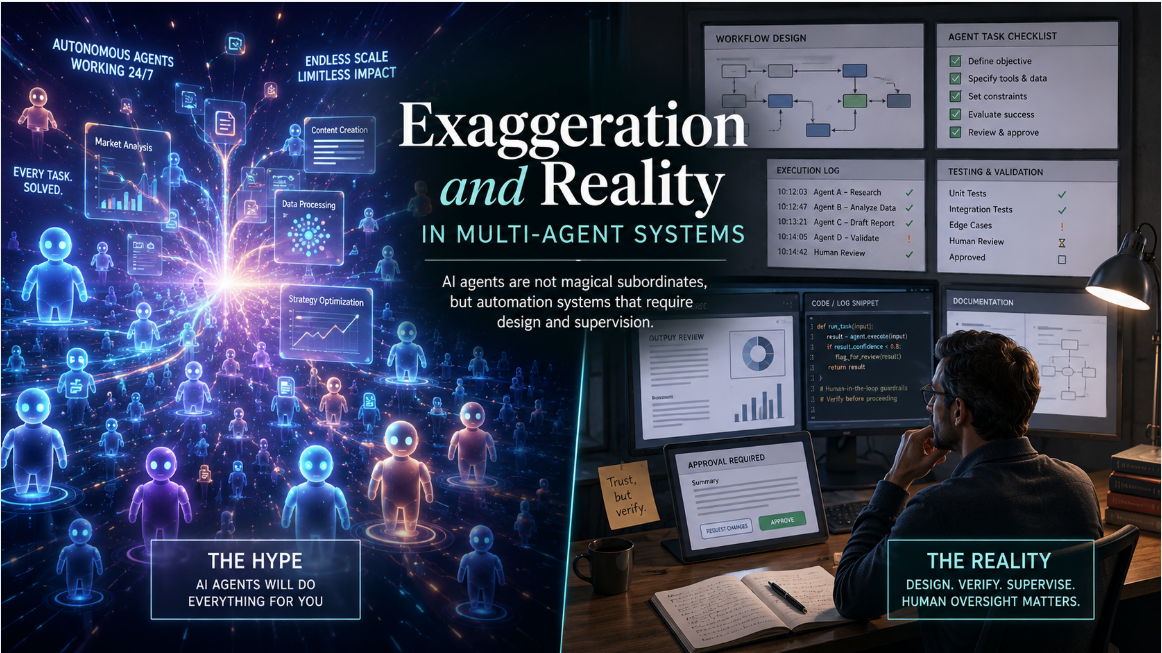
The Orchestrator creates a “Task Ledger” to plan tasks and uses a “Progress Ledger” to confirm task completion and track progress. In tests using the evaluation tool AutoGenBench, Magentic-One showed results surpassing GPT-4 but did not reach human-level accuracy. Microsoft warns that Magentic-One operates in a digital world designed for humans and may cause irreversible consequences.
Microsoft

  • Related Posts

    KJ Method Resurfaces in AI Workslop Problem

    To solve the AI ​​Workslop problem, an information organization technique invented in Japan in the 1960s may be effective. Kunihiro Tada, founder of the Mindware Research Institute, says that by reconstructing data mining technology in line with the KJ method,…

    AI Work Slop and the Productivity Paradox in Business

    Introduction: Modern AI tools promise to supercharge productivity, automating tasks and generating content at an unprecedented scale. Yet many business professionals are noticing a curious problem: an overabundance of low-quality, AI-generated work that adds noise and overhead instead of value.…

    You Missed

    Where Should AI Memory Live?

    Where Should AI Memory Live?

    2026 Will Be the First Year of Enterprise AI

    2026 Will Be the First Year of Enterprise AI

    Does the Age of Local LLMs Democratize AI?

    Does the Age of Local LLMs Democratize AI?

    Data Science and Buddhism: The Ugly Duckling Theorem and the Middle Way

    Data Science and Buddhism: The Ugly Duckling Theorem and the Middle Way

    Google’s Gemini 3: Launch and Early Reception

    Google’s Gemini 3: Launch and Early Reception

    AI Governance in Corporate AI Utilization: Frameworks and Best Practices

    AI Governance in Corporate AI Utilization: Frameworks and Best Practices

    AI Mentor and the Problem of Free Will

    AI Mentor and the Problem of Free Will

    The AI Bubble Collapse Is Not the The End — It Is the Beginning of Selection

    The AI Bubble Collapse Is Not the The End — It Is the Beginning of Selection

    Notable AI News Roundup: ChatGPT Atlas, Company Knowledge, Claude Code Web, Pet Cameo, Copilot 12 Features, NTT Tsuzumi 2 and 22 More Developments

    Notable AI News Roundup: ChatGPT Atlas, Company Knowledge, Claude Code Web, Pet Cameo, Copilot 12 Features, NTT Tsuzumi 2 and 22 More Developments

    KJ Method Resurfaces in AI Workslop Problem

    KJ Method Resurfaces in AI Workslop Problem

    AI Work Slop and the Productivity Paradox in Business

    AI Work Slop and the Productivity Paradox in Business

    OpenAI’s “Sora 2” and its impact on Japanese anime and video game copyrights

    OpenAI’s “Sora 2” and its impact on Japanese anime and video game copyrights

    Claude Sonnet 4.5: Technical Evolution and Practical Applications of Next-Generation AI

    Claude Sonnet 4.5: Technical Evolution and Practical Applications of Next-Generation AI

    Global AI Development Summary — September 2025

    Global AI Development Summary — September 2025

    Comparison : GPT-5-Codex V.S. Claude Code

    Comparison : GPT-5-Codex V.S. Claude Code

    【HRM】How a Tiny Hierarchical Reasoning Model Outperformed GPT-Scale Systems: A Clear Explanation of the Hierarchical Reasoning Model

    【HRM】How a Tiny Hierarchical Reasoning Model Outperformed GPT-Scale Systems: A Clear Explanation of the Hierarchical Reasoning Model

    GPT‑5‑Codex: OpenAI’s Agentic Coding Model

    GPT‑5‑Codex: OpenAI’s Agentic Coding Model

    AI Adoption Slowdown: Data Analysis and Implications

    AI Adoption Slowdown: Data Analysis and Implications

    Grokking in Large Language Models: Concepts, Models, and Applications

    Grokking in Large Language Models: Concepts, Models, and Applications

    AI Development — August 2025

    AI Development — August 2025

    Agent-Based Personal AI on Edge Devices (2025)

    Agent-Based Personal AI on Edge Devices (2025)

    Ambient AI and Ambient Intelligence: Current Trends and Future Outlook

    Ambient AI and Ambient Intelligence: Current Trends and Future Outlook

    Comparison of Auto-Coding Tools and Integration Patterns

    Comparison of Auto-Coding Tools and Integration Patterns

    Comparing the Coding Capabilities of OpenAI Codex vs GPT-5

    Comparing the Coding Capabilities of OpenAI Codex vs GPT-5

    Comprehensive Report: GPT-5 – Features, Announcements, Reviews, Reactions, and Impact

    Comprehensive Report: GPT-5 – Features, Announcements, Reviews, Reactions, and Impact