
 ChatGPT
Executive Summary
This report argues that the four approaches under comparison do not belong to a single methodological family in the same sense. Neo-Grounded Theory, LOGOS, and AcademiaOS are best understood as LLM-era attempts to automate, augment, or scale grounded-theory-style qualitative analysis for scholarly inquiry. By contrast, GNG+MST concept-structure analysis—as publicly positioned through ConceptMiner, ThinkNavi, and the broader Conceptual Investigation / Concept Research framework—is not primarily an academic grounded-theory method. It is explicitly framed as a method for business opportunity exploration, strategic qualitative synthesis, question discovery, and the refinement of organizational thinking, philosophy, and identity in conditions of uncertainty.
Among the three academically oriented methods, LOGOS is the most explicit about end-to-end automation and formal evaluation: it frames grounded-theory development as schema induction, automates open, axial, and selective coding, and introduces a five-dimensional codebook-quality metric together with a train-test protocol. Neo-Grounded Theory is strongest where one wants to combine scale with human interpretive intervention: its explicit claim is that human-AI collaboration is essential, because pure automation alone tends to produce abstract but less actionable theoretical outputs. AcademiaOS is the most open and pedagogically accessible: it is open source, uses a Gioia-style hierarchy of first-order concepts, second-order themes, and aggregate dimensions, and explicitly supports theoretical model generation, critique, and Mermaid visualization.
For strategy work and philosophy work, however, a different criterion matters. Strategy and corporate-philosophy work are not satisfied by codebooks alone. They require methods that can surface blank spaces, boundary categories, non-obvious bridges, and under-articulated possibilities. On its own public terms, GNG+MST is built precisely for this purpose: to reveal conceptual topology, support better questions, explore opportunity spaces not yet stabilized into existing categories, and help organizations escape “conceptual lock-in.” ThinkNavi’s public positioning goes further and explicitly targets users who want to deepen a distinctive company identity, individuality, and philosophy/ideals, rather than converge toward generic optimization.
The most defensible practical conclusion is therefore hybrid, not exclusivist. For scholarly qualitative research, LOGOS, Neo-Grounded Theory, and AcademiaOS are closer substitutes or complements within one broad family. For business strategy and technological/corporate philosophy, GNG+MST should be treated as a different layer: not a substitute for academic grounded theory, but a method for conceptual-space exploration that can be combined with the stronger coding, evaluation, and narrative-visualization features of the other three systems. The most promising integrated workflow is to begin with GNG+MST for conceptual mapping and gap-finding, use LOGOS for reusable codebook generation and evaluation, use Neo-Grounded Theory for human-guided theoretical refinement, and use AcademiaOS for theory narration and visual communication.
Background
Grounded theory, in its classical broad sense, is concerned with deriving concepts and explanatory categories from empirical material rather than imposing a prior theoretical scheme. The contemporary problem to which all three LLM-oriented scholarly methods respond is straightforward: manual qualitative analysis is slow, labor-intensive, expensive, and difficult to scale when researchers must process large corpora of interviews, documents, policies, case studies, or mixed textual traces. Both LOGOS and AcademiaOS explicitly frame this as the central bottleneck: expert-intensive coding constrains scope, repeatability, and timeliness.
The LLM-era responses differ in emphasis. AcademiaOS asks how an open platform can automate or augment grounded-theory development through coding, aggregation, theory generation, critique, and visualization. Neo-Grounded Theory asks how one can overcome the “scale-depth paradox” by combining embeddings, clustering, multi-agent parallelism, and human refinement. LOGOS asks how grounded-theory development can be treated as full schema induction, automated end-to-end, and evaluated with a standardized protocol rather than informal judgment alone. Each is therefore a different answer to the same broad methodological challenge.
GNG+MST concept-structure analysis arises from a partially different lineage. In Mindware Research Institute’s public materials, the relevant lineage runs from Concept Research / Conceptual Investigation, to SOM-based concept mapping, and then to ConceptMiner and ThinkNavi using GNG + MST. In that lineage, the international Grounded Theory Approach and the Japanese KJ method are acknowledged as related qualitative traditions, but the declared purpose is not primarily scholarly theory generation. Rather, the stated objectives include exploring business opportunities related to emerging technologies, building a knowledge base for business strategy, supporting consultants and managers, and restructuring how organizations think under uncertainty.
The public white paper Connecting “Conceptual Investigation” and Latent Space Through the GNG+MST Model makes the difference even clearer. It frames the core problem as organizational cognitive lock-in: firms become overadapted to existing categories, KPIs, evaluation frames, and language, and therefore fail to perceive new possibility spaces. Conceptual Investigation is then defined as an exploratory method focused on conceptual differences, unnamed signals, boundary phenomena, and future possibilities; GNG+MST is described as an interface that structures explicit conceptual space and indicates latent possibilities around it. That is a strategic-philosophical framing, not a conventional academic GTA framing.
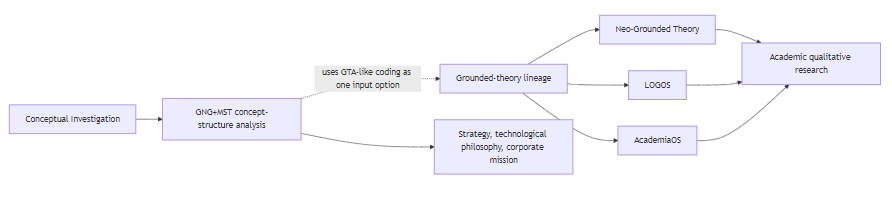
The conceptual relationship among the four methods can therefore be represented as follows. The diagram is an analytic synthesis of the cited sources, not itself an official figure.
Method Definitions
Neo-Grounded Theory
Neo-Grounded Theory is a 2025 arXiv preprint that proposes a methodological framework combining 1536-dimensional embeddings, hierarchical clustering, and parallel multi-agent coding in order to reconcile qualitative research’s “scale-depth paradox.” Its central empirical claim is that this design enables high-speed analysis of large qualitative corpora while preserving interpretive rigor and making human theoretical guidance more, not less, important. The preprint reports comparison against manual coding and ChatGPT-assisted coding on Chinese interview transcripts, with strong gains in speed and cost and somewhat higher quality scores in the reported setup.
Methodologically, Neo-Grounded Theory rests on three named pillars. According to the paper, these are computational emergence, in which semantic patterns self-organize through clustering rather than researcher-imposed categories; distributed cognition, in which specialized agents parallelize coding; and an augmented form of theoretical sensitivity, in which human interpretive intervention remains necessary for practical and theoretically meaningful results. The paper’s public descriptions emphasize that automation alone tends to yield more abstract frameworks, whereas human-guided refinement produces more actionable theories.
The published workflow, as described in the preprint and mirrored full text, is broadly: convert input materials into analyzable text, embed and cluster them, run parallel coding processes over those clusters, integrate outputs across clusters, and refine theory through human feedback loops. The authors also foreground transparency mechanisms, including audit trails, prompt logs, cluster theory files, and model reasoning traces, with the explicit aim of preserving methodological scrutiny and reproducibility in computational qualitative research.
For present purposes, Neo-Grounded Theory is best defined as a human-guided computational grounded theory framework: less rigidly automated than LOGOS in spirit, more explicitly committed to mixed human-AI theorizing, and more ambitious than AcademiaOS in its use of clustering and multi-agent parallelism. Public code or an official software project page was not specified in the sources consulted for this report.
LOGOS
LOGOS is a 2025 arXiv preprint, also posted to OpenReview as an ICLR 2026 submission, that formulates grounded-theory development as schema induction and proposes a fully automated end-to-end pipeline for turning raw text into a hierarchical theory. It explicitly claims to automate the canonical sequence of open coding, axial coding, and selective coding, and to do so in a domain-agnostic way.
In the paper’s full methodological description, the workflow begins with chunking the corpus and generating codes conditioned on a research question, then embedding and clustering those codes, generating higher-level codes for clusters, classifying code-pair relations, building a conflict-aware code graph, and iteratively refining the codebook. The paper explicitly maps chunking and code generation to open coding, clustering and higher-level code generation to axial coding, and graph-based cleanup and relationship reasoning to selective coding. The output is not just a bag of codes but a structured, hierarchical, theoretically connected codebook.
LOGOS’s distinctive strength is its evaluation design. The system introduces a five-dimensional metric for codebook quality and a train-test split protocol intended to support more standardized and less biased comparison. The arXiv v2 abstract reports performance across five corpora with an average 80.4% alignment to expert-developed schemas, while the earlier arXiv/ResearchGate abstract highlights 88.2% alignment on a complex dataset. The correct reading is that the public versions report different aggregates at different revision stages; the method’s overall claim is strong relative performance on multiple datasets, but users should be careful not to collapse the dataset-specific 88.2% figure into a universal average.
Conceptually, LOGOS is the most “pipeline-like” of the four methods. It is less concerned with philosophical reflection on meaning-space than with automated, reusable, evaluable coding and schema construction. That makes it highly attractive for repeated qualitative analysis regimes—such as recurring document sets, policy corpora, or comparable organizational datasets—where consistent codebook reuse matters. Public code or an official project repository was unspecified in the sources consulted for this report.
AcademiaOS
AcademiaOS is a 2024 arXiv paper and an open-source GitHub project that presents itself as a first attempt to automate grounded theory development with large language models. Unlike LOGOS, which emphasizes full automation and evaluation, AcademiaOS is explicitly designed as a platform that can automate or augment grounded-theory development under researcher supervision.
The system adopts a strongly structured workflow. It supports document curation from uploaded PDFs, JSON, and TXT files, as well as literature retrieval from Semantic Scholar. For coding, it follows a Gioia-like hierarchy of initial codes, second-order themes, and aggregate dimensions. It then proceeds to theory development by brainstorming applicable existing theories, generating concept tuples, using retrieval-augmented generation to gather grounded relationship evidence from source texts, producing a textual theoretical model, extracting a model name, rendering the model in MermaidJS, and finally critiquing the model to support iterative refinement.
AcademiaOS is also the most transparent in software terms. The GitHub repository is public, the project is distributed under the MIT license, and the README specifies a TypeScript/React/LangChainJS/SemanticScholarJS stack. The paper reports a small exploratory user study of 19 participants, and emphasizes local browser-side computation for privacy and maintainability. At the same time, it acknowledges a serious practical limitation: in its current form, it relies on the OpenAI developer platform for inference, so externally sensitive data should not be processed unless the system is modified to run against a self-hosted model.
In sum, AcademiaOS is best defined as an open-source, researcher-facing workflow platform for LLM-assisted theory development. Relative to Neo-Grounded Theory and LOGOS, it is less centered on clustering architecture or formal benchmark design and more centered on workflow transparency, accessibility, and communicable theoretical outputs. The live web application was identifiable, but its public interface required JavaScript and therefore could not be directly inspected in text mode during this review.
GNG+MST Concept-Structure Analysis
The term “GNG+MST concept-structure analysis,” as used here, refers to the ConceptMiner engine, the ThinkNavi application layer, and the broader Conceptual Investigation / Concept Research method as described in Mindware Research Institute’s official English and Japanese materials. The engine side is defined as a self-organizing semantic structure system that transforms text corpora into navigable concept networks using embeddings, dimensional compression / latent structure analysis, Growing Neural Gas, and Minimum Spanning Tree, optionally layered with LLM-based labeling and explanation.
On the business-method side, the official materials are explicit that this approach is meant for opportunity discovery and conceptual exploration rather than mainly for academic theory production. Mindware’s English “Concept Research” page defines the method as a technique for exploring business opportunities related to emerging technologies; its Japanese site presents it as a data-scientific method for building concepts from scattered information, with use cases including patent analysis, VOC analysis, business strategy formulation, and public-sector information analysis. The same materials state that KJ/GTA-like coding can be incorporated, but as part of a broader strategic-conceptual workflow.
The white paper on Conceptual Investigation sharpens the philosophical positioning. It defines the central problem as organizational overfitting to existing categories and evaluation frames, argues that organizations need not “more information” but a reorganization of conceptual space, and presents GNG+MST as an interface between human linguistic thought and the latent semantic space of LLMs. The model does not claim to reconstruct latent space fully; rather, it claims to reveal contours, densities, gaps, bridges, and peripheries in explicit conceptual space so that still-unspoken possibilities become explorable. In addition to strategy and new business, the white paper explicitly lists applications in R&D/technology exploration, organizational knowledge reorganization, and structured human-AI collaboration.
ThinkNavi’s current public positioning confirms the applied orientation. It describes itself as a system for business managers and consultants who need to collect qualitative strategic information faster, model and explore conceptual structures using GNG+MST, discover new ideas, and transform knowledge into reusable organizational assets. Its public FAQ further states that, in an age where AI can flatten everyone toward generic performance, the crucial task is to refine one’s distinctive philosophy and ideals, company identity, and individuality. That is the clearest reason GNG+MST should be positioned here as a business-strategy and philosophy method, not as a primary academic GTA automation framework.
Comparative Analysis
The comparison in Table 1 synthesizes the method papers and official project pages discussed above. Where a feature was not explicitly specified in the consulted sources, it is labeled as unspecified rather than inferred as absent. The table should therefore be read as a disciplined synthesis of available public descriptions, not as a reverse-engineered implementation audit.
| Dimension | Neo-Grounded Theory | LOGOS | AcademiaOS | GNG+MST concept-structure analysis |
|---|---|---|---|---|
| Purpose | Reconcile scale and interpretive depth in qualitative research | Fully automate grounded-theory / schema-induction workflow and produce reusable codebooks | Automate or augment grounded-theory development in an open research platform | Explore conceptual topology for strategy, opportunity discovery, and organizational thinking |
| Intended users | Qualitative researchers; computational social scientists | Qualitative researchers; HCI/NLP researchers; anyone needing scalable schema induction | Researchers, students, and practitioner-researchers | Business managers, consultants, AI service providers, strategy teams |
| Typical workflow | Embed corpus → cluster semantically → parallel agent coding → cross-cluster integration → human-guided refinement | Research-question-conditioned code generation → embedding/clustering → high-level code generation → relation graphing → iterative codebook refinement | Curate documents/literature → generate initial codes → second-order themes → aggregate dimensions → applicable theories → concept tuples + RAG → theory model → critique → Mermaid | Collect text chunks / concept tables → build concept structure with GNG+MST → AI labeling/interpretation → explore clusters, bridges, blank spaces, profiles, and inferred new concepts |
| Role of LLMs / automation | Multi-agent qualitative analysis plus human steering | End-to-end automation of code generation, clustering, graph reasoning, and refinement | LLM-centered orchestration under user supervision; theory narration and visualization included | LLMs aid labeling, coding, data collection, and interpretation; structural core is self-organizing concept-network modeling |
| Outputs / artifacts | Theory files, audit trails, prompt logs, reasoning traces, cluster theories | Hierarchical codebooks, code relations, schema/theory structures, evaluation scores | Codes, themes, dimensions, theory narratives, Mermaid diagrams, critique outputs | Concept networks, cluster maps, profile charts, idea maps, strategic white-space indications, exploratory chat grounded in structure |
| Validation and rigor | Comparative experiment against manual and ChatGPT-assisted coding; explicit audit-trail design | Strongest evaluation design among the four; five-dimensional metric and train-test protocol | Exploratory user study (n=19); open-source transparency | Public white paper and product documentation; strategic usefulness emphasized more than peer-reviewed method validation |
| Scalability | High; built for large corpora via embeddings and distributed agents | High; designed for multi-corpus end-to-end automation | Moderate to high; chunking, browser computation, and API-based parallelism | High for text-centric concept mapping; oriented to heterogeneous business knowledge corpora |
| Transparency / interpretability | Strongly emphasized via audit trails and human intervention points | Moderate to strong at the pipeline level; semantic reasoning still heavily model-mediated | Strong in workflow transparency; explicit stages and visual outputs | Strong visually; weaker in a strict methodological sense if one mistakes the map for the reality it models |
| Reproducibility | Claimed through documentation and reproducible vector operations | Strongest formal reproducibility intent; public code unspecified in consulted sources | Good workflow reproducibility; public GitHub repository and MIT license | Partly specified; depends on corpus curation, embeddings, and configuration choices |
| Required expertise | Qualitative research expertise plus prompt and workflow supervision | Qualitative research plus tolerance for more abstract pipeline outputs and evaluation interpretation | Moderate: qualitative logic plus platform operation | Strategy/facilitation, conceptual interpretation, and organizational sensemaking |
| Data types | Textualized multimodal qualitative data | Primarily text corpora | PDFs, JSON, TXT, interview transcripts, academic papers, policies, case materials | Text chunks, reports, meetings, Slack/Teams exports, CRM notes, patents, academic abstracts, chat histories, organizational documents |
| Tooling / resources | Embeddings, clustering, multi-agent orchestration; public software stack unspecified | LLMs, embedding model, clustering, relation classifier/graph, evaluation pipeline | React/TypeScript/LangChainJS/SemanticScholarJS; OpenAI API; optional OCR; GitHub | ConceptMiner / ThinkNavi stack; embeddings + GNG + MST; optional private deployment; can be combined with or used without conventional RAG stacks |
| Ethical / epistemic risks | Over-abstract theorizing under pure automation; evaluator dependence in reported quality setup | Reified schema hierarchy; potential loss of temporal/causal richness; strong automation may conceal interpretive gaps | Privacy risk if sensitive data sent to external APIs; template rigidity via Gioia-like structure; hallucinated theoretical links | Reifying the map as ontology; strategy bias from corpus selection; conceptual seduction without validation; philosophical framing may outrun empirical evidence |
| Typical use cases | Large-scale qualitative research; fast theory generation with human refinement | Reusable codebook construction; multi-corpus comparative qualitative analysis | Pedagogical GT workflows; exploratory theory-building; communicable research models | Strategic exploration, technological philosophy, corporate mission/identity work, innovation intelligence, VOC/patent/competitive concept mapping |
Two contrasts dominate the table. The first is a purpose contrast. Neo-Grounded Theory, LOGOS, and AcademiaOS are all in the business of turning data into theoretical structure in ways recognizable to qualitative scholarship. GNG+MST is in the business of turning heterogeneous language data into conceptual terrain that strategic actors can explore. The official ConceptMiner page is explicit that its value lies in discovering the structure one did not know existed, helping users ask better questions, and surfacing underdeveloped opportunity spaces; the Mindware and ThinkNavi materials consistently tie this to emerging-technology exploration, strategic qualitative information, and company-level distinctiveness.
The second is a rigor-and-reproducibility contrast. LOGOS has the clearest public benchmark logic; Neo-Grounded Theory has the clearest public account of audit trails and human intervention; AcademiaOS has the clearest open-source workflow transparency. GNG+MST, by contrast, offers a different kind of rigor: not benchmarked codebook fidelity, but strategic-exploratory rigor around concept-space structuring. That does not make it weaker for all purposes, but it does mean that it should not be represented as if it had already been validated as an academic GTA replacement at the same level of public methodological scrutiny.
A further difference concerns what counts as a finished artifact. In LOGOS, a successful output is a reusable hierarchical codebook and associated theoretical structure. In Neo-Grounded Theory, it is a theoretically richer synthesis produced through human-AI interaction and preserved in documentation. In AcademiaOS, it is a full end-to-end research story: coded evidence, dimensions, theory narrative, critique, and a presentable visual model. In GNG+MST, however, the key artifact is often not a final theory at all, but a map of tensions, bridges, blanks, and emerging regions from which strategy, R&D exploration, or philosophy work can proceed.
Critical Analysis for Strategy and Philosophy
Strategy work and philosophy work differ from ordinary descriptive qualitative analysis because their central tasks are not merely to describe “what themes are present.” They must determine what ought to be emphasized, which concepts are too narrow, where a firm’s worldview is overfitted, which futures deserve pursuit, and how technological possibilities relate to human meaning, identity, and collective purpose. For such tasks, a method’s ability to classify language is not enough; it must also support conceptual reframing.
From that perspective, Neo-Grounded Theory has an important advantage. Its authors openly state that pure automation produced abstract theoretical frameworks, whereas human-guided refinement produced more actionable theory. That claim matters for strategy and philosophy, because such work typically depends on tension, contradiction, and judgment rather than merely consensus coding. The weakness is that Neo-Grounded Theory remains a preprint and its reported evaluation is based on a relatively narrow empirical setting; moreover, the public materials do not specify an open project implementation comparable to AcademiaOS’s repository. It is therefore promising as a high-end collaborative method, but not yet a widely stabilized software standard.
LOGOS is stronger where an organization needs disciplined, repeatable qualitative governance over recurring corpora—for example, recurring policy documents, customer complaints, product feedback, internal memos, or competitive intelligence. Its codebook-centered design is well suited to situations where one wants robust category maintenance over time. The limitation for strategy and philosophy is that codebooks, however elegant, can remain too classificatory. Strategy often turns on category rupture rather than category stabilization; corporate philosophy often turns on value tensions and the invention of new distinctions, not only on refining existing ones. Even reading LOGOS in the most favorable way, its public framing privileges schema quality over philosophical provocation.
AcademiaOS is especially useful when strategy or philosophy work must be made communicable across stakeholders. Its concept-tuple step, RAG grounding, theory narration, model naming, Mermaid rendering, and model critique make it well suited to workshops, teaching, internal reports, and early-stage sensemaking. Its weakness is template risk. Because it organizes material through a Gioia-like hierarchy and a fairly legible theory-construction pipeline, it can make emerging philosophy appear more settled than it really is. That is excellent for communication, but not always ideal for preserving ambiguity where ambiguity is the source of insight. Moreover, its current reliance on external API inference is problematic for highly sensitive strategic material unless self-hosted substitutions are implemented.
For strategy and philosophical deepening, GNG+MST has the strongest native fit. Its white paper explicitly addresses new-business formation, strategic exploration, concept-boundary work, and the philosophical problem of how organizations become trapped inside inherited categories. It treats value not as faster answer generation but as the discovery of insufficiently formulated questions and insufficiently articulated possibilities. The same documents identify blank regions, candidate bridges, peripheral possibilities, and connectable but unnamed concepts as central objects of analysis. That orientation is unusually appropriate for technological philosophy and corporate mission work, because such work often begins precisely where existing categories break down.
The corresponding weakness of GNG+MST is equally important. A concept map is not yet a theory, and a topology is not yet a validated strategic judgment. Public official materials emphasize opportunity discovery, exploration, positioning, and structured human-AI collaboration, but they do not provide public peer-reviewed validation comparable to LOGOS’s benchmark design or even AcademiaOS’s user-study format. There is also an epistemic temptation built into any concept-structure visualization: once a map looks coherent, users may forget that the topology depends on corpus composition, embedding behavior, clustering dynamics, and labeling choices. In strategy and philosophy work, that risk is manageable only if leaders treat the model as a provocation and navigation aid, not as an oracle.
The practical conclusion is therefore sharp. If the goal is an academic grounded-theory study, GNG+MST should not be presented as the primary method, except perhaps as a supplementary scoping or exploratory device. If the goal is instead to deepen technological philosophy, corporate philosophy, or mission, then GNG+MST may be the most suitable entry point precisely because it is not trapped in a narrow scholarly coding logic. But it should then be followed by more disciplined downstream methods—such as LOGOS, Neo-Grounded Theory, or AcademiaOS—when the organization needs explicit explanation, evidence trails, or reusable interpretive artifacts.
Practical Recommendations and Hybrid Workflow
The best operational choice depends on the primary decision problem. If a team’s priority is publication-grade qualitative research, it should begin from LOGOS or Neo-Grounded Theory, because those approaches are designed around grounded-theory automation itself. LOGOS is preferable when repeatability, codebook reuse, and formal evaluation matter most. Neo-Grounded Theory is preferable when researchers want computational scale but still expect theory to emerge through iterative human steering and refinement. AcademiaOS is particularly useful as a companion layer for transparent workflowing and diagrammatic communication.
If a team’s priority is strategic exploration, technological philosophy, or corporate mission work, the sequence should be reversed. Start with GNG+MST to surface latent conceptual terrain, blank spaces, and bridge candidates. Then isolate the strategic clusters that matter, convert them into analyzable subsets or working corpora, and use LOGOS or Neo-Grounded Theory to transform that exploratory map into more disciplined explanatory structures. Finally, use AcademiaOS or a similar presentation layer to produce communicable models for discussion among executives, product leaders, researchers, and operating teams.
A second practical recommendation concerns governance and privacy. AcademiaOS explicitly warns that sensitive data should not be sent to external providers in its default configuration, although the paper notes that self-hosted LLMs could be substituted. ConceptMiner publicly advertises private deployment options and compatibility with on-premise models, and ThinkNavi’s FAQ states that enterprise configurations can run long-term memory engines on premises. Organizations handling confidential strategy materials should therefore assume that deployment architecture is a first-class methodological choice, not an implementation afterthought.
A third recommendation concerns team composition. Strategy/philosophy projects should not be delegated exclusively to data scientists or prompt engineers. The strongest hybrid use of these systems requires at least three forms of competence: qualitative or interpretive skill, domain/strategy judgment, and technical literacy about embeddings, clustering, and model outputs. Neo-Grounded Theory’s own framing of human-AI collaboration supports this conclusion, and the GNG+MST white paper implicitly does so as well by defining the model as an interface rather than a replacement for human judgment.
The hybrid workflow below is a proposal synthesized from the documented strengths of the four methods. It is not an official workflow from any one source.
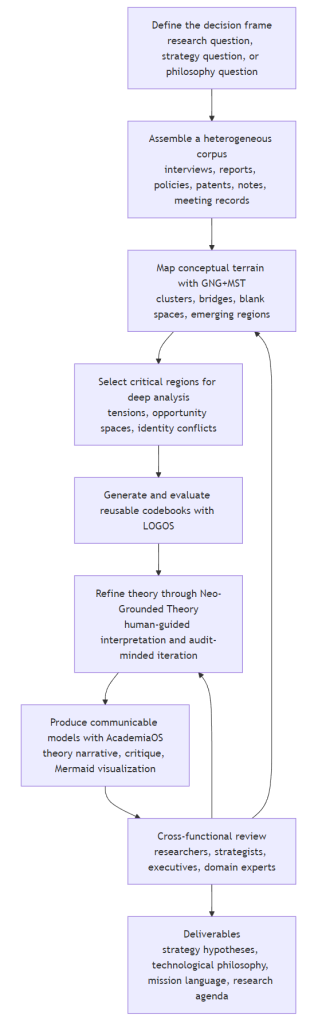
Operationally, the value of this hybrid is that it prevents each method from being used outside its natural strengths. GNG+MST performs the exploratory work of reorganizing conceptual space. LOGOS performs the codificatory work of creating reusable qualitative schemas. Neo-Grounded Theory performs the interpretive work of reconciling computation with human theoretical sensitivity. AcademiaOS performs the communicative work of making the emergent theory discussable, critiqueable, and shareable. Used together, they constitute a much more robust pipeline for strategy and philosophy work than any of the four in isolation.
Limitations and Conclusion
Several limitations must be made explicit. First, Neo-Grounded Theory, LOGOS, and AcademiaOS remain dependent on preprint or submission-stage materials rather than mature peer-reviewed journal literatures in the sources consulted here. LOGOS in particular exists in at least two publicly visible summary states: the earlier framing emphasizing 88.2% alignment on a complex dataset and the later arXiv/OpenReview framing emphasizing 80.4% average alignment across five corpora. That should be read as version-sensitive reporting rather than a contradiction, but it does mean users should cite the relevant version carefully.
Second, the evidence base for GNG+MST concept-structure analysis is fundamentally different from the evidence base for the three scholarly methods. The most informative sources are official product pages, a public white paper, site documentation, and company materials. Those are entirely appropriate for determining how the method is positioned and what it aims to do, which is central to this report’s thesis. They are not equivalent to a peer-reviewed corpus of benchmark studies. Accordingly, this report’s strongest claim about GNG+MST is not that it is already the most rigorously validated method, but that it is the most explicitly suited, by public design and philosophical orientation, to strategy and corporate-philosophy work.
Third, some public resources were only partially accessible. The AcademiaOS live site required JavaScript for interaction in text-mode browsing, and one Mindware English strategy page returned a 403 during inspection. These access limitations do not undermine the core comparison, because the papers, GitHub repository, white paper, and principal official pages were sufficient for the central distinctions developed here; but they do constrain how far one can independently inspect product behavior from the web interface alone.
The overall conclusion is straightforward. Neo-Grounded Theory, LOGOS, and AcademiaOS are best understood as three distinct scholarly responses to the LLM-era challenge of scaling grounded-theory-style qualitative inquiry. GNG+MST concept-structure analysis is best understood as a different but complementary method family: a business-strategy and conceptual-investigation approach designed to reveal latent opportunity structures, reorganize conceptual frames, and deepen organizational thought, including work on technological philosophy and corporate philosophy/mission. For academic GTA, treat GNG+MST as supplementary. For strategic and philosophical work, treat it as the natural front end—and then attach LOGOS, Neo-Grounded Theory, and AcademiaOS downstream where stronger codebook rigor, theoretical refinement, and communicable modeling are required.
References
- Wen, S., Ku, B., Wang, T., Zou, M., and Yang, Y. Neo-Grounded Theory: A Methodological Innovation Integrating High-Dimensional Vector Clustering and Multi-Agent Collaboration for Qualitative Research. arXiv:2509.25244.
- Pi, X., Yang, Q., and Nguyen, C. LOGOS: LLM-driven End-to-End Grounded Theory Development and Schema Induction for Qualitative Research. arXiv:2509.24294; OpenReview submission to ICLR 2026.
- Übellacker, T. AcademiaOS: Automating Grounded Theory Development in Qualitative Research with Large Language Models. arXiv:2403.08844.
- Übellacker, T. AcademiaOS GitHub repository, MIT-licensed project page.
- Mindware Research Institute. ConceptMiner Engine for Developers. Official project page.
- Mindware Research Institute. Concept Research. Official method page.
- Mindware Research Institute. Connecting “Conceptual Investigation” and Latent Space Through the GNG+MST Model: An AI Interface for Overcoming Organizational Cognitive Lock-In. Official white paper.
- ThinkNavi. Official site, About page, and public FAQ/positioning materials.
- Mindware Research Institute Japanese official pages on Concept Research and company history.
 tada@aicritique.org