
The Geometry of Concepts: Sparse Autoencoder Feature Structure

Yuxiao LiEric J. MichaudDavid D. BaekJoshua EngelsXiaoqing SunMax Tegmark

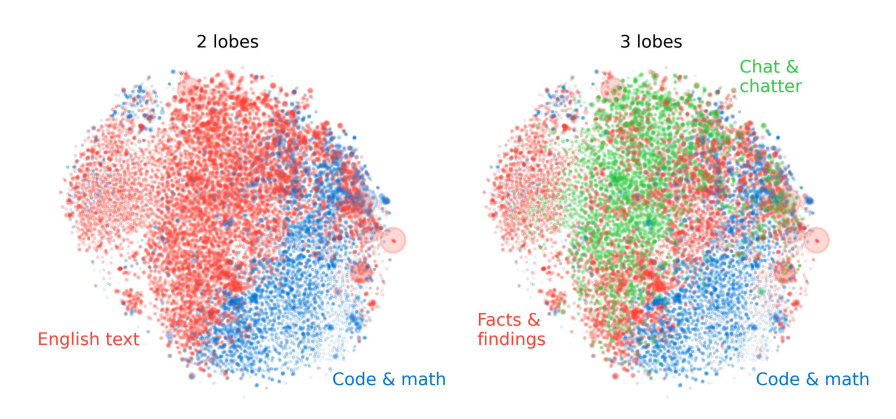
Sparse autoencoders have recently produced dictionaries of high-dimensional vectors corresponding to the universe of concepts represented by large language models. We find that this concept universe has interesting structure at three levels: 1) The “atomic” small-scale structure contains “crystals” whose faces are parallelograms or trapezoids, generalizing well-known examples such as (man-woman-king-queen). We find that the quality of such parallelograms and associated function vectors improves greatly when projecting out global distractor directions such as word length, which is efficiently done with linear discriminant analysis. 2) The “brain” intermediate-scale structure has significant spatial modularity; for example, math and code features form a “lobe” akin to functional lobes seen in neural fMRI images. We quantify the spatial locality of these lobes with multiple metrics and find that clusters of co-occurring features, at coarse enough scale, also cluster together spatially far more than one would expect if feature geometry were random. 3) The “galaxy” scale large-scale structure of the feature point cloud is not isotropic, but instead has a power law of eigenvalues with steepest slope in middle layers. We also quantify how the clustering entropy depends on the layer.

View PDF
  • Related Posts

    Google’s Gemini 3: Launch and Early Reception

    Overview – What is Gemini 3? Google’s Gemini 3 is the latest flagship AI model from Google DeepMind, positioned as the most advanced in Google’s lineup of generative AI systems. It’s a “natively multimodal” model – meaning it can handle text, images,…

    AI Mentor and the Problem of Free Will

    —How Far Can Human Consciousness Be Externalized?— 1. Prologue: AI as a Mirror of the Mind What humanity entrusts to artificial intelligence is not mere automation or efficiency.It is, more profoundly, the externalization of self-understanding—a continuation of the ancient project…

    Leave a Reply

    Your email address will not be published. Required fields are marked *

    You Missed

    Data Science and Buddhism: The Ugly Duckling Theorem and the Middle Way

    Data Science and Buddhism: The Ugly Duckling Theorem and the Middle Way

    Google’s Gemini 3: Launch and Early Reception

    Google’s Gemini 3: Launch and Early Reception

    AI Governance in Corporate AI Utilization: Frameworks and Best Practices

    AI Governance in Corporate AI Utilization: Frameworks and Best Practices

    AI Mentor and the Problem of Free Will

    AI Mentor and the Problem of Free Will

    The AI Bubble Collapse Is Not the The End — It Is the Beginning of Selection

    The AI Bubble Collapse Is Not the The End — It Is the Beginning of Selection

    Notable AI News Roundup: ChatGPT Atlas, Company Knowledge, Claude Code Web, Pet Cameo, Copilot 12 Features, NTT Tsuzumi 2 and 22 More Developments

    Notable AI News Roundup: ChatGPT Atlas, Company Knowledge, Claude Code Web, Pet Cameo, Copilot 12 Features, NTT Tsuzumi 2 and 22 More Developments

    KJ Method Resurfaces in AI Workslop Problem

    KJ Method Resurfaces in AI Workslop Problem

    AI Work Slop and the Productivity Paradox in Business

    AI Work Slop and the Productivity Paradox in Business

    OpenAI’s “Sora 2” and its impact on Japanese anime and video game copyrights

    OpenAI’s “Sora 2” and its impact on Japanese anime and video game copyrights

    Claude Sonnet 4.5: Technical Evolution and Practical Applications of Next-Generation AI

    Claude Sonnet 4.5: Technical Evolution and Practical Applications of Next-Generation AI

    Global AI Development Summary — September 2025

    Global AI Development Summary — September 2025

    Comparison : GPT-5-Codex V.S. Claude Code

    Comparison : GPT-5-Codex V.S. Claude Code

    【HRM】How a Tiny Hierarchical Reasoning Model Outperformed GPT-Scale Systems: A Clear Explanation of the Hierarchical Reasoning Model

    【HRM】How a Tiny Hierarchical Reasoning Model Outperformed GPT-Scale Systems: A Clear Explanation of the Hierarchical Reasoning Model

    GPT‑5‑Codex: OpenAI’s Agentic Coding Model

    GPT‑5‑Codex: OpenAI’s Agentic Coding Model

    AI Adoption Slowdown: Data Analysis and Implications

    AI Adoption Slowdown: Data Analysis and Implications

    Grokking in Large Language Models: Concepts, Models, and Applications

    Grokking in Large Language Models: Concepts, Models, and Applications

    AI Development — August 2025

    AI Development — August 2025

    Agent-Based Personal AI on Edge Devices (2025)

    Agent-Based Personal AI on Edge Devices (2025)

    Ambient AI and Ambient Intelligence: Current Trends and Future Outlook

    Ambient AI and Ambient Intelligence: Current Trends and Future Outlook

    Comparison of Auto-Coding Tools and Integration Patterns

    Comparison of Auto-Coding Tools and Integration Patterns

    Comparing the Coding Capabilities of OpenAI Codex vs GPT-5

    Comparing the Coding Capabilities of OpenAI Codex vs GPT-5

    Comprehensive Report: GPT-5 – Features, Announcements, Reviews, Reactions, and Impact

    Comprehensive Report: GPT-5 – Features, Announcements, Reviews, Reactions, and Impact

    July 2025 – AI Development Highlights

    July 2025 – AI Development Highlights

    ConceptMiner -Creativity Support System, Integrating qualitative and quantitative data to create a foundation for collaboration between humans and AI

    ConceptMiner -Creativity Support System, Integrating qualitative and quantitative data to create a foundation for collaboration between humans and AI

    ChatGPT Agent (Agent Mode) – Capabilities, Performance, and Security

    ChatGPT Agent (Agent Mode) – Capabilities, Performance, and Security