
Canadian Media Companies Sue OpenAI

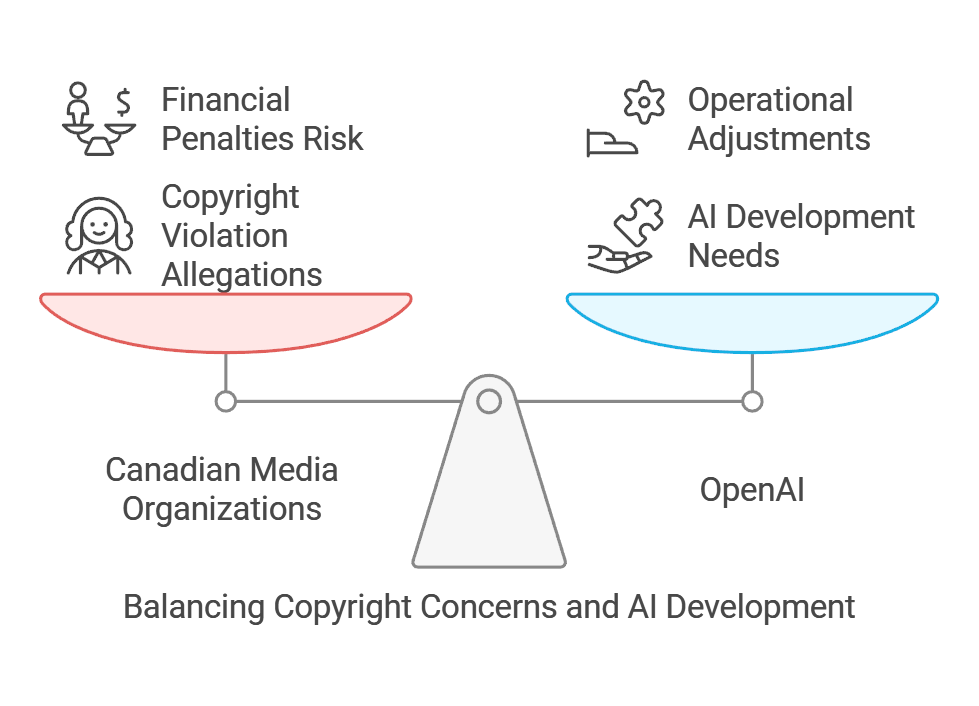
Five major Canadian media organizations have filed a lawsuit against OpenAI, alleging unauthorized use of their articles to train the AI model ChatGPT. This legal action underscores the growing concerns over intellectual property rights in the era of generative AI.

The lawsuit by Canadian media companies against OpenAI is a pivotal event in the ongoing discussion about the ethical and legal implications of AI development, particularly in the realm of content creation and intellectual property.

Key Details:

  1. Who is Involved?
    • The lawsuit was initiated by five major Canadian media organizations, including significant players like CBC (Canadian Broadcasting Corporation) and others.
    • The defendant is OpenAI, the company behind the widely used AI model ChatGPT.
  2. Core Allegations:
    • The media companies allege that OpenAI used their copyrighted articles without permission to train its AI models.
    • This includes text and content scraped or sourced without adequate licensing agreements, violating intellectual property laws.
  3. Why is This Important?
    • Intellectual Property Rights: This case underscores a critical issue: whether AI developers need explicit consent or licensing agreements to use copyrighted material for training.
    • Precedent Setting: A legal outcome against OpenAI could set a global precedent for how AI companies access and use content, potentially leading to stricter regulations.
    • Content Ownership: It raises broader questions about content ownership and compensation for creators when their work is utilized in AI training.
  4. Larger Context:
    • Global Trend: Similar concerns have been raised by other publishers and organizations worldwide, including lawsuits in the U.S. and Europe against generative AI developers like OpenAI, Meta, and Google.
    • Legislative Momentum: Governments, particularly in the EU and U.S., are increasingly looking to establish laws and frameworks to regulate AI’s interaction with copyrighted content.
    • Economic Impact: The lawsuit could lead to financial repercussions for OpenAI if damages are awarded or licensing fees are mandated, impacting its operational costs and model training processes.
  5. Potential Outcomes:
    • Monetary Damages: OpenAI may face significant financial penalties if found guilty.
    • Regulatory Changes: This case might accelerate the creation of regulations requiring explicit permissions and royalties for AI training.
    • Operational Adjustments: AI companies might need to revisit their training methodologies to comply with evolving legal standards, including employing synthetic or licensed datasets exclusively.

Implications for the AI Industry:

The lawsuit signals a growing pushback from content creators and publishers against AI companies leveraging vast amounts of data without proper agreements. The outcome could redefine how AI companies approach data sourcing, leading to a more structured and possibly restrictive training ecosystem.

  • Related Posts

    OpenAI’s “Sora 2” and its impact on Japanese anime and video game copyrights

    The Emergence of Sora 2 On October 1, 2025, OpenAI announced the video generation model “Sora 2” and a social app for iOS that uses the same model. forest.watch This app allows users to generate videos with realistic textures and…

    While the West Hesitates, China Advances: The AI Race Explained

    As we witness the rapid advancements in artificial intelligence (AI) within China, it’s crucial to understand the stark contrast between China’s proactive approach and the West’s ongoing deliberations. This blog delves into the implications of this technological race and highlights…

    Leave a Reply

    Your email address will not be published. Required fields are marked *

    You Missed

    Data Science and Buddhism: The Ugly Duckling Theorem and the Middle Way

    Data Science and Buddhism: The Ugly Duckling Theorem and the Middle Way

    Google’s Gemini 3: Launch and Early Reception

    Google’s Gemini 3: Launch and Early Reception

    AI Governance in Corporate AI Utilization: Frameworks and Best Practices

    AI Governance in Corporate AI Utilization: Frameworks and Best Practices

    AI Mentor and the Problem of Free Will

    AI Mentor and the Problem of Free Will

    The AI Bubble Collapse Is Not the The End — It Is the Beginning of Selection

    The AI Bubble Collapse Is Not the The End — It Is the Beginning of Selection

    Notable AI News Roundup: ChatGPT Atlas, Company Knowledge, Claude Code Web, Pet Cameo, Copilot 12 Features, NTT Tsuzumi 2 and 22 More Developments

    Notable AI News Roundup: ChatGPT Atlas, Company Knowledge, Claude Code Web, Pet Cameo, Copilot 12 Features, NTT Tsuzumi 2 and 22 More Developments

    KJ Method Resurfaces in AI Workslop Problem

    KJ Method Resurfaces in AI Workslop Problem

    AI Work Slop and the Productivity Paradox in Business

    AI Work Slop and the Productivity Paradox in Business

    OpenAI’s “Sora 2” and its impact on Japanese anime and video game copyrights

    OpenAI’s “Sora 2” and its impact on Japanese anime and video game copyrights

    Claude Sonnet 4.5: Technical Evolution and Practical Applications of Next-Generation AI

    Claude Sonnet 4.5: Technical Evolution and Practical Applications of Next-Generation AI

    Global AI Development Summary — September 2025

    Global AI Development Summary — September 2025

    Comparison : GPT-5-Codex V.S. Claude Code

    Comparison : GPT-5-Codex V.S. Claude Code

    【HRM】How a Tiny Hierarchical Reasoning Model Outperformed GPT-Scale Systems: A Clear Explanation of the Hierarchical Reasoning Model

    【HRM】How a Tiny Hierarchical Reasoning Model Outperformed GPT-Scale Systems: A Clear Explanation of the Hierarchical Reasoning Model

    GPT‑5‑Codex: OpenAI’s Agentic Coding Model

    GPT‑5‑Codex: OpenAI’s Agentic Coding Model

    AI Adoption Slowdown: Data Analysis and Implications

    AI Adoption Slowdown: Data Analysis and Implications

    Grokking in Large Language Models: Concepts, Models, and Applications

    Grokking in Large Language Models: Concepts, Models, and Applications

    AI Development — August 2025

    AI Development — August 2025

    Agent-Based Personal AI on Edge Devices (2025)

    Agent-Based Personal AI on Edge Devices (2025)

    Ambient AI and Ambient Intelligence: Current Trends and Future Outlook

    Ambient AI and Ambient Intelligence: Current Trends and Future Outlook

    Comparison of Auto-Coding Tools and Integration Patterns

    Comparison of Auto-Coding Tools and Integration Patterns

    Comparing the Coding Capabilities of OpenAI Codex vs GPT-5

    Comparing the Coding Capabilities of OpenAI Codex vs GPT-5

    Comprehensive Report: GPT-5 – Features, Announcements, Reviews, Reactions, and Impact

    Comprehensive Report: GPT-5 – Features, Announcements, Reviews, Reactions, and Impact

    July 2025 – AI Development Highlights

    July 2025 – AI Development Highlights

    ConceptMiner -Creativity Support System, Integrating qualitative and quantitative data to create a foundation for collaboration between humans and AI

    ConceptMiner -Creativity Support System, Integrating qualitative and quantitative data to create a foundation for collaboration between humans and AI

    ChatGPT Agent (Agent Mode) – Capabilities, Performance, and Security

    ChatGPT Agent (Agent Mode) – Capabilities, Performance, and Security