
 Editor
To solve the AI Workslop problem, an information organization technique invented in Japan in the 1960s may be effective. Kunihiro Tada, founder of the Mindware Research Institute, says that by reconstructing data mining technology in line with the KJ method, it is possible to build a new interface between humans and AI.
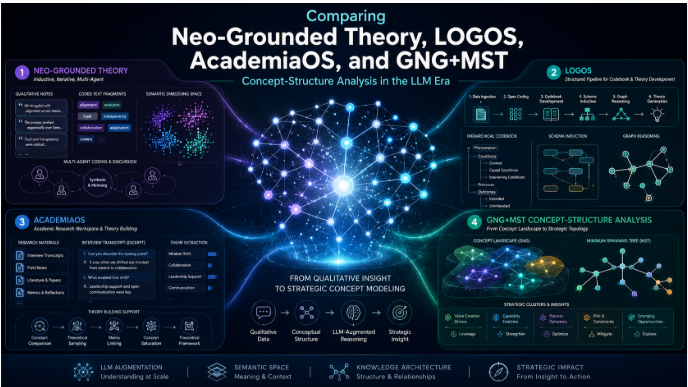
The KJ method was devised by cultural anthropologist Jiro Kawakita and is based on a concept very similar to the GTA (Grounded Theory Approach) used in Europe and the United States. In other words, this approach warns against simply applying existing theories to the research subject, and instead seeks to establish new theories by accumulating and organizing ideas based on observed facts. Philosophically, it can be considered to be a continuation of Husserl’s phenomenology. While the process of collecting pieces of information, categorizing them based on similarities, and finally explaining the relationships between those elements is similar to GTA, KJ is unique in that it involves working on a board and creating a visual diagram.
Like GTA, KJ method was developed for use in academic fields such as anthropology, sociology, and psychology, but became very popular in Japanese industry in the 1970s as a creativity method. Some critics have criticized it as being inefficient, like a three-legged race, but it has played a certain role in group activities within companies as a way to share thoughts among members.
From his experience at a consulting firm, Kunihiro Tada is well aware of the limitations of KJ methodology, which is carried out by groups of humans. However, he believes that if this method is used as a tool for humans and AI to understand each other, it could solve the various problems currently facing AI. That is:
- Hallucination problems
- Not behaving as intended by humans (not following instructions, doing things they weren’t instructed to do, sticking to one idea, not reporting failures, etc.)
- It takes time to generate a large amount of information and have human review it.
It’s like hiring an irresponsible, distracted, and stubborn intern. AI has information processing capabilities hundreds of times greater than humans, and we would like to make use of it, but the current state of AI is that it is also extremely dangerous. The problem is the disparity in information processing capabilities between AI and humans. In particular, AI operates in an ultra-high-dimensional semantic space with, for example, 1536 dimensions, while humans can only recognize up to three dimensions. Because of this difference, humans cannot build an equal relationship with AI!
Data mining technology is precisely the technology that overcomes this dimensional barrier. Mindware Research Institute will soon be launching a SaaS called ConceptMiner. As a first step, they will launch FactCollector, which automates information collection, and ConceptMap-Text, which organizes collected text chunks and performs clustering and profile analysis.
For example, if you give FactCollector a prompt like “Problems with using social media,” the AI will automatically collect information and compile hundreds of ideas into a CSV file. Other sources that can be collected include text describing competing products and services, sensory experiences of foods and beverages, news articles, abstracts of academic papers, and patent information. This information is saved in a CSV file, and CoceptMap-Text places the text chunks in a semantic space and displays them as a human-understandable visualization model, allowing for clustering and profile analysis (feature analysis).
In ConceptMap-Text, text chunks correspond to nodes connected in a network, and “concepts” are expressed by nodes or sets of nodes. New concepts can be created by performing logical operations on these concepts or by inferring from new coordinates in a multidimensional space. This feature is expected to be added later this year. Furthermore, our future plans include placing text chunks into a causal network to automate the creation of academic papers, patent applications, research reports, etc. As a side effect, we will be able to build a causal model from survey data and create a model that represents the market structure five years from now.
Currently, ConceptMiner is an analytical tool for R&D, product development, and marketing personnel, but in the future, it has the potential to evolve into a general-purpose interface between AI and humans. When humans utilize AI, it is expected that it will function as a core system that gives instructions to AI and helps humans understand the responses it gives, or as a security system that constantly monitors AI behavior, detects abnormalities, notifies humans, and resolves problems.
 ChatGPT
 tada@aicritique.org