

ChatGPT
- Main , News Topics
- October 1, 2025
- 2099 views
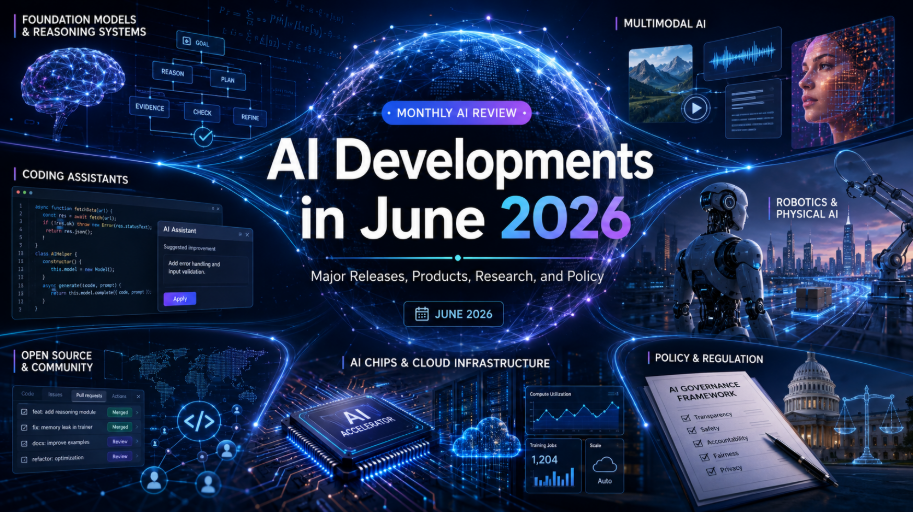
Global AI Development Summary — September 2025
September 2025 underscored a turning point: the phase of foundational breakthroughs is giving way to one of deployment, governance, and societal integration. Advances in technology, infrastructure, policy, and strategy are now unfolding in parallel—spotlighting both opportunity and risk. Below is…

- Automated Coding , LM
- September 30, 2025
- 5678 views
Comparison : GPT-5-Codex V.S. Claude Code
1. Overview and Background GPT-5-Codex: Background, objectives, and architecture (as known) Release & positioning Architecture & training methodology (public hints and inferences) Training data scale / types (publicly known or inferred) In short, GPT-5-Codex is a specialized, engineering-focused spin of…

- Automated Coding , LM
- September 19, 2025
- 9538 views
GPT‑5‑Codex: OpenAI’s Agentic Coding Model
Introduction OpenAI’s GPT‑5‑Codex is a domain‑specific variant of GPT‑5 designed to act as an autonomous software‑engineering assistant. OpenAI introduced the GPT‑5 family in August 2025 and described it as a unified system that routes requests among different model variants (the standard…

AI Adoption Slowdown: Data Analysis and Implications
Introduction The recent U.S. Census Bureau data revealed an unexpected dip in AI tool usage among large enterprises. Specifically, the biweekly Business Trends and Outlook Survey (BTOS) found that the share of companies with over 250 employees using AI dropped…

Grokking in Large Language Models: Concepts, Models, and Applications
Basic Concepts and Historical Background Definition of Grokking: Grokking refers to a surprising phenomenon of delayed generalization in neural network training. A model will perfectly fit the training data (near-100% training accuracy) yet remain at chance-level on the test set…

- News Topics , Uncategorized
- September 1, 2025
- 4343 views
AI Development — August 2025
Executive summary (as of Sept 2025) 1) Major model releases & technical announcements 1.1 OpenAI GPT-5 (released Aug 7) What shippedOpenAI introduced GPT-5 as a unified system: a fast “smart” model for most queries, a deeper reasoning model for hard…

Agent-Based Personal AI on Edge Devices (2025)
A structured, source-backed report on trends, capabilities, risks, and what to build next. Executive summary (high-level) 1) Technical foundations 1.1 Hardware platforms (edge-ready, 2024–2025) 1.2 Software stacks & toolchains 1.3 Architectural trend: hybrid (local + cloud) 2) Evolution of personal…

Ambient AI and Ambient Intelligence: Current Trends and Future Outlook
1. Definition and Conceptual Clarity Ambient Intelligence (AmI) refers to digital environments embedded with sensors, IoT devices, and AI that are context-aware, adaptive, and responsive to people’s presence and needsen.wikipedia.orgen.wikipedia.org. In an AmI environment, computing “weaves itself into the fabric…

- Automated Coding
- August 13, 2025
- 3279 views
Comparison of Auto-Coding Tools and Integration Patterns
Comparative Table Item GitHub Copilot Replit Agent Devin AI (Cognition) OpenAI Codex (Web & CLI) GPT-5 (OpenAI) Claude (Anthropic) Gemini (Google) Cursor (AI IDE) Overview MS/GitHub AI pair-programmer; 201 copilot era → 2025 agent mode & Workspace Replit’s in-IDE/Cloud coding…

- Automated Coding
- August 13, 2025
- 19454 views
Comparing the Coding Capabilities of OpenAI Codex vs GPT-5
Model Overview OpenAI Codex: Codex was introduced in August 2021 as an AI model specifically designed to translate natural language into source codeen.wikipedia.orgmedium.com. Built on the GPT-3 architecture, Codex was a fine-tuned 12-billion-parameter version of GPT-3 trained on billions of…