

Claude
- Automated Coding , Creativity , Generative AI , LM , Reasoning
- October 1, 2025
- 3226 views
Claude Sonnet 4.5: Technical Evolution and Practical Applications of Next-Generation AI
Released in September 2025, Claude Sonnet 4.5 is the latest and most advanced model in Anthropic’s Claude 4 family. This model transcends the limitations of traditional AI assistants, achieving superior reasoning capabilities, practicality, and efficiency. This article provides a comprehensive…

ChatGPT
- Automated Coding , LM
- September 30, 2025
- 5258 views
Comparison : GPT-5-Codex V.S. Claude Code
1. Overview and Background GPT-5-Codex: Background, objectives, and architecture (as known) Release & positioning Architecture & training methodology (public hints and inferences) Training data scale / types (publicly known or inferred) In short, GPT-5-Codex is a specialized, engineering-focused spin of…

Video To Blog
- LM , Reasoning
- September 19, 2025
- 2806 views
【HRM】How a Tiny Hierarchical Reasoning Model Outperformed GPT-Scale Systems: A Clear Explanation of the Hierarchical Reasoning Model
This article summarizes and expands on a recent presentation by Singular Radio that explained the Hierarchical Reasoning Model (HRM) — an architecture that recently attracted attention for solving benchmark reasoning tasks with an extremely small parameter count. Singular Radio’s hosts…

- Automated Coding , LM
- September 19, 2025
- 9007 views
GPT‑5‑Codex: OpenAI’s Agentic Coding Model
Introduction OpenAI’s GPT‑5‑Codex is a domain‑specific variant of GPT‑5 designed to act as an autonomous software‑engineering assistant. OpenAI introduced the GPT‑5 family in August 2025 and described it as a unified system that routes requests among different model variants (the standard…

Grokking in Large Language Models: Concepts, Models, and Applications
Basic Concepts and Historical Background Definition of Grokking: Grokking refers to a surprising phenomenon of delayed generalization in neural network training. A model will perfectly fit the training data (near-100% training accuracy) yet remain at chance-level on the test set…

Ambient AI and Ambient Intelligence: Current Trends and Future Outlook
1. Definition and Conceptual Clarity Ambient Intelligence (AmI) refers to digital environments embedded with sensors, IoT devices, and AI that are context-aware, adaptive, and responsive to people’s presence and needsen.wikipedia.orgen.wikipedia.org. In an AmI environment, computing “weaves itself into the fabric…

Perplexity
- Generative AI , LM
- August 8, 2025
- 6709 views
Comprehensive Report: GPT-5 – Features, Announcements, Reviews, Reactions, and Impact
1. Introduction GPT-5, OpenAI’s latest large language model, was officially launched in August 2025. Marking a leap in artificial intelligence capabilities, GPT-5 powers ChatGPT and is being rapidly integrated into products and services across the tech industry. This report provides…

- Academic , LM
- July 8, 2025
- 2144 views
Why AI Gets “Lost” in Multi-Turn Conversations: Causes and Solutions Explained
Have you ever had an extended conversation with an AI, only to feel like it’s getting confused or stubbornly refusing to adjust its answers? Maybe you noticed it going in circles or giving inconsistent responses as the chat went on.…

Potemkin Understanding in AI: Illusions of Comprehension in Large Language Models
Executive Summary Figure: A newly painted façade of a building in Kolín, Czech Republic conceals the decayed structure behind it. The term “Potemkin” originates from such facades that create an illusion of substance – a fitting metaphor for AI systems…
- Generative AI , LM
- April 10, 2025
- 2430 views
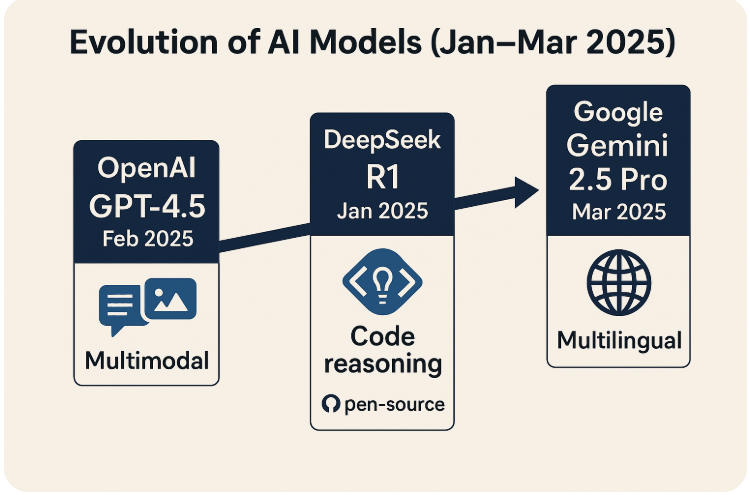
Evolution of AI Models (Jan–Mar 2025)
Figure: Timeline of major AI model releases in Q1 2025 – OpenAI’s GPT-4.5 (Feb 2025), DeepSeek’s R1 (Jan 2025), and Google’s Gemini 2.5 Pro (Mar 2025). Each model introduced key advancements: multimodal inputs (text+images), code reasoning, multilingual abilities, and in…